Definition: Serum total calcium >10.5 mg/dL. Remember to correct for albumin: Corrected Ca2+ = Measured Ca2+ + 0.8 * (4 - measured albumin).
Tip
- Total protein normal level 6.0 to 8.3 g/dL (60 to 83 g/L)
- Albumin normal level 3.4 to 5.4 g/dL (34 to 54 g/L)
- Phosphorus normal level 2.5 to 4.5 g/dL (25 to 45 g/L)
Etiology
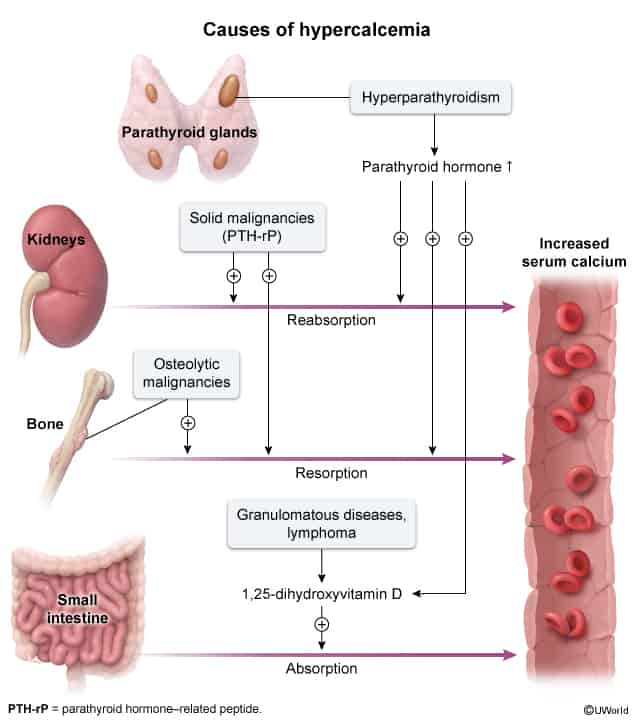
- PTH-Dependent (High or inappropriately normal PTH)
- Primary Hyperparathyroidism: Most common outpatient cause. Usually due to a parathyroid adenoma.
- Familial Hypocalciuric Hypercalcemia (FHH): Autosomal dominant mutation in the Ca2+-sensing receptor (CaSR). Leads to high PTH and high serum Ca2+, but low urine Ca2+.
- Tertiary Hyperparathyroidism: Seen in patients with chronic kidney disease where longstanding secondary hyperparathyroidism leads to autonomous parathyroid function.
- PTH-Independent (Low PTH)
- Malignancy: Most common inpatient cause.
- PTHrP (PTH-related peptide) mediated: Secreted by squamous cell carcinomas (lung, head, neck), renal, and breast cancer. Mimics PTH actions.
- Osteolytic lesions: Direct bone destruction from metastases (e.g., breast cancer) or multiple myeloma (release of local cytokines).
- Ectopic Vitamin D production: Granulomatous diseases (e.g., sarcoidosis, TB) and lymphomas can have macrophages that express 1α-hydroxylase, leading to excess active Vitamin D (Calcitriol).
- Vitamin D Toxicity: Over-ingestion of vitamin D supplements.
- Medications: Thiazide diuretics (increase renal Ca2+ reabsorption), lithium.
- Immobilization: Increased osteoclast activity.
- Milk-alkali syndrome
- Excessive intake of calcium carbonate and absorbable alkali (e.g., antacids, calcium supplements for osteoporosis). c
- Risk Factors:
- Postmenopausal women on calcium supplements.
- Pts w/ GERD, peptic ulcer disease taking over-the-counter calcium antacids.
- Pts w/ CKD or volume depletion (impairs renal calcium excretion).
- Concomitant use of thiazide diuretics, NSAIDs, or ACEi/ARBs.
- Initial/Key Labs:
- Hypercalcemia (often total Ca > 12 mg/dL).
- Metabolic Alkalosis (↑ , ↑ pH).
- Renal Insufficiency: ↑ Cr, ↑ BUN.
- Suppressed PTH: Low or undetectable serum PTH (ddx from primary hyperparathyroidism).
- Phosphate: Variable (often low/normal, but can be high in renal failure).
- 25-OH Vitamin D & 1,25-(OH)2 Vitamin D: Normal or low.
- Malignancy: Most common inpatient cause.
Tip
Severe hypercalcemia (> 14 mg/dL) is almost always due to malignancy or severe primary hyperparathyroidism (rarely > 12 mg/dL). c
Clinical features
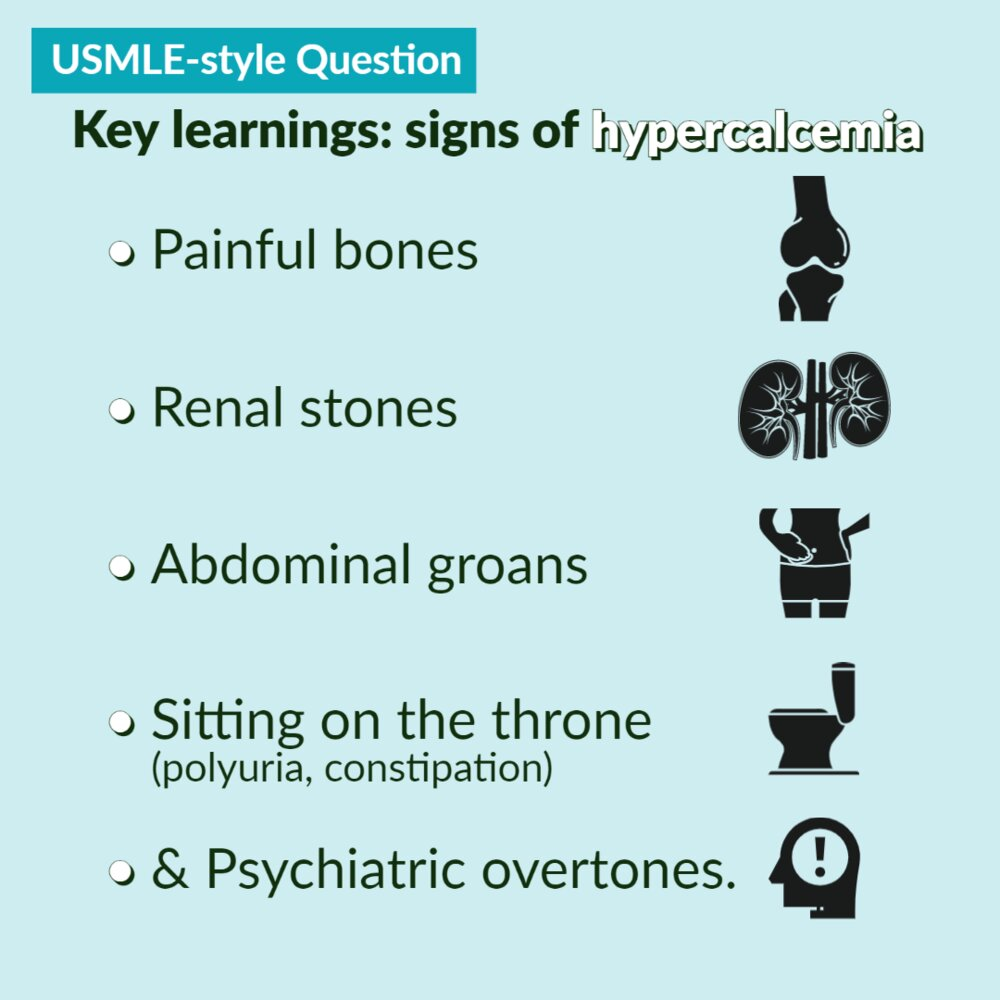
- “Stones”: Nephrolithiasis, nephrocalcinosis.
- “Bones”: Bone pain, pathological fractures, osteitis fibrosa cystica (subperiosteal bone resorption in PHPT).
- “Groans”: Constipation, nausea, vomiting, anorexia, abdominal pain, pancreatitis.
- “Thrones”: Polyuria, polydipsia (due to nephrogenic diabetes insipidus). c
- Due to acquired renal ADH resistance. Although ADH is being secreted, the kidneys no longer respond to it adequately (nephrogenic diabetes insipidus).
- Physiological teleology: Stone Prevention: If the kidney concentrated urine in the setting of hypercalciuria (high urinary Ca), the calcium would precipitate into stones (nephrolithiasis)
- “Psychiatric overtones”: Fatigue, depression, confusion, lethargy, stupor/coma.
- Cardiac: Bradycardia, AV block, shortened QT interval on ECG.
Diagnostics
- Initial: Measure total serum Ca (must correct for albumin) or measure ionized Ca (physiologically active form).
- Corrected Ca formula: Measured Ca + 0.8 x (4.0 - Albumin).
- Etiology workup: Order serum PTH level first to differentiate path.
- ↑/Normal PTH: PTH-dependent (PHPT, FHH, Lithium).
- ↓ PTH: PTH-independent (Malignancy, Vit D toxicity, Sarcoidosis, Milk-alkali).
- Key Labs:
- If PTH-dependent: Check 24-hr urine Ca and fractional excretion of Ca (FE_Ca).
- FE_Ca < 1%: Familial Hypocalciuric Hypercalcemia (FHH) [1].
- FE_Ca > 2%: PHPT [1].
- If PTH-independent: Check PTHrP (malignancy), 25-OH Vit D (dietary excess), 1,25-(OH)2 Vit D (granulomas, lymphoma), and SPEP/UPEP (multiple myeloma).
- If PTH-dependent: Check 24-hr urine Ca and fractional excretion of Ca (FE_Ca).
- ECG: Assess for arrhythmia and shortened QT interval.
Treatment
- Mild/Asymptomatic (< 12 mg/dL): No immediate treatment. Avoid volume depletion, thiazides, and high-Ca diet.
- Moderate (12–14 mg/dL): Standard therapy not required unless symptomatic (then treat as severe).
- Severe (> 14 mg/dL) or symptomatic:
- Immediate First-line: Aggressive IVF (Normal Saline) at 200–500 mL/hr to restore intravascular volume and promote renal Ca excretion. c
- Immediate Adjunct: Calcitonin (rapid onset in 4–6 hours; inhibits osteoclast activity). Limit use to 48 hours due to tachyphylaxis risk.
- Long-term/Delayed: IV Bisphosphonates (Zoledronic acid or Pamidronate). Onset takes 2–4 days; provides sustained reduction by inhibiting bone resorption.
- Granulomatous/Lymphoma etiology: Corticosteroids (e.g., Prednisone) to decrease extrarenal 1-alpha-hydroxylase activity.
- Refractory Malignancy: Denosumab (monoclonal antibody targeting RANKL; useful if bisphosphonates are contraindicated/ineffective).
- Severe renal failure/heart failure: Hemodialysis (if patient cannot tolerate aggressive IVF volume expansion).
- Note: Avoid loop diuretics (e.g., Furosemide) unless volume overload occurs during IVF hydration.