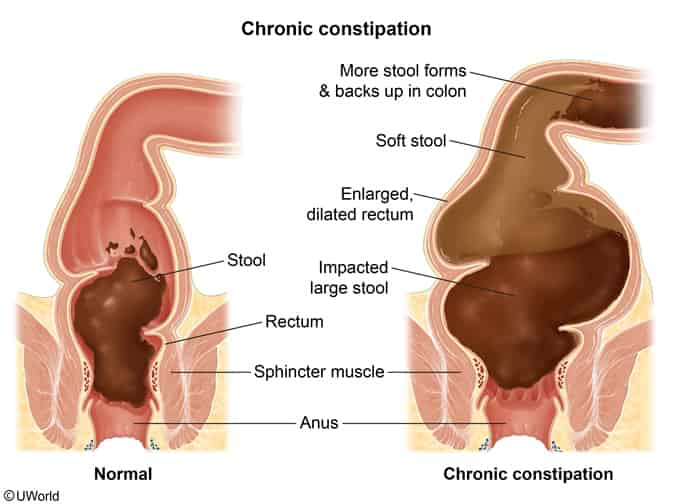
Epidemiology

  • Demographics: More common in elderly, females, and hospitalized/immobile pts.
  • Dietary factors: Low dietary fiber, inadequate fluid intake, and physical inactivity.
  • Secondary medical conditions:
    • Endocrine/Metabolic: Hypothyroidism, hypercalcemia, hypokalemia, DM.
    • Neurologic: Parkinson disease, MS, spinal cord injury, Hirschsprung disease (in neonates).
    • Structural: Colorectal cancer (CRC), rectal prolapse, anal stricture.
  • Medications (highly tested):
    • Opioids (decrease peristalsis, increase water absorption).
    • Anticholinergics (e.g., diphenhydramine, TCAs, oxybutynin).
    • Calcium channel blockers (CCBs) (especially verapamil).
    • Iron supplements, aluminum antacids.

Etiology


Pathophysiology


Clinical features


Diagnostics


Treatment


Approach

  • First-line: nonpharmacological measures (e.g., high-fiber diet, increased fluid intake, and exercise) and/or trial of bulk-forming laxatives c
  • Second-line: step-wise pharmacotherapy with laxatives from other classes
    • Begin with an osmotic laxative.
    • If symptoms persist, add a short course of a stimulant laxative.

Laxatives

  • Bulk-Forming
    • Psyllium, Methylcellulose
    • ↑ stool mass → stimulates peristalsis
    • Onset: 12-72h
    • SE: Bloating; needs water to prevent obstruction
  • Osmotic
    • Lactulose (also for hepatic encephalopathy), Polyethylene glycol (PEG), Mg(OH)₂
    • Draw water into lumen
    • PEG: First-line for chronic constipation; safe, effective, well-tolerated
    • Onset: 0.5-3h (saline), 24-48h (lactulose)
    • SE: Dehydration, electrolyte loss; Mg2+ toxicity in renal failure
  • Stimulant
    • Bisacodyl, Senna
    • Stimulate enteric nerves → ↑ peristalsis
    • Onset: 6-12h (oral), 15-60min (rectal)
    • SE: Cramping; chronic use → melanosis coli, cathartic colon
  • Stool Softeners
    • Docusate
    • Detergent allows water penetration
    • Use: Prevent straining post-op, post-MI
  • Lubricant
    • Mineral oil
    • SE: Lipid pneumonia (aspiration), ↓ fat-soluble vitamin absorption
  • Secretagogues
    • Lubiprostone (ClC-2 activator), Linaclotide/Plecanatide (GC-C agonists)
    • ↑ intestinal fluid secretion
    • Use: IBS-C, chronic constipation
  • Opioid Antagonists
    • Methylnaltrexone, Naloxegol
    • Block peripheral μ-receptors (don’t cross BBB)
    • Use: Opioid-induced constipation

Fecal Impaction

Epidemiology & Risk Factors

  • Epidemiology: Most common in elderly, institutionalized/nursing home residents, and pediatric populations with developmental delays.
  • Risk Factors:
    • Chronic constipation.
    • Immobility/sedentary lifestyle.
    • Neurological disorders (e.g., Parkinson disease, MS, spinal cord injury, dementia).
    • Medications: Opioids, anticholinergics, iron supplements, CCBs, NSAIDs.
    • Psychiatric conditions (e.g., depression, eating disorders).

Clinical Features

  • History:
    • Decreased stool frequency or inability to pass flatus/stool.
    • Paradoxical diarrhea (liquid stool bypasses the obstructing fecal mass; often misdiagnosed as infectious diarrhea). c
    • Vague lower abdominal pain, distension, tenesmus, and anorexia.
    • Urinary retention or frequency (due to extrinsic compression on bladder/urethra).
  • Physical Exam:
    • Digital Rectal Exam (DRE): Palpable hard, dry, impacted stool in the rectal vault.
    • Abdomen: Distended, tympanitic, sometimes a palpable firm left lower quadrant mass. Mild tenderness, but peritonitis is absent unless perforation has occurred.

Diagnosis

  • Initial: Digital Rectal Exam (DRE). Diagnostic for low/distal impaction.
  • Imaging:
    • Abdominal X-ray (XR): Indicated if DRE is negative but clinical suspicion remains high (evaluates for high/proximal impaction). Shows large amounts of stool in the colon, megacolon, or dilated bowel loops with air-fluid levels.
    • Abdominal CT: Reserved for cases with suspected complications (e.g., perforation, stercoral colitis) or to rule out a mechanical mass (e.g., colorectal cancer).
  • Key Labs: Generally normal. Check BMP if severe vomiting/dehydration (hypokalemia, acute kidney injury) or to rule out hypercalcemia/hypothyroidism as a cause of constipation.

Management

  1. Manual Disimpaction:
    • First-line for distal/rectal impactions.
    • Perform gently using lubricated, gloved finger. May use topical lidocaine jelly to reduce discomfort.
  2. Enemas & Suppositories:
    • Indicated after manual disimpaction or if stool is out of reach of manual extraction.
    • Use mineral oil enemas (to lubricate) or warm water/phosphate enemas (to stimulate motility).
    • Note: Avoid phosphate enemas in elderly or renal insufficiency due to risk of hyperphosphatemia.
  3. Oral Laxatives (Maintenance & Proximal Impaction):
    • Polyethylene glycol (PEG) is highly effective once the distal rectum is cleared.
    • Contraindication: Do NOT give oral laxatives (especially osmotic/stimulant) if complete distal obstruction is present, as it can cause severe abdominal cramping, vomiting, or perforation.
  4. Prevention:
    • Increase dietary fiber, fluid intake, and physical activity.
    • Minimize constipating medications; use prophylactic bowel regimens if opioids are mandatory (e.g., senna + docusate, methylnaltrexone).