Epidemiology
Etiology
- Abnormal accumulation of cerebrospinal fluid (CSF) leading to ventricular enlargement and ↑ intracranial pressure (ICP).
- Non-communicating (Obstructive)
- Caused by a structural blockage of CSF flow within the ventricular system.
- Leads to enlargement of ventricles proximal to the obstruction.
- Common causes:
- Aqueductal stenosis (most common cause in newborns)
- Tumors (e.g., colloid cyst of the 3rd ventricle, posterior fossa tumor)
- Arnold-Chiari malformation
- Dandy-Walker malformation: congenital malformation caused by failure of the fourth ventricle to close, which leads to persistence of Blake’s pouch (cyst in the 4th ventricle) and cerebellar vermis hypoplasia
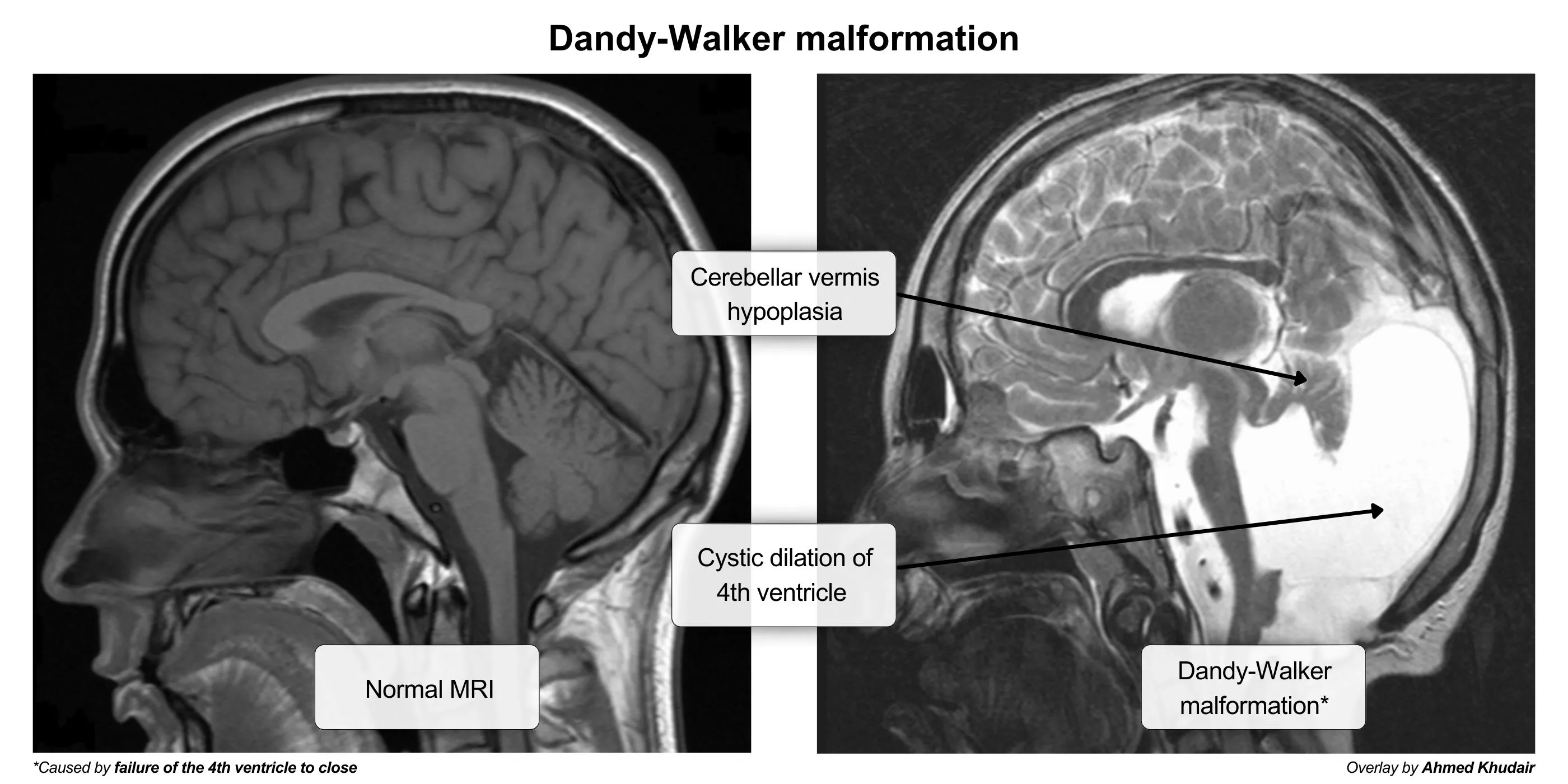
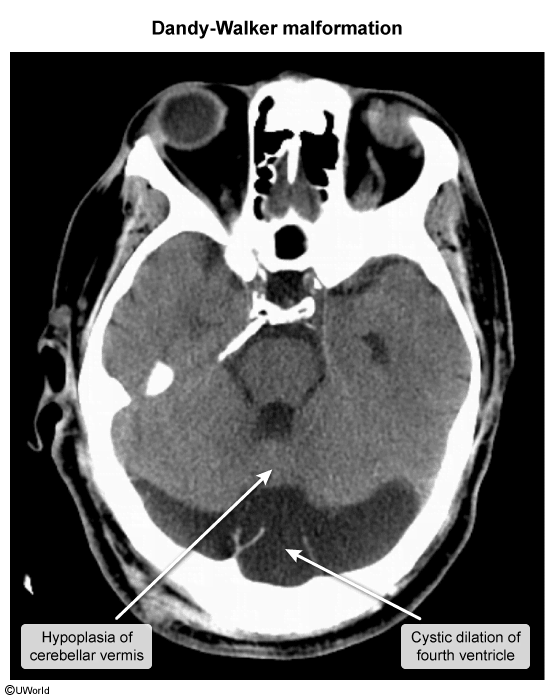
- Causes a variety of neurologic abnormalities (e.g., ataxic gait) and noncommunicating hydrocephalus
- Associated with a variety of extracranial abnormalities (e.g., craniofacial abnormalities, cardiac defects, spina bifida)
- Communicating
- Dysfunction of subarachnoid cisterns or arachnoid villi resulting in decreased CSF absorption or increased CSF production.
- All ventricles are symmetrically enlarged.
- Common causes:
- Post-meningitis scarring
- Subarachnoid hemorrhage (blood clogs granulations)
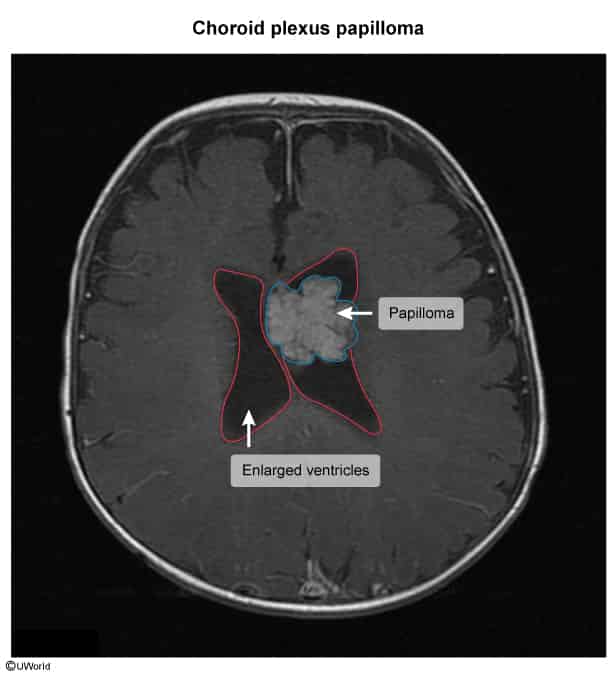
- Choroid plexus papilloma
- Rare benign tumor of the choroid plexus
- Typically manifests with headache (and other symptoms of intracranial hypertension) due to hydrocephalus secondary to cerebrospinal fluid overproduction
- Normal Pressure Hydrocephalus (NPH)
- Chronic form of communicating hydrocephalus in the elderly.
- CSF pressure is episodically elevated but often normal on lumbar puncture.
- Pathophysiology: Impaired absorption at arachnoid granulations leads to ventricular expansion that stretches the corona radiata fibers.
Chiari malformation vs Dandy-Walker malformation
Feature Chiari Malformation Dandy-Walker Malformation Pathophysiology Cerebellum herniates through foramen magnum due to small posterior fossa. Agenesis of cerebellar vermis allows 4th ventricle to enlarge into a cyst. Posterior Fossa Small / Normal Enlarged Key Abnormality Tonsillar (Type I) or vermis + tonsillar (Type II) herniation. Absent cerebellar vermis. Hydrocephalus Common, due to CSF outflow obstruction. Very common, due to cystic 4th ventricle. Key Associations - Type I: Syringomyelia.
- Type II: Myelomeningocele.Hydrocephalus, Spina Bifida, Agenesis of corpus callosum. Typical Presentation - Type I: Adult w/ headaches.
- Type II: Infant w/ brainstem dysfunction.Infant w/ macrocephaly. Chiari畸形:过度拥挤的房间
请把后颅窝想象成一个小卧室,把小脑和脑干想象成里面的家具。
- 问题所在: 在Chiari畸形中,这个房间建得太小了,无法容纳所有它需要放置的家具。
- 后果: 为了把所有东西都塞进去,一部分家具(小脑扁桃体)被挤了出来,并从唯一的开口——门道(枕骨大孔)——伸了出去。
- 结果: 这些堵在门口的家具阻碍了交通(脑脊液流动),导致房间内压力积聚(脑积水),并影响到走廊的墙壁(脊髓空洞症)。
核心:Chiari是一个_拥挤_问题。
Dandy-Walker畸形:缺失的帐篷支柱
请把后颅窝想象成一个大帐篷,把小脑蚓部想象成它主要的中央支撑柱。
- 问题所在: 在Dandy-Walker畸形中,这根中央帐篷支柱缺失了(蚓部发育不全)。
- 后果: 没有了支柱的支撑,帐篷的顶部(第四脑室)无法正常成型。它会塌陷并被“雨水”(脑脊液)充满,形成一个巨大的、充满液体的囊肿。
- 结果: 这个不断膨胀的水囊肿将帐篷壁向外推(后颅窝扩大),并堵住了拉链出口(脑脊液流出道),将所有的水都困在里面,导致整个帐篷都肿胀起来(脑积水)。
核心:Dandy-Walker是一个_结构缺陷_问题。
Link to original
Pathophysiology
Clinical features
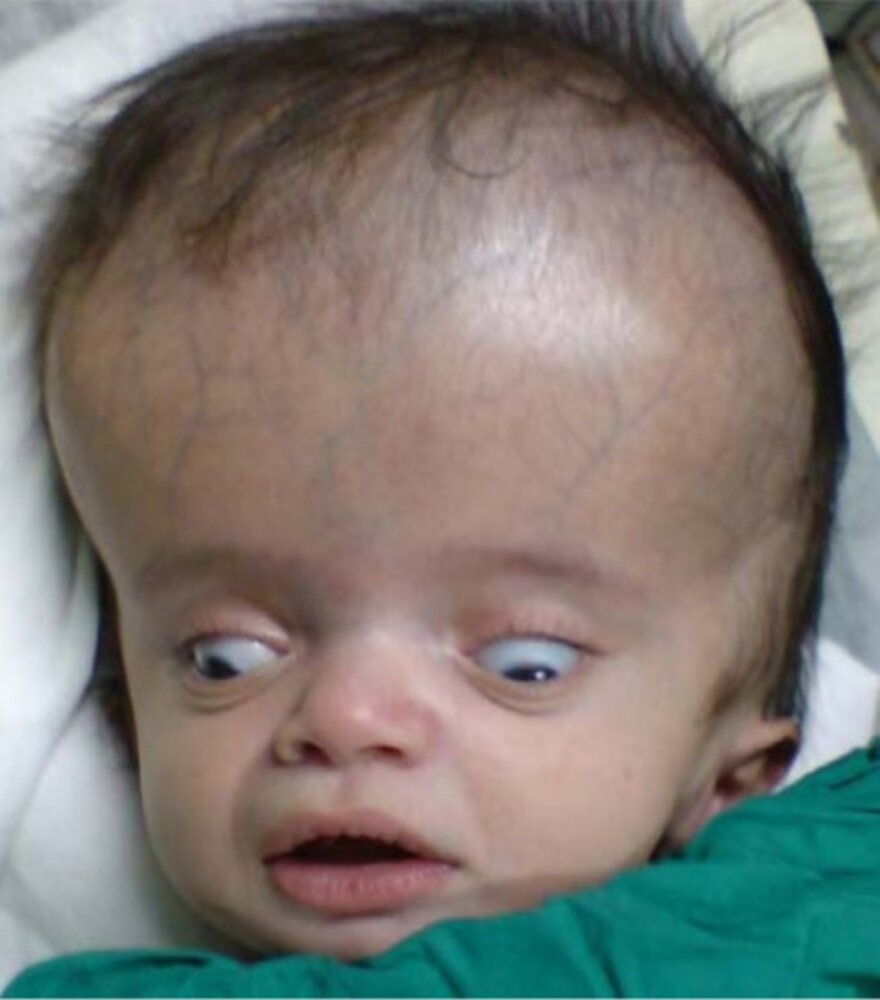
- Infants
- Rapidly increasing head circumference.
- Bulging, tense fontanelle.
- Splayed cranial sutures.
- “Sunsetting” eyes due to impaired upward gaze.
- Irritability, vomiting, poor feeding, somnolence.
- Seizures or developmental regression.
- Older Children & Adults (Acute / Elevated ICP):
- Early morning headaches (worsened by recumbency, coughing, straining), nausea, vomiting.
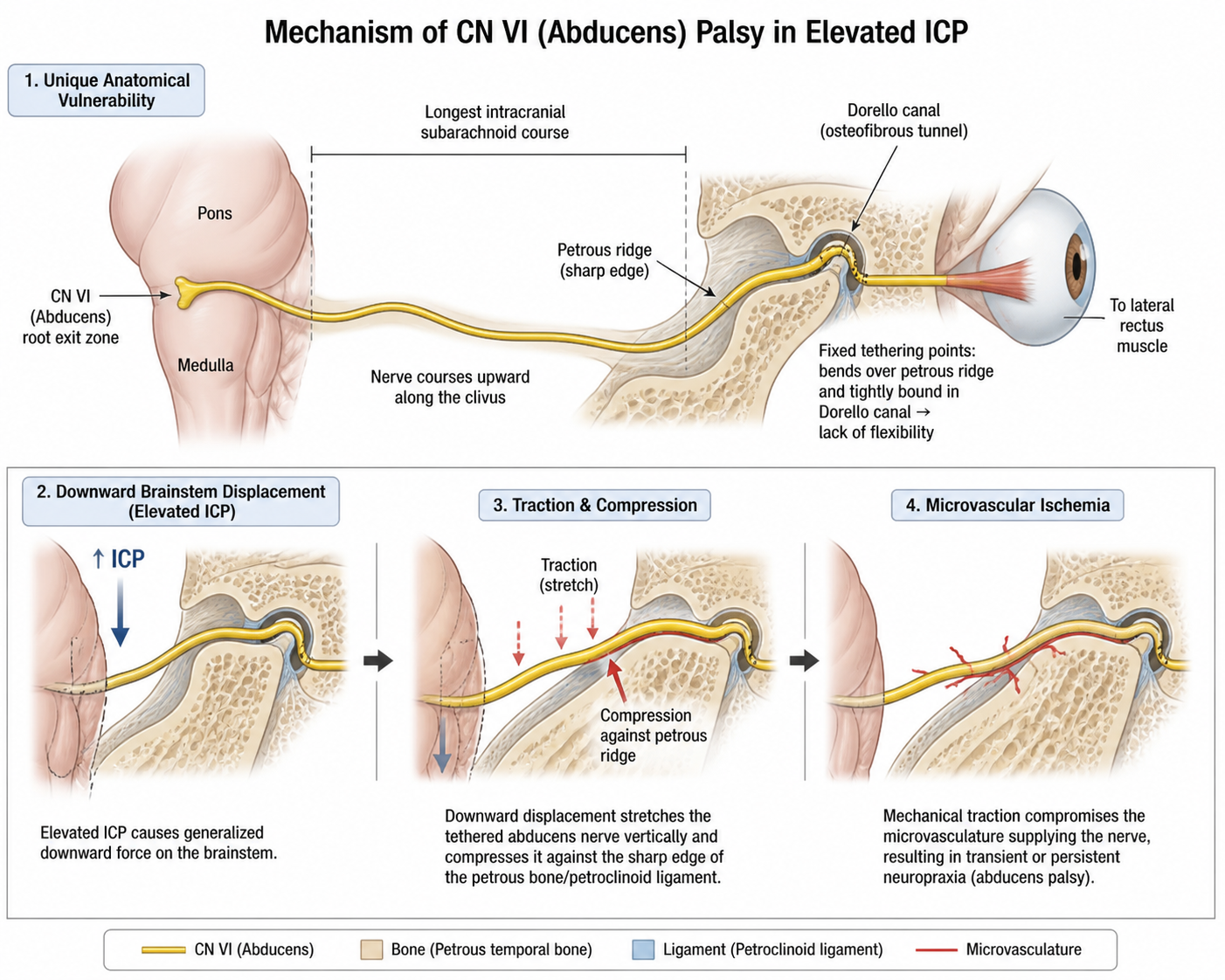
- Papilledema, blurred vision, diplopia due to CN VI (abducens) nerve palsy (false localizing sign). c
- Long Intracranial Course: Travels a long distance through the subarachnoid space, exposing it to generalized pressure.
- Sharp Bony Anchor: Makes an acute bend over the petrous temporal bone entering Dorello canal.
- Downward Traction: ↑ ICP pushes the brainstem downward, stretching and pinching the tethered nerve against the rigid bone.
- Cushing Triad (impending herniation): Hypertension, Bradycardia, Irregular respirations.
- Pineal region mass association: Parinaud syndrome (upward gaze palsy, convergence-retraction nystagmus, light-near pupillary dissociation).
Diagnostics
Treatment
- Acute Obstructive / High ICP (Emergency):
- Emergent decompression: External Ventricular Drain (EVD).
- Medical bridge: HOB elevation (>30°), IV Mannitol or 3% Hypertonic Saline, hyperventilation.
- Definitive: Endoscopic Third Ventriculostomy (ETV) (for aqueductal stenosis) or mass excision.
- Communicating Hydrocephalus / NPH:
- First-line / Definitive: Ventriculoperitoneal (VP) Shunt placement.