Overview

  • Surgical delivery of fetus, placenta, and membranes through abdominal (laparotomy) and uterine (hysterotomy) incisions.
  • Common indications include arrest of labor, nonreassuring fetal heart rate patterns, and fetal malpresentation.

Indications

Fetal Indications

  • Nonreassuring fetal status: Persistent late decelerations, severe variable decelerations, prolonged bradycardia, Category III FHR tracing.
  • Malpresentation: Breech (frank, complete, footling), transverse lie, face presentation (mentum posterior).
  • Umbilical cord prolapse: Acute emergency requiring elevation of presenting part + stat C-section.
  • Macrosomia: Estimated fetal weight (EFW) >5000 g in non-diabetic mothers or >4500 g in diabetic mothers.
  • Congenital anomalies: Severe hydrocephalus, sacrococcygeal teratoma, abdominal wall defects.

Maternal Indications

  • Active genital HSV: Visible lesions or prodromal symptoms at labor onset.
  • HIV infection: Maternal viral load >1000 copies/mL near delivery (at >38 wks) or unknown viral load.
  • Cardiac pathology: Severe aortic stenosis, Marfan syndrome w/ dilated aortic root (>40 mm), acute decompensated HF.
  • Uterine scar history: Prior classical C-section, prior transmural myomectomy (entering endometrial cavity).
  • Obstructive lesions: Large leiomyomas, pelvic deformities, cervical cancer obstructing birth canal.

Obstetric & Placental Indications

  • Placenta previa or vasa previa: Absolute indication due to severe hemorrhage risk.
  • Placenta accreta spectrum: Planned C-hysterectomy at 34 0/7–35 6/7 wks.
  • Placental abruption: If severe w/ unstable fetus/mother or failed induction.
  • Labor Arrest:
    • First stage arrest: Dilated ≥6 cm w/ ROM + no progress after ≥4 hrs of adequate contractions OR ≥6 hrs of oxytocin w/ inadequate contractions.
    • Second stage arrest: No progress in descent/rotation after ≥3 hrs of pushing in nulliparous (≥4 hrs w/ epidural) or ≥2 hrs in multiparous (≥3 hrs w/ epidural).

Trial of Labor After Cesarean (TOLAC) & VBAC

Candidate Selection

  • Eligible: 1 or 2 prior low-transverse C-sections (LTCS), clinically adequate pelvis, no other uterine scars.
  • Contraindicated:
    • Prior classical or T-shaped uterine incision.
    • Prior uterine rupture.
    • Prior extensive transfundal uterine surgery/myomectomy.
    • High risk for uterine rupture (e.g., <18 months interdelivery interval).

Key Risk: Uterine Rupture (0.5–0.9% w/ LTCS)

  • Clinical Presentation: Sudden loss of fetal station, severe abdominal pain, chest/shoulder pain, fetal bradycardia (most common sign), loss of uterine tone/contractions, vaginal bleeding.
  • Management: Stat intraop laparotomy + fetal delivery; uterine repair vs emergency hysterectomy.
  • High-Yield Pitfall: Prostaglandins (misoprostol, dinoprostone) are strictly contraindicated for cervical ripening in pts w/ prior C-section due to high risk of uterine rupture.

Preoperative & Perioperative Management

Infection Prophylaxis

  • Antibiotic Prophylaxis: Cefazolin IV administered within 60 min prior to skin incision.
  • Add Azithromycin IV if pt is in labor or has ruptured membranes (reduces post-op endometritis and wound infection).

Thromboembolism Prophylaxis

  • Mechanical prophylaxis (sequential compression devices [SCDs]) for all pts.
  • Add pharmacologic prophylaxis (LMWH/UFH) for high-risk pts (prior VTE, thrombophilia, high BMI).

Anesthesia

  • Neuraxial (Spinal / Epidural): Preferred for elective and non-emergent procedures (maintains maternal consciousness, avoids airway management).
  • General Anesthesia: Reserved for acute fetal distress (emergent category 1 C-section), maternal severe hemorrhage/shock, or failed neuraxial anesthesia.
  • Aspiration Prophylaxis: Sodium citrate (non-particulate antacid) + H2-blocker/PPI prior to anesthesia.

Surgical Technique

Hysterotomy Options

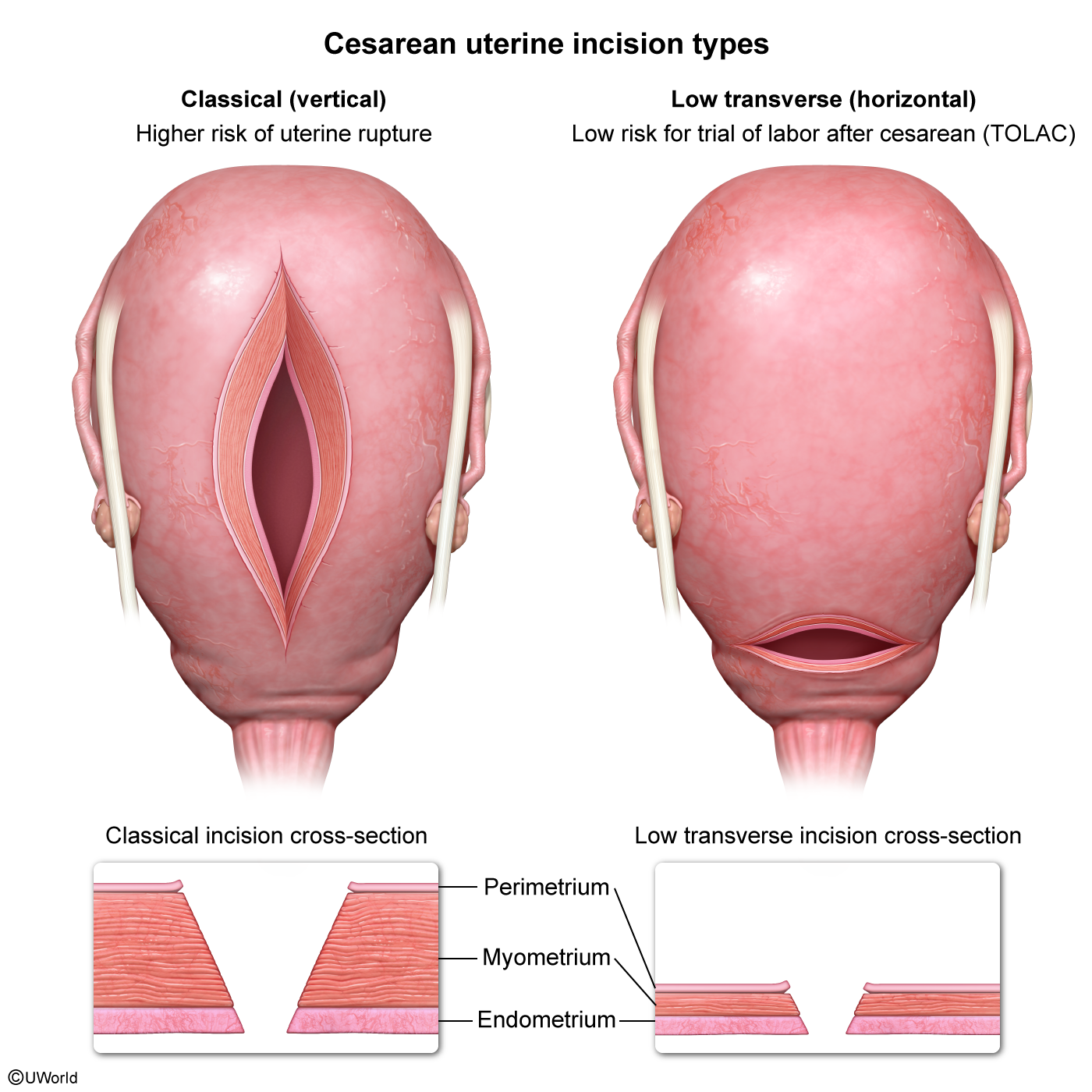
  • Low-Transverse Incision (LTCS): Incision in lower uterine segment. Standard choice. Lowest rate of rupture in future pregnancies (<1%).
  • Classical (Vertical) Incision: Incision into upper contractile uterine segment.
    • Indications: Undeveloped lower uterine segment (<24 wks), transverse lie w/ back down, dense adhesions, placenta previa covering lower segment, massive fibroids.
    • Risk: High recurrence rate of uterine rupture (4–9%) in future pregnancies; requires repeat elective C-section at 36 0/7–37 6/7 wks. c

Intraoperative Delivery

  • Spontaneous placental extraction w/ umbilical cord traction preferred over manual extraction (decreases risk of endometritis and blood loss).
  • Post-delivery routine IV Oxytocin infusion to promote uterine contraction and prevent atony.

Postoperative Management & Care

  • Analgesia: Multimodal regimen (NSAIDs [ibuprofen/ketorolac] + Acetaminophen) + neuraxial opioids. Minimizes systemic opioid use.
  • Catheter Care: Remove indwelling bladder catheter within 12–24 hrs post-op to reduce UTI risk.
  • Early Ambulation: Encouraged within 12–24 hrs to prevent deep vein thrombosis (DVT) and paralytic ileus.
  • Lactation: Encouraged immediately post-op; neuraxial opioids do not interfere w/ breastfeeding.

Complications

Maternal Complications

  • Postpartum Endometritis: Most common post-op infection (fever, uterine tenderness, purulent lochia, leukocytosis).
    • First-line Treatment: IV Clindamycin + Gentamicin.
  • Postpartum Hemorrhage (PPH): Estimated Blood Loss (EBL) ≥1000 mL. Causes: uterine atony, surgical lacerations, broad ligament hematoma.
  • Incisional Infections: Superficial surgical site infection (SSI) or wound dehiscence.
  • Visceral Injury:
    • Bladder Injury: Most common visceral injury (especially w/ prior C-sections or emergent entry).
    • Ureteral Injury: Occurs during extension of uterine incision or vascular ligation.
    • Bowel Injury: Rare; increased risk w/ extensive adhesions.
  • Thromboembolism: DVT/PE risk is 4x to 5x higher after C-section compared to vaginal delivery.
  • Long-term Risks:
    • Placenta Accreta Spectrum (accreta, increta, percreta) in subsequent pregnancies (risk increases exponentially w/ each prior C-section).
    • Uterine scar defect (isthmocele/niche) leading to abnormal postmenstrual bleeding or secondary infertility.
    • Asherman Syndrome (intrauterine adhesions).

Fetal Complications

  • Transient Tachypnea of the Newborn (TTN): Caused by delayed clearance of fetal lung fluid (absence of vaginal squeeze and catecholamine surge).
    • CXR: Perihilar streaking, fluid in interlobar fissures, cardiomegaly.
    • Management: Supportive care (oxygen, self-limiting within 24–72 hrs).
  • Iatrogenic Prematurity: Incorrect gestational age assessment.
  • Fetal Laceration: Rare accidental injury from scalpel (1–2%).