Postoperative complications
Postoperative fever
- Overview
- Definition: Temperature 38.0°C (100.4°F) post-op.
- Key Concept: Postoperative Day (POD) dictates the differential diagnosis and management strategy.
- Etiology Timeline (The 5 W’s)
- POD 0–2: Wind
- Physiologic SIRS: Tissue trauma, cytokine release. Most common cause POD 0–1. Tx: Observation, antipyretics.
- Malignant Hyperthermia (MH): Occurs intra-op or PACU. Triggered by inhaled anesthetics/succinylcholine. Signs: Masseter rigidity, , hyperthermia, rhabdomyolysis. Tx: Dantrolene, 100% , cooling.
- Aspiration Pneumonia: Hypoxia, fever, infiltrate on CXR. Tx: Empiric Abx.
- POD 3–5: Water
- Urinary Tract Infection (UTI): Associated w/ indwelling Foley catheter > 48–72 hrs. Dx: UA ( WBC, (+) nitrites/leukocyte esterase) + UCx. Tx: Remove catheter, empiric Abx.
- POD 5–7: Wound
- Superficial Surgical Site Infection (SSI): Incisional erythema, warmth, purulent drainage. Most common org: S. aureus. Tx: Open/drain wound; add Abx if systemic signs/cellulitis present.
- POD 7–10+: Walking
- DVT / PE: Unilateral leg swelling or acute dyspnea, hypoxia, pleuritic chest pain. Dx: Duplex US (DVT) or CTPA (PE). Tx: Anticoagulation (Heparin/LMWH).
- POD > 10 / Delayed: Wonder Drugs & Deep Infections
- Intra-abdominal Abscess: Persistent fever + leukocytosis 1–2 weeks post-op. Dx: CT A/P w/ IV contrast. Tx: Percutaneous drainage + IV Abx.
- Drug Fever: Diagnosis of exclusion. Fever 7–14 days post-new drug (e.g., Abx, heparin), eosinophilia, maculopapular rash. Tx: Stop offending agent.
- C. difficile: Post-Abx watery diarrhea, leukocytosis. Dx: Stool PCR/toxin. Tx: Oral Vancomycin or Fidaxomicin.
- POD 0–2: Wind
- Workup & Management Strategy
- Hemodynamically Unstable: ABCs, IVF bolus, Blood cultures x2, STAT CXR/UA, empiric broad-spectrum Abx (e.g., Zosyn + Vancomycin).
- Hemodynamically Stable:
- POD 0–2: Observation, incentive spirometry, CXR only if hypoxemic.
- POD 3–5: UA + UCx, catheter removal.
- POD 5–7: Inspect incision, unroof/drain if purulent.
- POD > 7: CT A/P w/ contrast (if abdominal surgery) or Duplex US/CTPA.
- High-Yield Step 2 CK Pearls
- Isolated POD 1 fever in a stable patient: Normal stress response. Do not perform extensive workup; reevaluate patient.
- Earliest indicator of MH: (refractory to hyperventilation), NOT temperature rise (temperature is a late sign).
- Persistent fever + normal CXR/UA 1 week post-laparotomy: Suspect intra-abdominal abscess Order CT A/P w/ contrast Perform percutaneous drainage.
Cardiovascular & Pulmonary Complications
- Postoperative MI
- Usually POD 2-3. Often silent (no chest pain) due to analgesia/anesthesia. c
- Risk Factors: Pre-existing CAD, CHF, CKD, diabetes mellitus, advanced age (> 65), and high-risk surgical procedures (e.g., vascular, prolonged open abdominal/thoracic surgeries).
- Pathophysiology: Usually due to surgical stress (↑ catecholamines causing ↑ myocardial oxygen demand/tachycardia) superimposed on baseline CAD (demand ischemia/Type 2 MI), or plaque rupture (Type 1 MI) secondary to hypercoagulability/inflammation.
- Presentation: Hypotension, arrhythmias, dyspnea, new-onset HF.
- Dx: ECG, Troponins.
- Tx: PCI or medical management (Aspirin, statin, beta-blocker if hemodynamically stable).
- ARDS (Acute Respiratory Distress Syndrome)
- Post-trauma, massive transfusion, or sepsis.
- Dx: Bilateral opacities on CXR, PaO2/FiO2 < 300.
- Tx: Mechanical ventilation with low tidal volumes (6 mL/kg) & PEEP.
- Postoperative atelectasis
-
Most common after thoracic or upper abdominal surgeries.
-
PE: ↓ breath sounds, dullness to percussion, basilar crackles.
-
Management
- First-line / Prevention: Incentive spirometry (NBS & best preventive measure), early ambulation. c
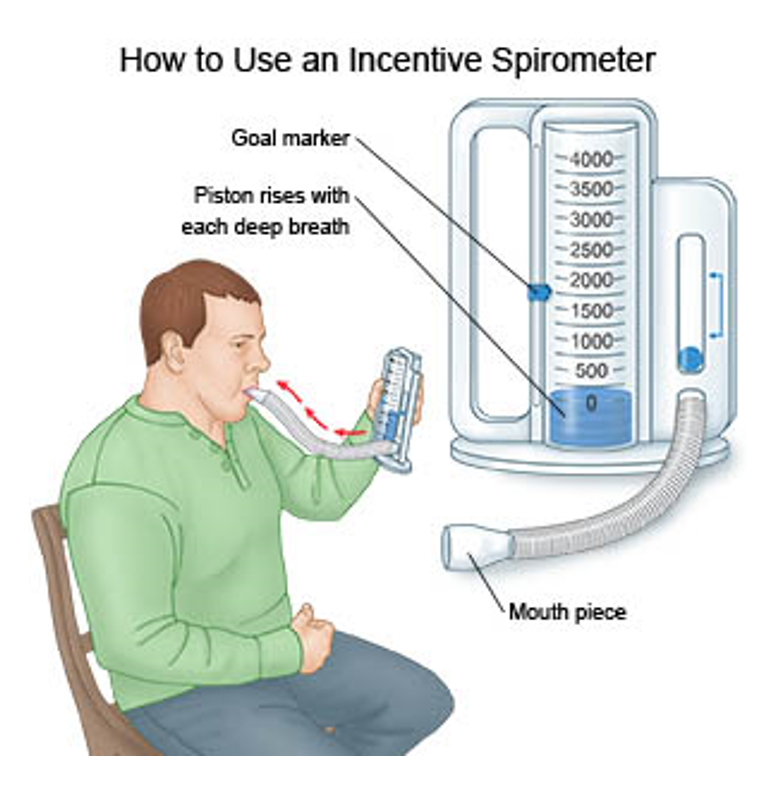
- Second-line: Optimize pain control (e.g., epidural/PCA to allow deep breaths).
- Refractory: CPAP/BiPAP for persistent hypoxemia.
- First-line / Prevention: Incentive spirometry (NBS & best preventive measure), early ambulation. c
-
- Postoperative pneumonia
- Management
- Prevention (Most Important):
- Incentive spirometry, deep breathing exercises. c
- Early mobilization.
- Adequate post-op pain control (epidural/regional blocks preferred over high-dose opioids to prevent hypoventilation).
- First-line (Empiric Antibiotics): Must target Gram-negatives (including Pseudomonas) and Gram-positives (including MRSA) based on local antibiogram.
- Pseudomonas coverage (choose 1): Piperacillin-tazobactam (Zosyn), Cefepime, or Meropenem.
- MRSA coverage (choose 1): Vancomycin or Linezolid.
- Second-line / De-escalation: Narrow Abx spectrum based on sputum/blood culture results after 48-72 hours. Duration: Typically 7 days for uncomplicated HAP.
- Supportive: Supplemental (maintain ), chest physiotherapy, aggressive pulmonary toilet.
- Prevention (Most Important):
- Management
Acute Postoperative Mediastinitis
- Epidemiology & Risk Factors
- < 14 days post-median sternotomy (CABG/valves).
- Orgs: S. aureus, S. epidermidis.
- Risks: DM, obesity, smoking, reoperation.
- Clinical Features
- Fever, tachycardia, purulent wound drainage.
- Buzzword: Sternal instability (“clicking” or “rocking” w/ breathing).
- Diagnosis
- Initial: Blood & wound cx, CBC (↑ WBC).
- Imaging: CT Chest w/ contrast (mediastinal fluid/gas). Note: Small amt of pneumomediastinum on CXR is normal < 14 days post-op; worsening gas is pathologic.
- Confirmatory: Surgical exploration w/ positive cx.
- Differential Diagnostics
- Superficial Skin Infection: Intact sternum (no clicking), no systemic toxicity.
- Postpericardiotomy Syndrome: Autoimmune, weeks-months later. Pleuritic pain, friction rub. Tx: NSAIDs.
- Non-infectious Dehiscence: Sternal clicking without fever or purulence (mechanical failure).
- Management
- Surgical (Immediate): Urgent exploration, debridement, & sternal fixation (muscle flaps). c
- Medical: Empiric IV Abx (Vanco + Cefepime) targeting MRSA/Gram-negatives.
- Ongoing: 4-6 wks IV Abx tailored to cx.
- Complications
- Sepsis / Septic shock (high mortality).
- Sternal osteomyelitis.
Surgical site infection
- Definition & Timing:
- Infection within 30 days of surgery (90 days if implant/prosthesis placed).
- Risk factor
- Patient Risk Factors: Uncontrolled DM (perioperative hyperglycemia), smoking, obesity, malnutrition, chronic steroid use, active infection at distant site. c
- Surgical Risk Factors: Shaving hair with razors (use clippers instead), dirty/contaminated surgical wound class, prolonged operative time (> 75th percentile), hypothermia, inadequate pre-op Abx prophylaxis.
- High-Yield Microbiology:
- Most common overall: S. aureus (MSSA/MRSA), S. epidermidis (implants/prosthetics).
- GI / Colorectal: Gram-negative rods (E. coli, Klebsiella) + anaerobes (B. fragilis).
- Early post-op (< 24–48 hrs): S. pyogenes (GAS) or C. perfringens (severe pain, bronze fluid, gas).
- Prevention:
- Prophylactic Abx: Cefazolin IV within 60 mins prior to incision (Vancomycin if severe PCN allergy). Indicated for surgeries with entrance into GI, GU, or respiratory tract
- Hair Removal: Use clippers only (never razors).
- Management:
- Superficial Incisional:
- 1st Line: Incision & Drainage (I&D) + suture removal + packing.
- Systemic Abx: NOT indicated for uncomplicated superficial SSI. Add oral Abx (e.g., Cephalexin or TMP-SMX) only if spreading cellulitis (>2 cm), systemic signs (fever/leukocytosis), or immunocompromised.
- Deep Incisional / Organ-Space:
- Percutaneous Drainage (CT/US-guided) for intra-abdominal fluid collections > 3 cm.
- Empiric IV Abx: Broad-spectrum (e.g., Vancomycin + Zosyn or Cefepime + Metronidazole).
- Superficial Incisional:
- Key Complications:
- Evisceration: Cover with warm, moist sterile saline dressings → urgent surgical repair.
- Necrotizing Fasciitis: Severe pain out of proportion, crepitus, bullae → emergent surgical debridement.
Sternal dehiscence
- Definition & Timing: Separation of median sternotomy bony edges; most common within 1–2 weeks post-op.
- Key Risk Factors: Obesity, DM, COPD (chronic cough), and bilateral internal mammary artery (BIMA) harvest.
- Clinical Presentation:
- Sensation of sternal “clicking,” “popping,” or rocking with coughing or breathing.
- Physical Exam: Palpable sternal instability/mobility and sternal “click” on palpation.
- Diagnostics:
- Diagnosis is primarily clinical (palpable motion/step-off).
- CXR: Displaced, fractured, or rotated sternal wires.
- Chest CT: Visualizes dehiscence and evaluates for underlying deep mediastinitis.
- Key Step 2 CK Distractor:
- Superficial dehiscence/infection: Skin opens, but the sternum remains rigid/completely stable (treated with local wound care, not immediate OR).
- Next Best Step in Management:
- Urgent surgical re-exploration and sternal rewiring/fixation (surgical emergency; avoids RV laceration). c
- IV broad-spectrum antibiotics (e.g., Vancomycin + Piperacillin-Tazobactam) if signs of infection (fever, purulence, leukocytosis).
- Debridement ± flap closure (pectoralis major) if osteomyelitis or gross infection is present.
- Major Complications: Acute mediastinitis (high mortality), RV rupture/laceration, sternal osteomyelitis, sepsis.