Etiology
Pathogens
- Escherichia coli: leading cause of UTI (approx. 80%)
- Ten times more common in females (shorter urethras colonized by fecal microbiota).
- Staphylococcus saprophyticus: 2nd leading cause of UTI in sexually active women
- Klebsiella pneumoniae: 3rd leading cause of UTI
- Proteus mirabilis
- Produces ammonia, giving the urine a pungent or irritating smell
- Associated with struvite stone formation
- Nosocomial bacteria: Serratia marcescens, Enterococci spp., and Pseudomonas aeruginosa are associated with increased drug resistance.
Tip
- Urethritis is often caused by sexually transmitted infections (STIs), e.g. N gonorrhoeae.
- UTIs are generally caused by bacteria from the gastrointestinal tract, e.g. E coli.
Classification
| Feature | Upper UTI (Pyelonephritis) | Lower UTI (Cystitis) |
|---|---|---|
| Location | Kidney / Renal Pelvis | Bladder / Urethra |
| Systemic Sx | Yes (Fever, Chills, Malaise) t | No (Typically Afebrile) |
| Key Sign | CVA Tenderness, Flank Pain | Suprapubic Tenderness |
| Urinary Sx | May be present | Predominant (Dysuria, Frequency) |
| UA KEY FINDING | WBC Casts | NO WBC Casts |
| Severity | More Severe | Less Severe |
| Management | Often Inpatient, IV Antibiotics | Usually Outpatient, Oral Antibiotics |
- Cystitis (Lower UTI):
- Pyelonephritis (Upper UTI):
- Fever, chills, flank pain, CVA tenderness, N/V.
- Systemic signs of sepsis (tachycardia, hypotension).
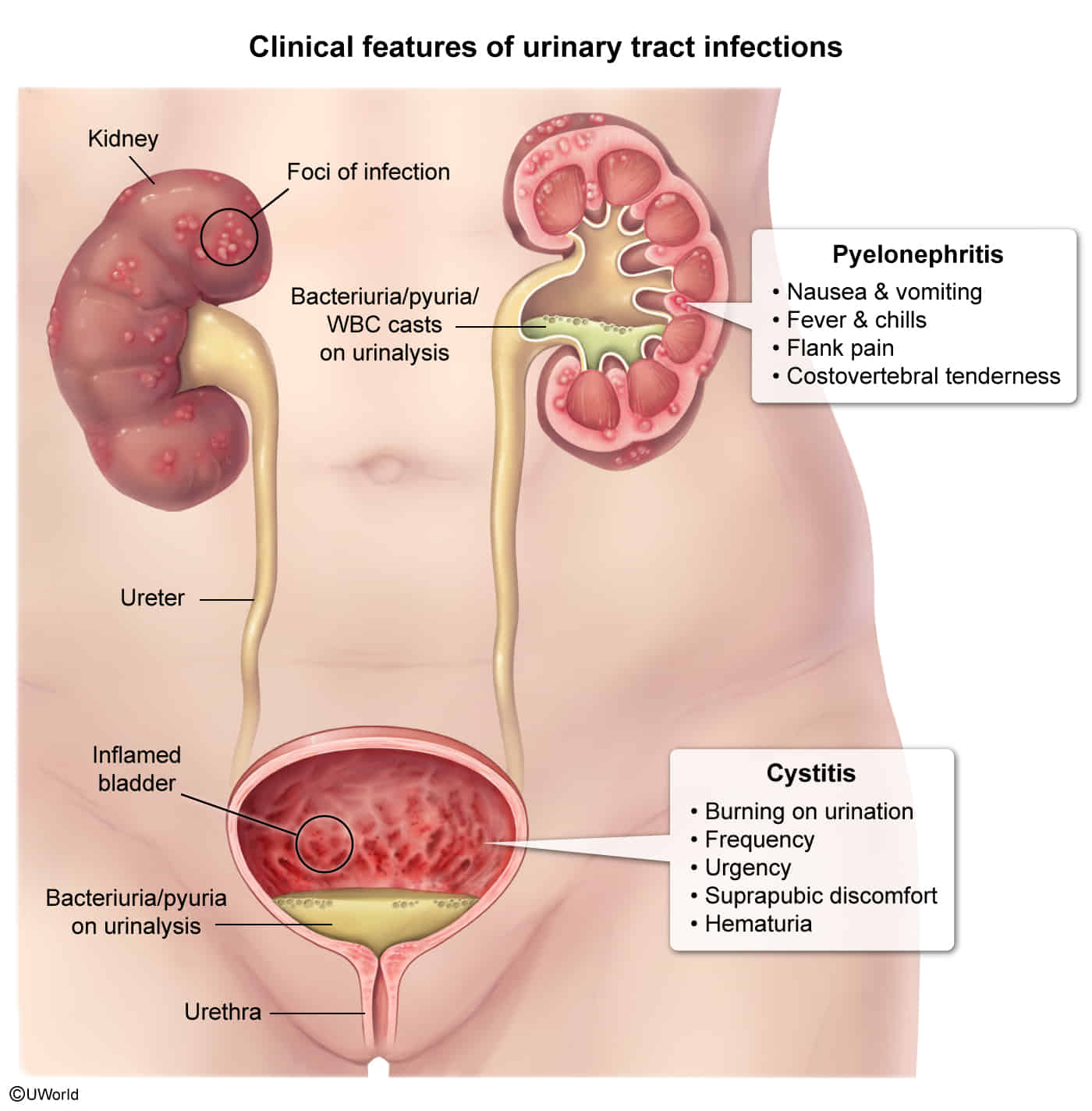
Clinical features
Diagnostics
Urinalysis
- Pyuria: presence of white blood cells (WBCs) in the urine
- Positive leukocyte esterase: an enzyme produced by WBC
- ≥ 5 WBC/HPF
- Bacteriuria: presence of bacteria in the urine
- Positive urinary nitrites: indicate bacteria that convert nitrates to nitrites (most commonly gram-negative bacteria; e.g., E.coli, Klebsiella, Proteus mirabilis)
- Other findings
- Leukocyte casts may indicate pyelonephritis.
- Micro- or macroscopic hematuria may be present.
- Alkaline urine (pH > 8) and struvite crystals in sediment: indicate urease-producing organisms (e.g., Proteus, Klebsiella, Staphylococcus saprophyticus)
Drawing 2025-03-29 16.01.03.excalidraw
⚠ Switch to EXCALIDRAW VIEW in the MORE OPTIONS menu of this document. ⚠ You can decompress Drawing data with the command palette: ‘Decompress current Excalidraw file’. For more info check in plugin settings under ‘Saving’
Excalidraw Data
Text Elements
Lactose Fermenters
Nitrate Reducers
Proteus
Urease Production
Helicobacter pylori Ureaplasma urealyticum Staphylococcus saprophyticus (3rd) Corynebacterium spp.
E. coli (1st) Enterobacter Citrobacter
Klebsiella (2nd)
Pseudomonas
Embedded Files
1d31e51a4dbefce0670aa7da4357fddf403fccdd: Gemini_Generated_Image_wapvdcwapvdcwapv.png
32b3a48d96d30b68f178804fbc510ef15c83cea3: Gemini_Generated_Image_ednoi4ednoi4edno.png
12d8036895fa186aba0d7b9b88f6b88c31682b83: Gemini_Generated_Image_o62ynao62ynao62y.png
Link to original



Treatment
- Classification:
- Uncomplicated: Non-pregnant, premenopausal, immunocompetent females with normal genitourinary (GU) anatomy.
- Complicated: Males, pregnant women, postmenopausal women, immunocompromised (DM, CKD, HIV), structural/functional GU abnormalities (neurogenic bladder, stone, BPH), indwelling catheters, or hospital-acquired.
- Uncomplicated Cystitis:
- First-line: Nitrofurantoin (5 days), TMP-SMX (3 days, if local resistance <20%), or Fosfomycin (single dose). c
- Nitrofurantoin: Concentrates rapidly and exclusively in the urine/bladder. Minimal systemic absorption reduces systemic side effects and limits collateral damage to bowel flora.
- First-line: Nitrofurantoin (5 days), TMP-SMX (3 days, if local resistance <20%), or Fosfomycin (single dose). c
- Complicated Cystitis:
- Longer course (7-14 days) of oral fluoroquinolones (e.g., Ciprofloxacin) or TMP-SMX.
- Recurrent cystitis
- Defined as ≥2 UTIs/6 months or ≥3/year.
- Options: postcoital or continuous low-dose antimicrobial prophylaxis. c
- Vaginal estrogen for peri/postmenopausal patients.
- Outpatient Pyelonephritis (Mild-to-Moderate):
- Oral fluoroquinolones (e.g., Ciprofloxacin, Levofloxacin) for 7-14 days.
- Inpatient Pyelonephritis (Severe):
- IV antibiotics (e.g., Fluoroquinolones, extended-spectrum Cephalosporins like Ceftriaxone, or Piperacillin-tazobactam).
- Asymptomatic Bacteriuria:
- Generally not treated, except in pregnant patients or before urologic procedures.
Mnemonic
- 口诀——三光政策(急性膀胱炎治疗三天)首选喹诺酮类药物(妊娠的以及<18岁的首选三代头孢)
- 口诀——两个周瑜(急性肾盂肾炎治疗两周)喹诺酮类药物
UTI in pregnancy
- Pathophysiology & Risk:
- Progesterone-induced ureteral relaxation -> hydronephrosis/stasis (R > L).
- Pathogens: E. coli (#1), Klebsiella, Proteus, GBS.
- Screening:
- Routine Urine Culture (UCx) for ALL pregnant pts at 12–16 weeks (or 1st visit).
- Asymptomatic Bacteriuria (ASB) & Acute Cystitis:
- Must treat ASB to prevent pyelonephritis, preterm labor, and low birth weight.
- Safe Abx: Nitrofurantoin (avoid 1st trimester & ≥37 wks), Cephalexin, Amoxicillin-clavulanate, Fosfomycin.
- Contraindicated Abx: TMP-SMX (1st trimester -> NTDs; 3rd trimester -> kernicterus), Fluoroquinolones (cartilage damage).
- GBS Bacteriuria: Treat UTI now + mandatory IV Penicillin during labor (skip 36–37 wk screen).
- Follow-up: Mandatory test-of-cure UCx 1–2 weeks post-treatment.
- Acute Pyelonephritis:
- Presentation: Fever, chills, flank pain, costovertebral angle (CVA) tenderness, N/V.
- Obstetric Findings: Uterine contractions, signs of preterm labor.
- Management: Inpatient admission + IV Ceftriaxone or Ampicillin/Gentamicin. c
- Transition to PO Abx once 24–48 hrs afebrile (10–14 days total course).
- Requires daily low-dose suppressive Abx (e.g., Nitrofurantoin) for the remainder of pregnancy.
- Presentation: Fever, chills, flank pain, costovertebral angle (CVA) tenderness, N/V.
- Key Complications:
- Maternal: ARDS, septic shock, perinephric abscess.
- Fetal/Obstetric: Preterm delivery, low birth weight, perinatal mortality.