Epidemiology
Etiology
- Metabolic/Endocrine:
- Diabetes Mellitus (DM): Most common cause overall (>50% of pts with long-standing DM).
- Hypothyroidism, Uremia (End-Stage Renal Disease [ESRD]).
- Toxic / Medication-Induced:
- Alcohol abuse (direct neurotoxicity + nutritional deficiency).
- Chemotherapy: Cisplatin, Oxaliplatin, Paclitaxel, Vincristine.
- Other drugs: Isoniazid (INH), Metronidazole, Amiodarone, Nitrofurantoin, Phenytoin.
- Heavy metals: Lead, Arsenic, Thallium.
- Nutritional Deficiencies:
- Vit B12 (Cobalamin) deficiency: Pernicious anemia, veganism, gastric bypass, ileal resection.
- Vit B1 (Thiamine) deficiency: Dry beriberi, Wernicke-Korsakoff syndrome.
- Vit B6 (Pyridoxine) deficiency (e.g., INH therapy without B6 co-administration) or toxicity.
- Vit E deficiency (mimics Friedreich ataxia).
- Inflammatory / Autoimmune / Paraproteinemic:
- Chronic Inflammatory Demyelinating Polyneuropathy (CIDP), Guillain-Barré Syndrome (AIDP).
- Monoclonal Gammopathy of Undetermined Significance (MGUS), Multiple Myeloma (MM), AL Amyloidosis.
- Vasculitides (PAN, SLE, RA, EGPA, Sjögren syndrome).
- Infectious:
- HIV, Hepatitis C (cryoglobulinemia), Lyme disease, Leprosy (Hansen disease).
- Hereditary:
- Charcot-Marie-Tooth (CMT) disease (most commonly PMP22 duplication / CMT1A).
Tip
Diabetes mellitus and alcohol use disorder account for most cases in developed countries.
Pathophysiology
Clinical features
- Symmetrical distal sensory loss (glove and stocking pattern)
- Vibratory perception is often lost first, followed by loss of pin-prick, temperature, and light touch perception.
- May be accompanied by neuropathic pain, paresthesias, and motor weakness
- Burning-foot syndrome: burning pain, tingling, pins-and-needles sensation, or formication , hyperhidrosis
- Atrophy of muscles: e.g., stork legs in the case of Charcot-Marie-Tooth disease
- Sensory ataxia: caused by loss of sensation, particularly proprioception, that affects the afferent limb of postural reflexes (e.g., due to vitamin B12 deficiency).
- ↓ Deep tendon reflexes
Subtypes and variants
Hereditary motor sensory neuropathy (HMSN)
Also known as Charcot-Marie-Tooth disease
- Pathophysiology
- Primarily demyelinating neuropathy
- Various mutations cause impaired growth or function of the axons or Schwann cells (e.g., defects in axon or myelin sheath proteins).
- Clinical features: onset before the age of 20 years with distal symmetrical sensorimotor polyneuropathy
- Foot drop, pes cavus deformity, hammer toe
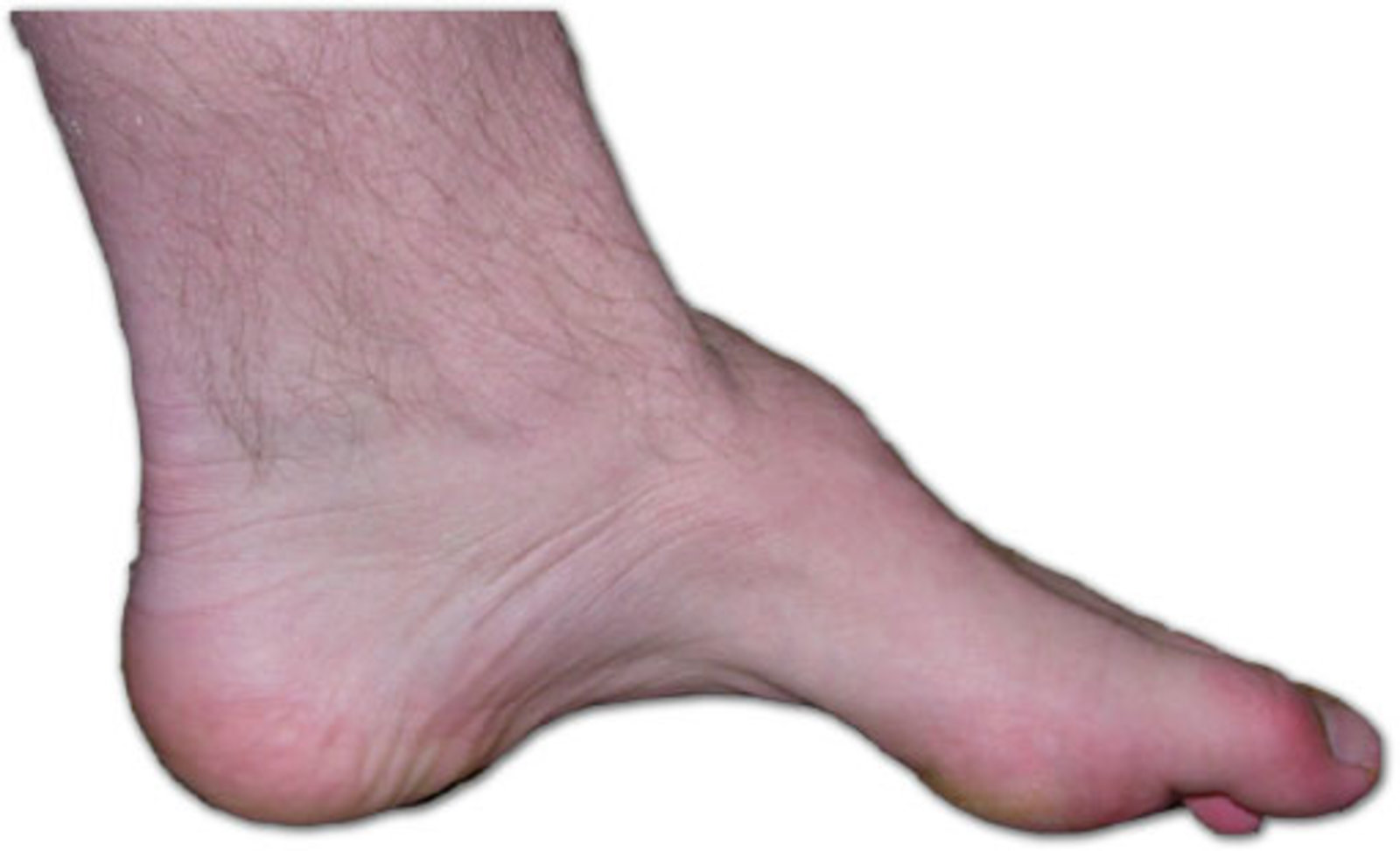
- Atrophy of the calf muscles (stork leg appearance)
- vs Myotonic syndromes, which has pseudohypertrophy (rather than atrophy) of the calf muscles.
- Weak intrinsic hand muscles
- Sensory loss
- Foot drop, pes cavus deformity, hammer toe
Chronic inflammatory demyelinating polyneuropathy
- Overview:
- Autoimmune demyelination of peripheral nerves and nerve roots.
- Chronic course lasting > 8 weeks (distinguishes from GBS/AIDP).
- Associated with MGUS, DM, HIV, and autoimmune disorders.
- Clinical Presentation:
- Motor: Symmetric, progressive proximal AND distal muscle weakness (difficulty climbing stairs and gripping objects).
- Sensory: “Stocking-glove” sensory loss; loss of vibration & proprioception > pinprick/temperature; sensory ataxia ((+) Romberg).
- Reflexes: Generalized areflexia or hyporeflexia.
- Diagnosis:
- Initial & Best Test: NCS/EMG showing primary demyelination (↓ conduction velocity, conduction blocks, prolonged distal latencies).
- LP: Albuminocytologic dissociation (↑ CSF protein with normal CSF WBC count).
- Imaging: Spine MRI shows gadolinium enhancement and hypertrophy of cauda equina/nerve roots.
- Biopsy (rare): Sural nerve biopsy showing “onion-bulb” formations.
- Differential Diagnosis:
- GBS (AIDP): Acute onset (< 4 weeks to nadir), autonomic instability, steroids are ineffective.
- Diabetic Neuropathy: Distal only (no proximal weakness), axonal pattern on NCS, normal CSF protein.
- Charcot-Marie-Tooth (CMT): Autosomal dominant, childhood onset, pes cavus, hammer toes.
- Management:
- First-Line: Corticosteroids (steroid-responsive, unlike GBS), IVIG, or Plasma Exchange (PLEX) (all equally effective).
- Maintenance: Periodic IVIG/SCIG or slow steroid taper + steroid-sparing agents (Azathioprine, Mycophenolate).
- Refractory: Rituximab.
- Symptomatic: Gabapentin/Pregabalin for neuropathic pain; PT/OT and AFOs for gait instability.
Alcoholic polyneuropathy
- Pathophysiology & Risk Factors:
- Direct neurotoxicity from chronic heavy ethanol/acetaldehyde exposure.
- Concurrent nutritional deficiency, predominantly thiamine (vitamin B1), folate, and B12.
- Associated with chronic, severe alcohol use disorder (AUD).
- Clinical Features:
- Sensory (early/prominent): Symmetric, distal-to-proximal “stocking-glove” loss; burning pain, paresthesias, allodynia, loss of vibration/proprioception.
- Motor (late): Distal muscle weakness, intrinsic foot/hand atrophy, bilateral foot drop (steppage gait). c
- Reflexes: ↓ or absent deep tendon reflexes (DTRs); loss of ankle jerks (Achilles reflex) is the earliest sign.
- Gait/Coordination: Sensory ataxia with (+) Romberg sign.
- Autonomic (severe): Orthostatic hypotension, erectile dysfunction, impaired sweating, GI dysmotility.
- Diagnosis:
- Clinical: History of heavy AUD + symmetric length-dependent sensorimotor polyneuropathy.
- EMG & Nerve Conduction Studies (NCS): Symmetric, length-dependent sensorimotor axonal degeneration (marked ↓ in SNAP and CMAP amplitudes; normal/mildly reduced conduction velocity).
- Exclusionary Labs: Whole blood thiamine, vitamin B12 & MMA, HbA1c/fasting glucose, TSH, folate, CBC (↑ MCV), LFTs (AST:ALT > 2:1).
- Key Differentials:
- Diabetic Peripheral Neuropathy: Identical distribution; differentiated by elevated HbA1c and absence of severe AUD.
- B12 Deficiency (Subacute Combined Degeneration): Differentiated by UMN signs (hyperreflexia, spasticity, (+) Babinski) + elevated MMA.
- Guillain-Barré Syndrome (AIDP): Acute ascending motor paralysis, demyelinating pattern on NCS, and albuminocytological dissociation on LP.
- Management:
- Etiology-directed (First-line):
- Strict alcohol cessation/abstinence (mandatory to halt progression).
- Nutritional repletion: High-dose Thiamine (vitamin B1) + comprehensive B-complex and multivitamin.
- Neuropathic Pain:
- 1st-line: Gabapentin, Pregabalin, Duloxetine, or TCAs (e.g., Amitriptyline).
- Topical/Adjunct: Capsaicin cream or Lidocaine 5% patch.
- Supportive & Rehabilitative:
- Physical/Occupational therapy for fall prevention and gait retraining.
- Ankle-foot orthosis (AFO) for foot drop.
- Routine daily foot inspections to prevent unperceived trauma/ulcers.
- Etiology-directed (First-line):
- Complications:
- Recurrent falls, gait instability, and traumatic fractures.
- Neurotrophic skin breakdown, painless neuropathic ulcers, and secondary osteomyelitis.
- Permanent lower-extremity paresis and wheelchair dependence.
Diagnostics
Differential diagnostics
Mononeuritis multiplex
- Definition & Pathophysiology:
- Infarction of the vasa nervorum causing ischemic axonal injury.
- Presents as painful, asymmetric, asynchronous sensorimotor deficits in ≥2 discrete peripheral nerves.
- High-Yield Etiologies:
- Systemic Vasculitides (Most common): Polyarteritis nodosa (PAN) (classic association), EGPA (Churg-Strauss), Cryoglobulinemic vasculitis (associated with HCV), GPA, MPA.
- Infections: HBV (PAN link), HCV, HIV, Lyme disease, Leprosy.
- Connective Tissue Diseases: SLE, RA, Sjögren syndrome.
- Metabolic: Diabetes mellitus (diabetic amyotrophy).
- Clinical Presentation:
- Sudden, patchy nerve deficits: e.g., Foot drop (common peroneal n.) + Wrist drop (radial n.) occurring days/weeks apart. c
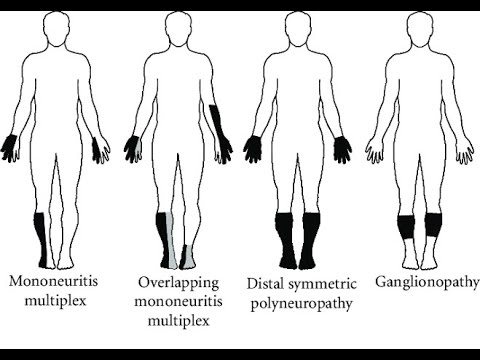
- Neuropathic symptoms: Severe burning pain, paresthesias, localized sensory loss, and asymmetric weakness/areflexia.
- Systemic vasculitic signs: Fever, weight loss, palpable purpura, livedo reticularis, renal involvement (hematuria/proteinuria).
- Sudden, patchy nerve deficits: e.g., Foot drop (common peroneal n.) + Wrist drop (radial n.) occurring days/weeks apart. c
- Diagnosis:
- Initial / Best Neuro Test: EMG / NCS shows multifocal, asymmetric axonal neuropathy (decreased CMAP/SNAP amplitudes).
- Etiology Labs: ↑ ESR/CRP, ANCA (c-ANCA/p-ANCA), HBV/HCV serologies, cryoglobulins, ANA, RF, complement (↓ C3/C4).
- Confirmatory / Gold Standard: Nerve & muscle biopsy (typically sural nerve) shows necrotizing transmural vasculitis and axonal degeneration.
- Key Differentials:
- Diabetic Polyneuropathy: Symmetric, length-dependent (“stocking-glove”) pattern (not patchy/asymmetric).
- Guillain-Barré (AIDP): Symmetric, ascending weakness; CSF shows albuminocytologic dissociation.
- Multifocal Motor Neuropathy (MMN): Pure motor (no sensory loss), asymmetric, (+) anti-GM1 Ab, conduction block on NCS.
- Management:
- 1st-Line (Systemic Vasculitis): High-dose corticosteroids (IV Methylprednisolone oral Prednisone) + Cyclophosphamide or Rituximab (for severe/organ-threatening disease).
- Viral-Associated:
- HBV: Short-course steroids + Plasma exchange (PLEX) + Antivirals (Entecavir/Tenofovir).
- HCV: Direct-acting antivirals (DAAs) ± Rituximab.
- Symptomatic / Supportive:
- Neuropathic pain: Gabapentin, Pregabalin, or Duloxetine.
- Functional support: Ankle-foot orthosis (AFO) for foot drop; PT/OT.