Decision Overview: NIV vs. Invasive Ventilation
Core Principle : Always trial Noninvasive Positive-Pressure Ventilation (NIV) first in cooperative, hemodynamically stable patients with reversible causes (e.g., COPD , CHF) to reduce mortality, length of stay, and Ventilator-Associated Pneumonia (VAP) .Immediate Invasive Mechanical Ventilation (IMV / ETT) is reserved for patients who cannot protect their airway , have severe hemodynamic/neurologic compromise, or present with specific anatomical/physiological contraindications to NIV.
Monitoring
Basic Parameters & Definitions
F i O 2 < 60% O 2 PEEP Positive End-Expiratory Pressure . Maintains alveolar patency.Tidal Volume (TV) : Volume per breath (Goal: 6-8 mL/kg ideal body weight; 6 mL/kg in ARDS ).Respiratory Rate (RR) : Primary tool for C O 2 Minute Ventilation (V E : R R × T V P a C O 2
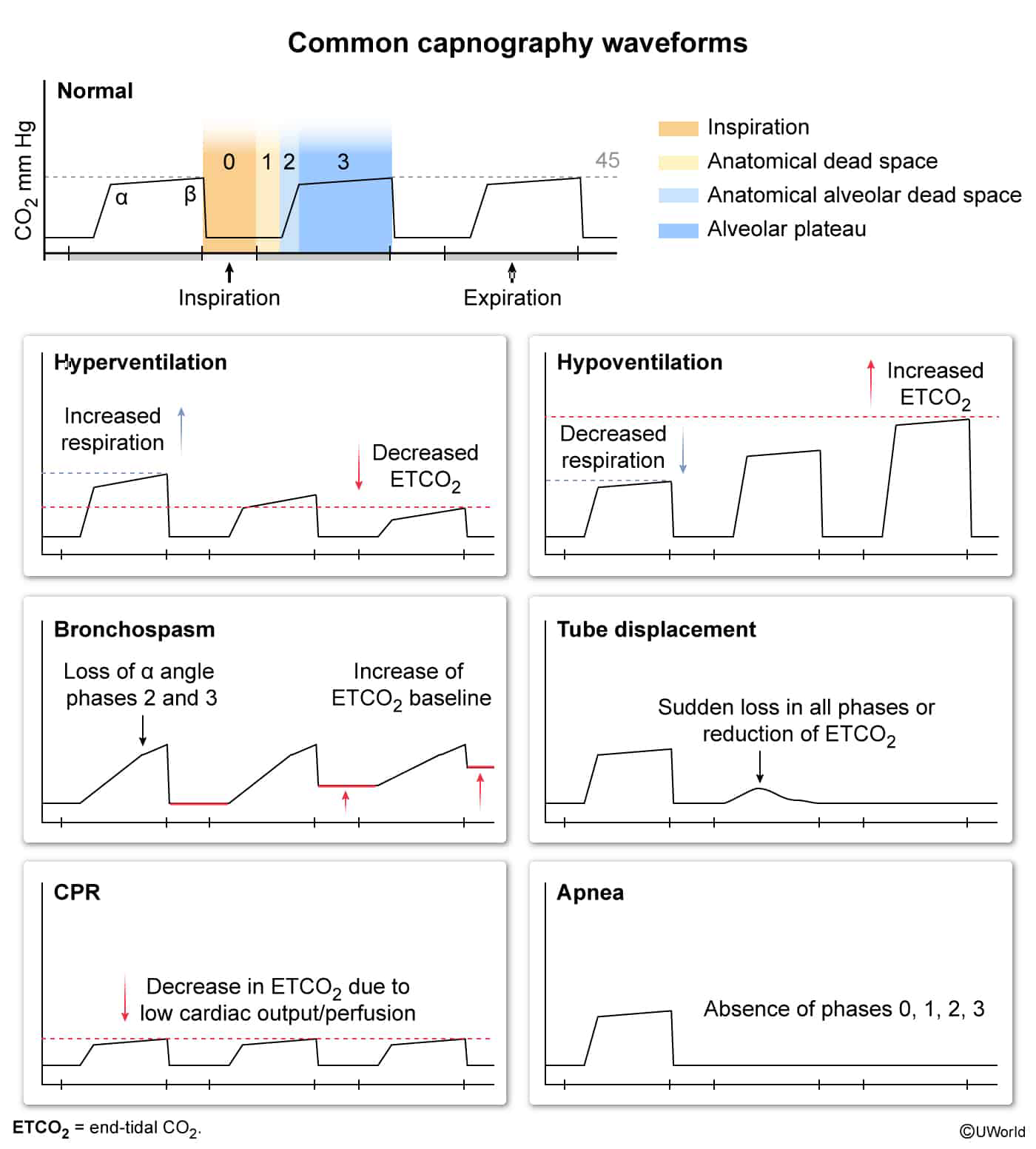
Capnography
Continuous, noninvasive monitoring of end-tidal carbon dioxide (E tC O 2
Reflects ventilation (elimination of C O 2 C O 2 C O 2
Normal range: 35–45 mmHg.
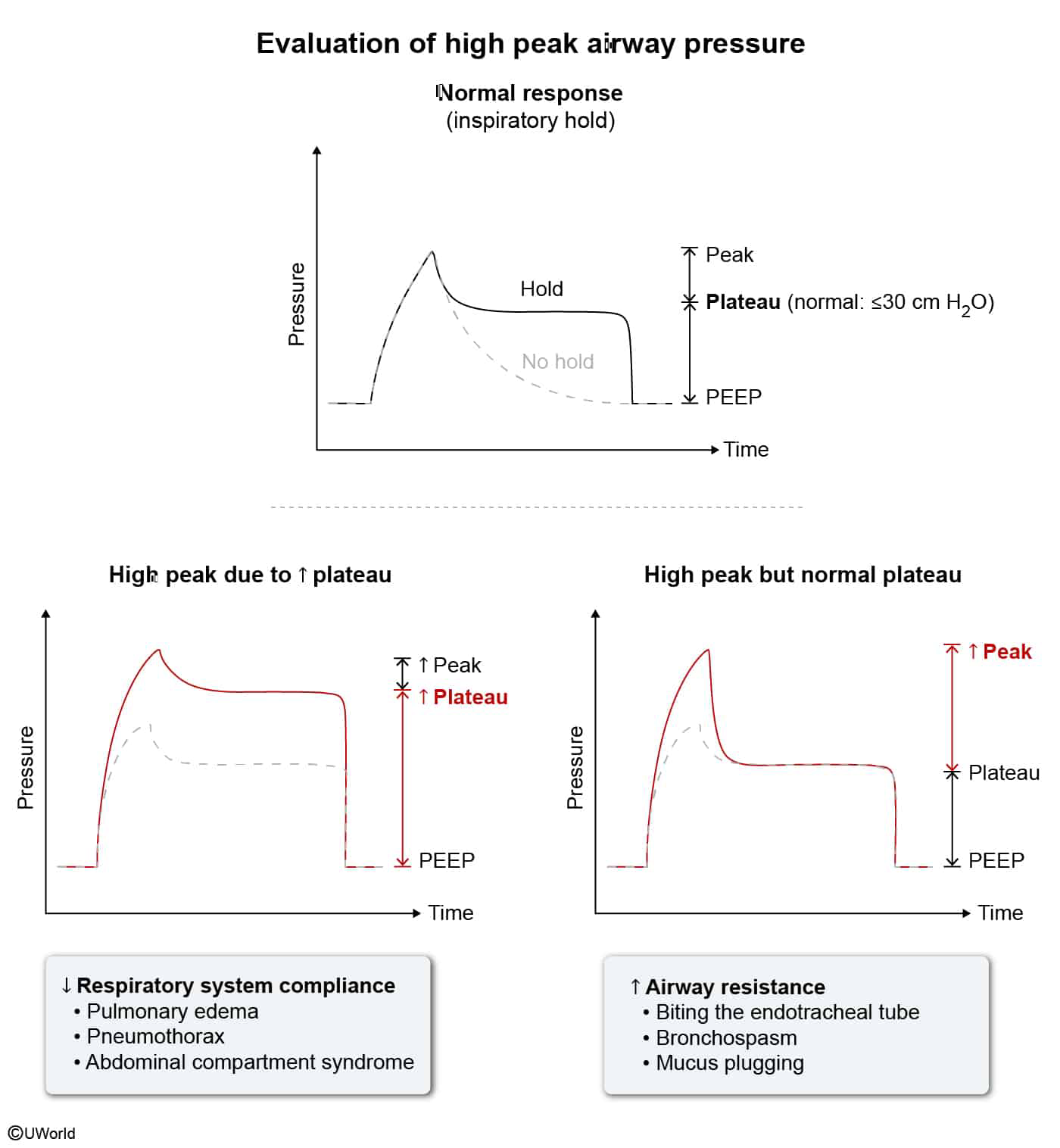
Airway Pressure Monitoring
Peak Inspiratory Pressure (PIP) : Max pressure during inspiration. Reflects airway resistance + lung compliance. Plateau Pressure (P pl a t : Pressure during inspiratory hold (no airflow). Reflects lung compliance/alveolar elastic recoil only. Pressure Differential Analysis :
↑ ↔ P pl a t ↑
Causes: Mucus plug, bronchospasm, biting ETT, kinked tube.
↑ ↑ P pl a t ↓ c
Auto-PEEP (Intrinsic PEEP )
Definition : Incomplete expiration causing air trapping (common in COPD /Asthma ).Detection : Measured via expiratory hold maneuver. Look for “flow-volume” loop failing to return to zero before next breath.Management : ↓ ↓ ↑ ↑
ABG Monitoring & Adjustments
Oxygenation (P a O 2 :
Adjust via F i O 2 PEEP
Goal: P a O 2 S p O 2
Ventilation (P a C O 2
Adjust via RR and TV .
Goal: pH 7.35-7.45.
In ARDS : “Permissive hypercapnia” (pH > 7.20) is acceptable to avoid barotrauma from high TV.
Complications
Barotrauma : PTX, pneumomediastinum due to high pressures (P pl a t > 30 H 2 O VAP (Ventilator-Associated Pneumonia) : Occurs > 48 Cardiovascular : ↑ → ↓ → Oxygen Toxicity : Free radical damage if F i O 2 > 60%
Weaning Readiness (SBT - Spontaneous Breathing Trial)
Criteria :
Cause of RF improving/resolved.
Hemodynamically stable (minimal/no vasopressors).
Adequate oxygenation (P a O 2 ≥ 60 F i O 2 ≤ 40% ≤ 8
Intact mentation/cough/gag.
RSBI (Rapid Shallow Breathing Index) : R R / T V ( L ) < 105