Etiology
Pathophysiology
Clinical features
Diagnostics
Light criteria
Tip
- Total protein normal level 6.0 to 8.3 g/dL (60 to 83 g/L)
- Albumin normal level 3.4 to 5.4 g/dL (34 to 54 g/L)
- LDH normal level 105 to 333 U/L
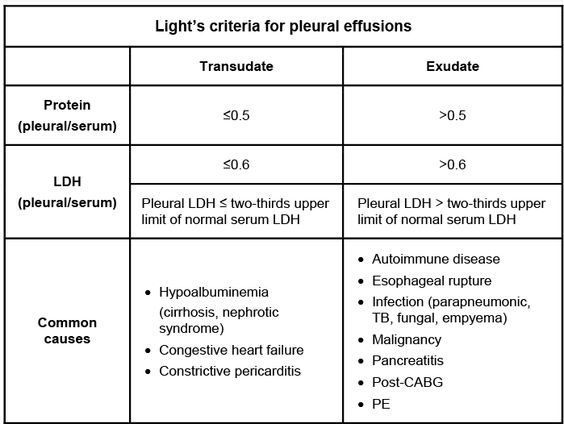
Satisfying any ONE criterium means it is exudative:
- Pleural Total Protein/Serum Total Protein ratio > 0.5
- Pleural lactate dehydrogenase/Serum lactate dehydrogenase ratio > 0.6
- Pleural lactate dehydrogenase level > 2/3 upper limit of the laboratory’s reference range of serum lactate dehydrogenase.
Treatment
Subtypes
| Parameter | Uncomplicated Parapneumonic Effusion | Complicated Parapneumonic Effusion | Empyema |
|---|---|---|---|
| Etiology | Sterile inflammatory fluid translocation from pneumonia | Direct bacterial invasion into pleural space | Frank bacterial colonization leading to purulent fluid |
| Pleural Fluid pH | 7.20 | < 7.20 | < 7.20 |
| Pleural Fluid Glucose | > 60 mg/dL (or normal) | < 60 mg/dL (↓) | < 60 mg/dL (↓) |
| Pleural Fluid LDH Ratio | > 0.6 (Exudative) | > 0.6 (typically > 1000 U/L) | > 0.6 |
| Gram Stain & Culture | Negative | Positive or negative | Positive (or gross pus / putrid odor) |
| Management | Abx alone | Abx + Chest tube drainage | Abx + Chest tube drainage Surgical debridement (VATS) |
- Normal Pleural Fluid pH: ~7.60 – 7.64 (physiologically alkaline compared to arterial blood pH of ~7.40 due to active bicarbonate secretion into the pleural space).
- Acts as a chemical buffer to prevent local tissue acidosis in a closed, narrow cavity with relatively low turnover of fluid.
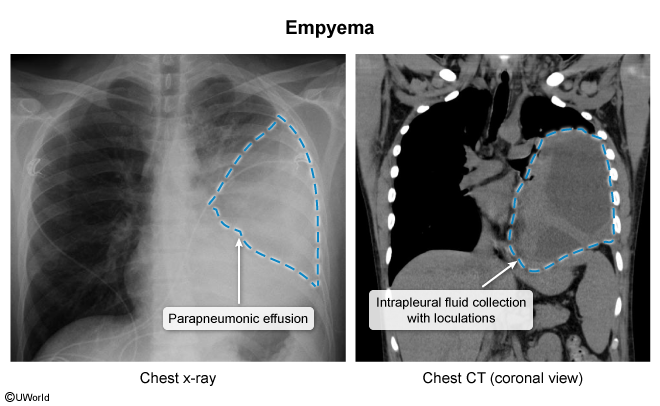
Pleural empyema
- Accumulation of pus in the pleural cavity
- Exudative effusion (bacterial colonization)
- Differ from uncomplicated parapneumonic effusion, which is just exudative effusion (without direct bacterial invasion)