Epidemiology
Etiology
Subtypes
Tip
Each one of the diagnosis is superseded by the one above it: Bipolar I > Bipolar II > Depression > Cyclothymia > Dysthemia
Persistent depressive disorder (dysthymia)
- Clinical features: Unlike in MDD, thoughts of suicide, loss of interest, and psychomotor agitation or retardation are not typical features of persistent depressive disorder; therefore, dysthymia is often regarded as a milder form of MDD.
- Diagnostic criteria
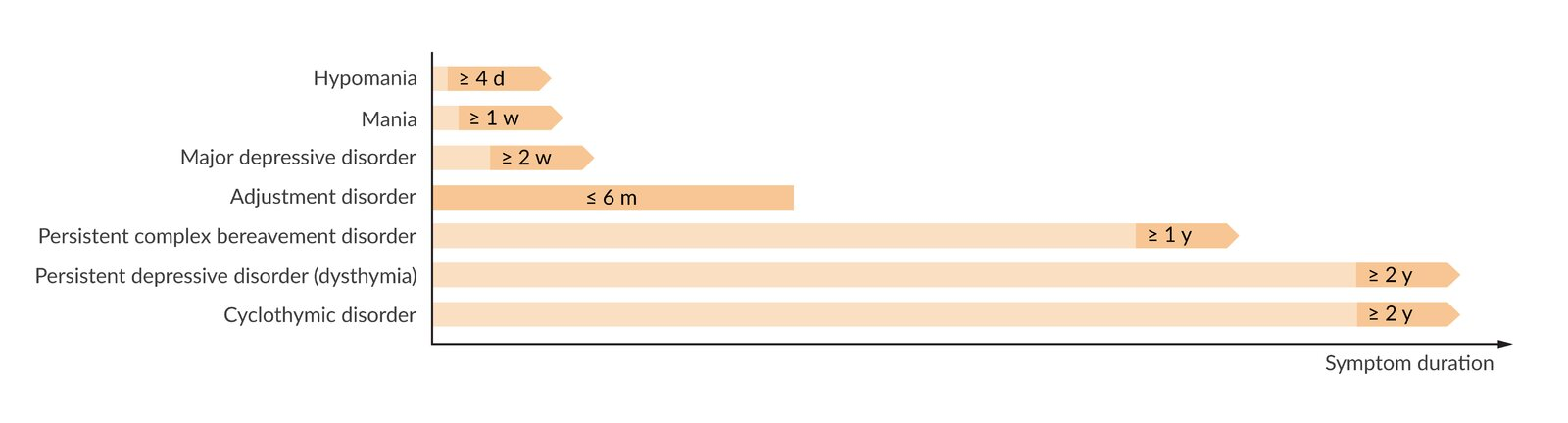
- Chronic depressed mood for ≥ 2 years in adults (≥ 1 year in children/adolescents).
- Never symptom-free for ≥ 2 consecutive months.
- No history of manic/hypomanic episodes.
Major depressive disorder with seasonal pattern (seasonal affective disorder, winter depression)
- Epidemiology & Risk Factors:
- High latitude (decreased winter sunlight/photoperiod).
- Females > Males (~4:1); peak onset age 18–30.
- Family history of MDD or bipolar disorder.
- Clinical Presentation:
- Meets standard MDD criteria (SIGECAPS) for ≥2 weeks.
- Dominated by atypical depressive features:
- Hypersomnia and daytime fatigue.
- Hyperphagia with carbohydrate cravings and weight gain.
- Leaden paralysis (heavy extremities).
- Predictable onset in fall/winter with spontaneous full remission in spring/summer.
- Diagnostic Criteria & Workup:
- DSM-5 criteria: Recurrent MDEs with seasonal onset and remission for ≥2 consecutive years without non-seasonal episodes.
- Must rule out medical mimics: Order TSH to exclude hypothyroidism.
- Screen for history of hypomania/mania (MDQ) to exclude bipolar disorder.
- Management:
- First-line (non-pharmacologic): Bright light therapy (10,000 lux for 30 min/day immediately upon waking). c
- First-line (pharmacologic): SSRIs (e.g., Sertraline, Fluoxetine) or Bupropion XL (FDA-approved; start in autumn prior to symptom onset).
- Psychotherapy: CBT-SAD (tailored cognitive behavioral therapy).
- Refractory: Combination therapy (Light + SSRI/Bupropion), SNRIs, or ECT (if severe/psychotic/suicidal).
- High-Yield Complications:
- Suicidality and severe functional decline.
- Treatment-emergent mania if underlying bipolar disorder is missed.
Pathophysiology
Clinical features
- Subtypes / Specifiers:
- Atypical features: Mood reactivity (mood brightens with positive events), leaden paralysis (heavy arms/legs), hyperphagia, hypersomnia, hypersensitivity to interpersonal rejection. c
- Melancholic features: Severe anhedonia, lack of mood reactivity, early morning awakenings (terminal insomnia), marked psychomotor retardation, excessive guilt, anorexia/weight loss.
- Psychotic features: Delusions or hallucinations (usually mood-congruent: guilt, poverty, disease, punishment).
- Peripartum onset: Onset during pregnancy or within 4 weeks postpartum.
- Seasonal pattern: Depressive episodes recurring during specific seasons (typically winter); responsive to light therapy.
Diagnostics
Diagnostic criteria
- Diagnostic Criteria (DSM-5-TR):
- ≥5/9 SIG E CAPS for ≥2 weeks causing significant functional impairment.
- Symptoms NOT attributable to substance use, medication, or general medical condition. c
- No lifetime history of manic or hypomanic episodes (rules out Bipolar Disorder).
A. Five or more of the nine symptoms listed below, for at least 2 weeks, with at least one of the symptoms being depressed mood or anhedonia
- Sleep disturbances
- Anhedonia (↓ Interest in pleasurable activities)
- Guilt or feelings of worthlessness
- ↓ Energy
- ↓ Concentration
- Appetite/weight changes (either gain or loss)
- Psychomotor retardation or agitation
- Suicidal ideation
Mnemonic
SAGE CAPS Imagined a very sad wizard in a fancy hat. 2 weeks = too blue

Tip
Some individuals with MDD do not report feeling depressed due to poor recognition or concerns of stigma and may come to their primary care physicians with excessive worry over physical health, pain symptoms (eg, muscle aches, abdominal cramps, headaches), and other somatic symptoms (eg, fatigue, sleep disturbance, appetite change).
Further assessment
- Suicide: MDD is a major risk factor for suicide. Always assess for suicidal ideation.
Differential diagnostics
- Substance/Medication-Induced Mood Disorder:
- Diff by: Symptoms develop during or within 1 month of substance intoxication/withdrawal (e.g., alcohol, cocaine, opioids) or medication initiation (e.g., corticosteroids, interferon-α, β-blockers).
Treatment
- First-Line Therapy:
- Mild-to-Moderate MDD: Psychotherapy (CBT, Interpersonal Therapy) OR Pharmacotherapy (SSRIs, SNRIs, Bupropion, Mirtazapine).
- Moderate-to-Severe MDD: Combination therapy (Psychotherapy + Pharmacotherapy).
- Pharmacotherapy Selection Pearls:
- SSRIs (e.g., Sertraline, Escitalopram): First-line overall.
- Bupropion (NDRI): Good for fatigue, hypersomnia, nicotine dependence; no sexual dysfunction or weight gain. Contraindicated in bulimia/anorexia nervosa and seizure disorders.
- Mirtazapine (α2-antagonist): Good for insomnia and anorexia/cachexia (causes sedation & weight gain).
- Duloxetine / Venlafaxine (SNRIs): Good for comorbid chronic pain, neuropathy, or fibromyalgia.
- Treatment Timeline & Duration:
- Acute phase: Allow 4–8 weeks at therapeutic dose to evaluate clinical response. c
- Continuation phase: Continue antidepressant for ≥6 months at full therapeutic dose following remission to prevent relapse. c
- Maintenance phase: Indicated for 1–3 years or indefinitely if:
- ≥3 lifetime episodes of MDD.
- ≥2 lifetime episodes with high-risk features (severe episodes, suicide attempts, psychotic features, strong family history).
- Second-Line & Augmentation (Incomplete / Non-response):
- If no response after 4–8 weeks: Switch to a different first-line agent (within-class or different class). c
- If partial response: Augment with:
- Second antidepressant of a different class (e.g., SSRI + Bupropion). c
- Second-generation atypical antipsychotic (e.g., Aripiprazole, Quetiapine).
- Lithium or Triiodothyronine (T3).
Special patient groups
Depression in children and adolescents
- Clinical Presentation:
- Hallmark: Often manifests primarily as irritability, crankiness, or hostility rather than overt sadness.
- DSM-5 Criteria: of 9 SIGECAPS symptoms for weeks (must include irritable/depressed mood or anhedonia).
- Pediatric Nuance: Appetite disturbance frequently presents as failure to make expected weight gain.
- School & Somatic: Declining school grades, social withdrawal, and recurrent vague somatic complaints (headaches, abdominal pain) with negative workups. c
- Management:
- Safety & Means Restriction: Assess immediate SI; counsel parents to remove/lock up firearms, medications, and sharps; hospitalize if high imminent risk.
- Mild MDD: Psychotherapy alone (CBT or Interpersonal Psychotherapy [IPT]).
- Moderate to Severe MDD: Combination therapy (CBT + Pharmacotherapy).
- 1st-line SSRIs: Fluoxetine (approved years) or Escitalopram (approved years).
- 2nd-line: Switch to alternate SSRI (e.g., Sertraline).
- Black Box Warning (BBW): SSRIs carry a risk of transiently increased suicidal ideation and behaviors in patients years old (does not increase completed suicide); requires weekly follow-up during the first month. c
- Physical and psychomotor energy improve before cognitive depressive distortions and hopelessness resolve.
- Result: The patient gains the physical energy, motivation, and executive function to act on pre-existing suicidal ideations before mood lifts (therapeutic lag for mood is 2–4+ weeks).