Epidemiology
Etiology
Pathophysiology
- Dopamine hypothesis: ↑ dopamine activity in mesolimbic pathway (positive Sx), ↓ dopamine in mesocortical pathway (negative/cognitive Sx).
- Other neurotransmitters implicated: ↓ activity at NMDA glutamate receptors, role of serotonin (basis for SGA efficacy).
Clinical features
Subtypes and variants
Catatonia
- Etiology & Triggers:
- Most common in severe bipolar disorder (mania or depression) and MDD with psychotic features > schizophrenia.
- Medical triggers: CNS infections, anti-NMDA receptor encephalitis (young females with teratoma), BZD withdrawal.
- High-Yield Clinical Features:
- Catalepsy: Maintenance of postures passively held against gravity.
- Waxy Flexibility: Initial resistance to movement followed by smooth release (bending like a candle).
- Mutism & Stupor: Alert pt unable/unwilling to speak or interact.
- Negativism: Involuntary resistance to external instructions or movement.
- Echolalia (mimicking speech) and echopraxia (mimicking movements).
- Malignant variant: Acute rigidity, fever, and autonomic instability (mimics NMS).
- Diagnosis:
- Lorazepam Challenge Test: Rapid, temporary symptom relief within 5–10 min after IV Lorazepam 1–2 mg confirms diagnosis.
- Continuous EEG: Mandatory to rule out non-convulsive status epilepticus (NCSE).
- Differential Diagnosis:
- NMS: Features severe “lead-pipe” rigidity, triggered by D2 antagonists; minimal response to lorazepam.
- Serotonin Syndrome: Features hyperreflexia and ocular/inducible clonus + tremor + diarrhea.
- Management Algorithm:
- Immediate Action: Stop all antipsychotics immediately (worsens catatonia and triggers malignant form).
- 1st-Line: Lorazepam IV/PO (often requires high doses: 6–16 mg/day). c
- Definitive / 2nd-Line: Electroconvulsive Therapy (ECT) (indicated if no response to BZDs in 48–72h, or first-line if malignant catatonia).
- Supportive: Aggressive VTE prophylaxis (heparin/LMWH due to immobility) + IVF hydration.
- Key Complications:
- DVT / Fatal PE (most common cause of death).
- Rhabdomyolysis / AKI (elevated serum CK from sustained muscle contraction/immobility).
- Dehydration, malnutrition, and aspiration pneumonia.
Diagnostics
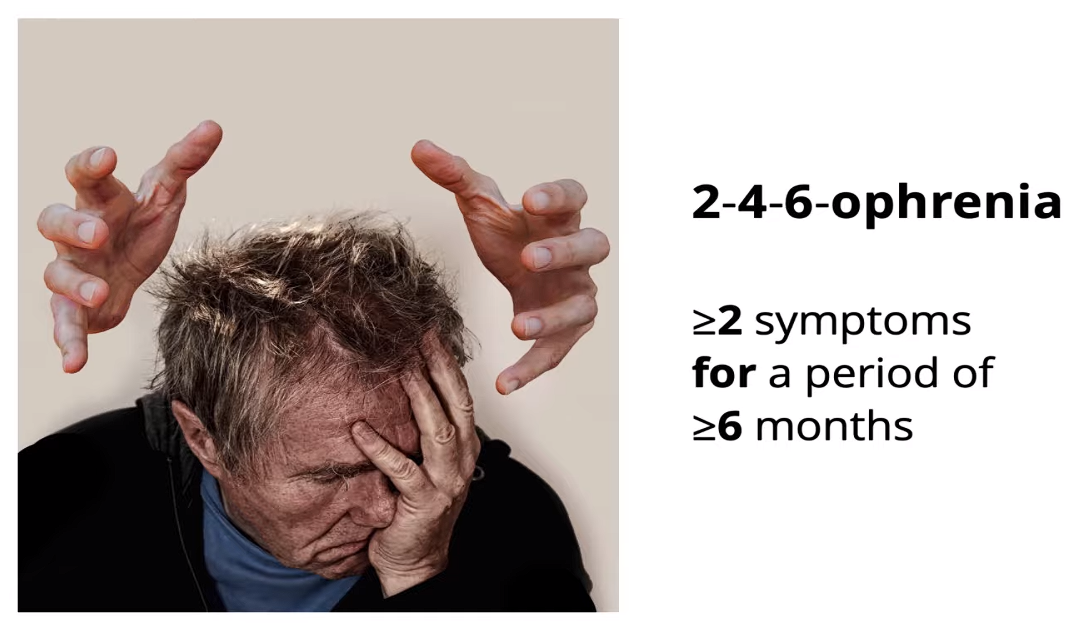
- At least two of the following symptoms must be present, with at least one of these from the first three symptoms listed:
- Delusions
- Hallucinations
- Disorganized speech
- Grossly disorganized or catatonic behavior
- Negative symptoms
- Apathy: lack of motivation
- Social withdrawal
- Flat affect: emotional flattening/monotone speech
- Poverty (lack) of speech
- Anhedonia: inability to experience pleasure
- The above symptoms persist for ≥ 1 month.
- There are continuous cognitive or affective disturbances for ≥ 6 months.
- Symptoms must cause social, occupational, or personal functional impairment lasting ≥ 6 months.
Mnemonic
Patients can hear high definition voices. But they are not real. Like there are radiowaves spreading fake bullshit (BS) via a network
Differential diagnosis
- Schizophrenia: ≥ 6 months
- Schizophreniform disorder: 1–6 months
- Brief psychotic disorder: > 1 day but ≤ 1 month
- Brief psychotic disorder usually develops after stressful life events.
- With eventual full return to premorbid functioning. c
- Schizoaffective disorder
- Meets criteria for Schizophrenia AND a Major Mood Disorder (MDD or Bipolar).
- Differentiation Rule: Psychosis must occur for > 2 weeks in the absence of a major mood episode (depressive or manic) to rule out Mood Disorder w/ Psychotic Features.
- MDD with psychotic features doesn’t have psychotic symptoms alone without mood symptoms
- A single illness episode where both of the following occur concurrently:
- Psychotic symptoms that meet the criteria for schizophrenia
- Features of a major mood episode (major depressive episode OR manic episode OR mixed episode)
- Psychotic symptoms occur at least once in the absence of mood disorder symptoms.
- Delusional disorder
- ≥ 1 month
- At least one delusion
- No other prominent psychotic symptoms (e.g., hallucinations, disorganized speech, negative symptoms)
- E.g., delusional parasitosis: the fixed belief that the body is infested with a parasite despite the lack of supporting evidence
- Social and occupational functioning are not markedly impaired (vs psychosis) c
Treatment
- Acute Phase / First-Line:
- Second-Generation Antipsychotics (SGAs): Preferred first-line due to lower risk of EPS/TD.
- Options: Risperidone, Olanzapine, Quetiapine, Aripiprazole, Ziprasidone.
- First-Generation Antipsychotics (FGAs): High potency (e.g., Haloperidol, Fluphenazine); equally efficacious for positive symptoms, but higher EPS risk.
- Acute Agitation: IM Haloperidol, IM Ziprasidone, or IM Olanzapine; combine with IM Lorazepam if severe.
- Second-Generation Antipsychotics (SGAs): Preferred first-line due to lower risk of EPS/TD.
- Maintenance & Non-Adherence:
- Long-Acting Injectable (LAI) Antipsychotics: Indicated for recurrent relapses due to non-adherence (e.g., Paliperidone palmitate, Haloperidol decanoate, Aripiprazole depot).
- Must establish oral tolerability first.
- Antipsychotic medication be continued indefinitely to all pts to reduce the risk of relapse c
- Long-Acting Injectable (LAI) Antipsychotics: Indicated for recurrent relapses due to non-adherence (e.g., Paliperidone palmitate, Haloperidol decanoate, Aripiprazole depot).
- Treatment-Resistant Schizophrenia (Refractory):
- Clozapine: Indicated after failure of ≥2 adequate antipsychotic trials (including at least 1 SGA) or for persistent suicidality/aggression. c
- Absolute Neutrophil Count (ANC) monitoring: Required due to risk of agranulocytosis (baseline and routine monitoring; stop if ANC <1000/µL).
- Psychosocial Interventions:
- Family Therapy/Psychoeducation: Crucial to reduce high expressed emotion in the household (significantly lowers relapse rates). c
- Cognitive Behavioral Therapy for psychosis (CBT-p), social skills training, Assertive Community Treatment (ACT) for high-utilization patients.
Prognosis
| Good | Poor |
|---|---|
| Later onset | Onset in childhood or adolescence |
| Female sex | Male sex |
| Acute onset with precipitant | Gradual onset (prodrome), no precipitant |
| Predominantly positive symptoms | Predominantly negative symptoms |
| No family history | Family history of psychotic illness |
| Short duration of active symptoms | Long duration of untreated psychosis |