Mnemonic
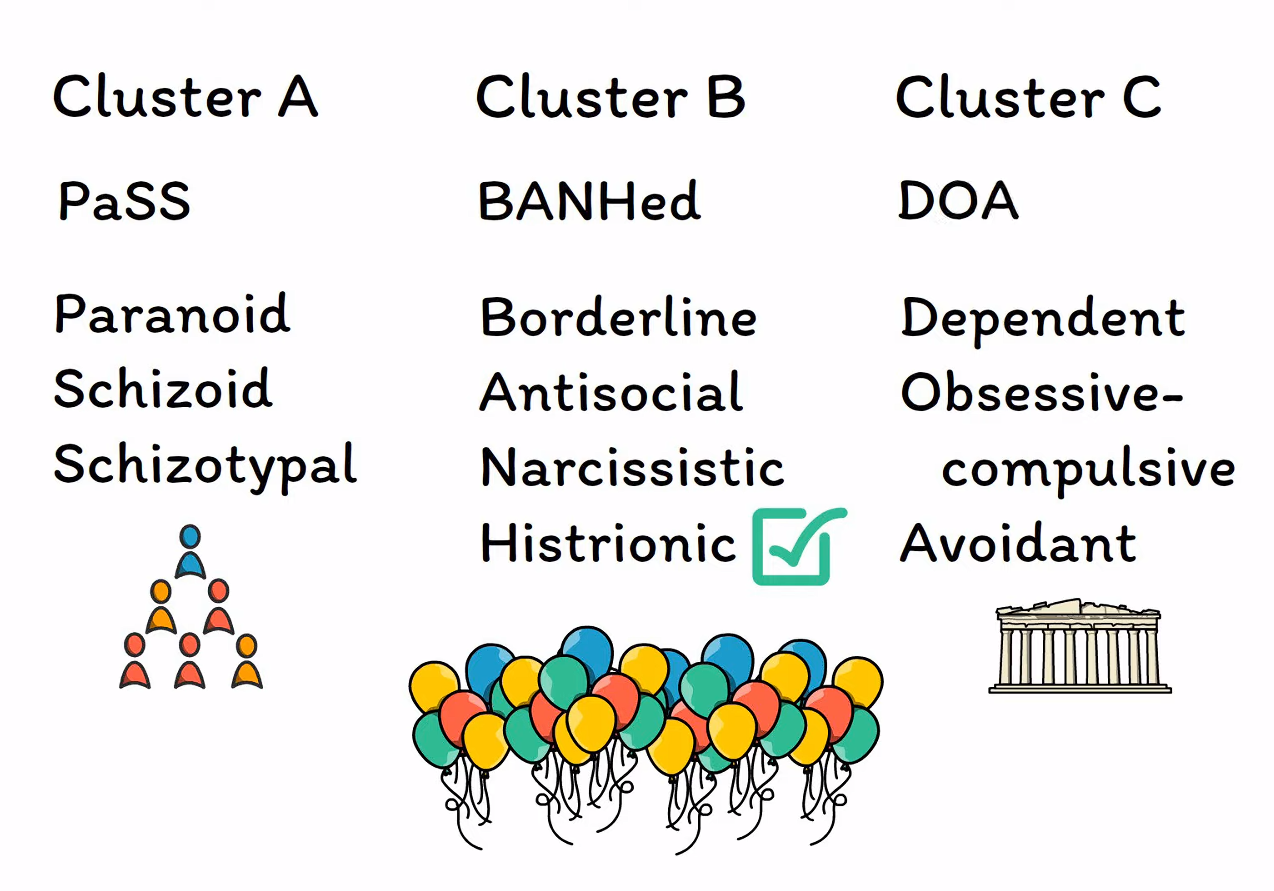
- Cluster A (weird) will pass the party
- Cluster B (wild) will come to the party, but they are likely getting banned from future parties
- Cluster C (worried) will come to the party, but the party will be dead on arrival, because they will drag down the spirit
Tip
Personality disorders are not diagnosed when the behavior is better explained by another mental disorder and are generally not diagnosed before age 18. c
Cluster A
Paranoid personality disorder
Don’t trust others, but do not involve specific delusions (eg, persistent false, fixed beliefs). c
Schizoid personality disorder
- Voluntary detachment from social relationships (e.g., family) t
- Comfortable with social isolation (unlike in avoidant personality disorder)
- The “schizo-” prefix is more of a historical artifact, reflecting an early conceptualization of profound social and emotional detachment as a form of “splitting” from the interpersonal world. It does not imply the presence of psychotic symptoms or a direct progression to schizophrenia in most cases. The key feature is a pervasive lack of interest in social interaction, not a distorted perception of reality.
Mnemonic
Schiz-avoid
Schizotypal personality disorder
Unusual/magical thoughts, perceptions & behavior, but no fixed delusions; Eccentric appearance c2
Cluster B
Antisocial and borderline tend to be severely socially disabling (e.g. cannot find a job or maintain a relationship), while histrionic and narcissistic are mild.
Borderline personality disorder
- It is called ‘borderline’ because doctors previously thought that it was on the border between two different disorders: neurosis and psychosis.
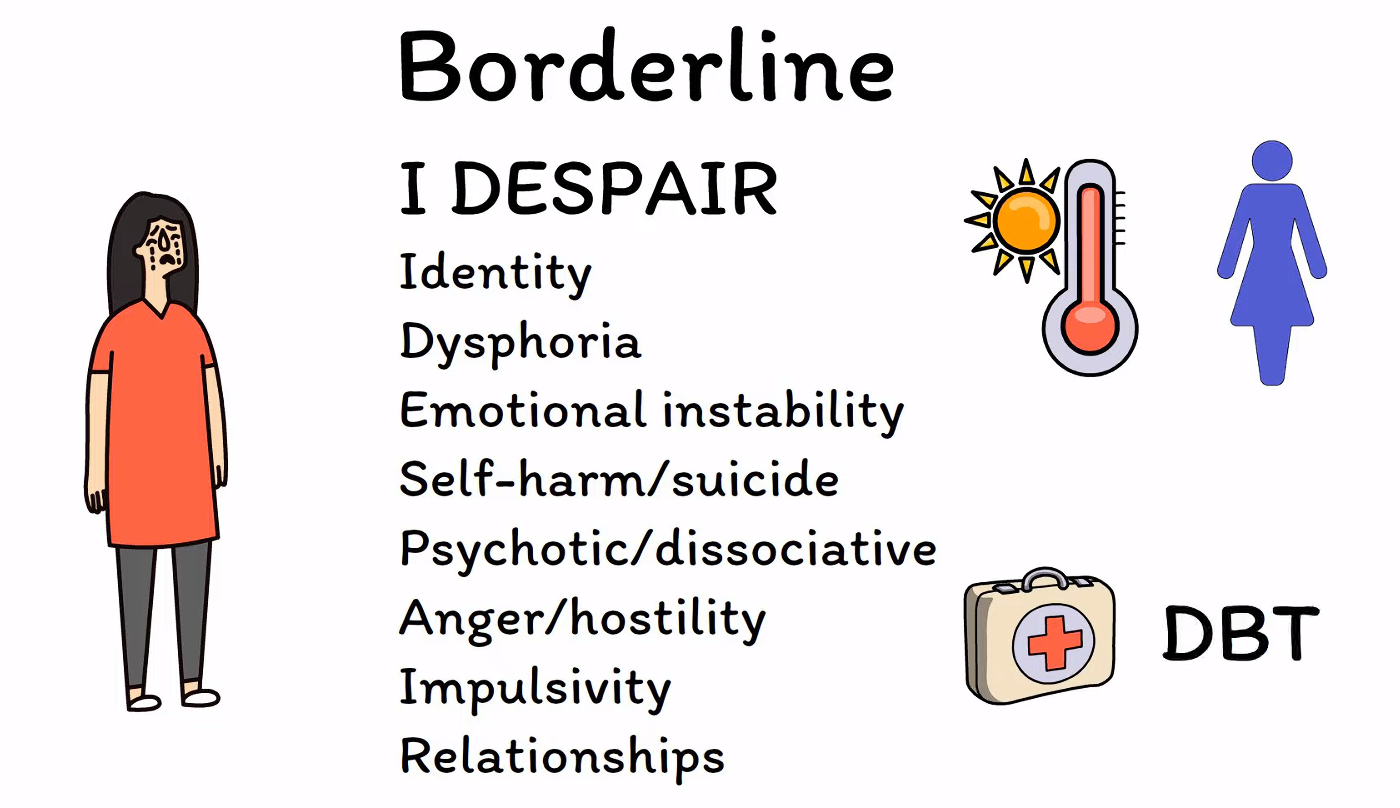
- Instability in interpersonal relationships, self-image, and affects; marked impulsivity.
- Frantic efforts to avoid real/imagined abandonment, chronic feelings of emptiness, intense anger.
- Recurrent suicidal threats/gestures and non-suicidal self-injury (NSSI, e.g., cutting).
- Often driven by abandonment fears
- Other features: splitting (psychiatry), a defense mechanism in which relationships are categorically good or bad
Mnemonic
Borders split countries.
Antisocial personality disorder
Clinical features
- Violates rights of others, social norms, laws
- Impulsive, irritable, aggressive (fights, assaults)
- Consistently irresponsible, lies, is deceitful
- Lack of remorse
- Age ≥18
- Evidence of conduct disorder before age 15 t
Differential diagnosis
- Borderline personality disorder (exploitative behaviors related to abandonment fears)
- Conduct disorder (pattern of violating societal norms & rights of others; age < 18)
- Narcissistic personality disorder (no pattern of violence or criminal activity)
Histrionic personality disorder
- Presentation: Excessive emotionality and attention-seeking. Often theatrical, sexually provocative, and easily influenced. Shallow, shifting, dramatic emotions. Considers relationships to be more intimate than they are. c
Narcissistic personality disorder
- Presentation: Grandiosity, need for admiration, and lack of empathy. Has a sense of entitlement and exploits others for personal gain. Fragile self-esteem, sensitive to criticism (“narcissistic injury”).
| Feature | Histrionic PD (HPD) | Narcissistic PD (NPD) |
|---|---|---|
| Core Need | Attention (any spotlight) | Admiration (status/superiority) |
| Self-Image | Not grandiose; easily influenced | Grandiose, entitled, unique |
| Affect | Theatrical, labile, shallow | Arrogant, cold; rage if slighted |
| Relationships | Overestimates intimacy; seductive | Exploitative; lacks empathy |
| Vignette Clue | Flamboyant dress; flirtatious with MD | Demands “the Chief of Medicine” |
| Tx | Psychotherapy (CBT) | Psychotherapy (CBT) |
Cluster C
- Avoidant: avoidance due to fears of criticism & rejection
- But they strongly desire relationships and social acceptance, different from schizoid c
- Dependent: submissive, clingy, needs to be taken care of
- Obsessive-compulsive: Preoccupation with orderliness, perfectionism, and mental/interpersonal control, at the expense of flexibility and efficiency. Often rigid, stubborn, and perfectionistic to the point that it interferes with task completion. Ego-syntonic nature c
Management Strategies & Doctor-Patient Communication
1. General Principles
- First-Line: Psychotherapy is the definitive treatment across all PDs.
- Dialectical Behavior Therapy (DBT): Treatment of choice for Borderline PD (focuses on emotional regulation, distress tolerance, mindfulness). c
- Cognitive Behavioral Therapy (CBT): Effective for Cluster C PDs and ASPD.
- Psychodynamic Psychotherapy: Effective for Cluster C and Histrionic PD.
- Pharmacotherapy: Adjunctive only.
- No FDA-approved drugs for personality disorders themselves.
- Used to manage comorbid psychiatric conditions (e.g., SSRIs for comorbid MDD/Anxiety; low-dose SGAs for transient micro-psychotic episodes in BPD/Schizotypal).
2. High-Yield Physician-Patient Interaction Scenarios
- Borderline PD:
- Risk: Splitting the medical team (praising one physician while vilifying another).
- Strategy: Set clear, firm, and consistent boundaries; schedule regular, structured follow-ups; maintain open team-wide communication.
- Paranoid PD:
- Risk: Accusing physician of deception or incompetence.
- Strategy: Maintain a professional, straightforward, non-defensive demeanor; provide detailed explanations and clear documentation.
- Histrionic PD:
- Risk: Boundary crossings, flirtatious behavior.
- Strategy: Maintain professional boundaries, use chaperone during PE, focus communication on objective medical facts.
- Narcissistic PD:
- Risk: Demanding “the best” doctor, demeaning staff.
- Strategy: Avoid direct confrontation or power struggles; acknowledge pt’s feelings while maintaining hospital policies and boundaries.
- Dependent PD:
- Risk: Demanding constant reassurance, excessive messaging/calls.
- Strategy: Avoid making decisions for the pt; encourage active participation in treatment plans; set defined communication limits.