Sleep physiology
Mnemonic
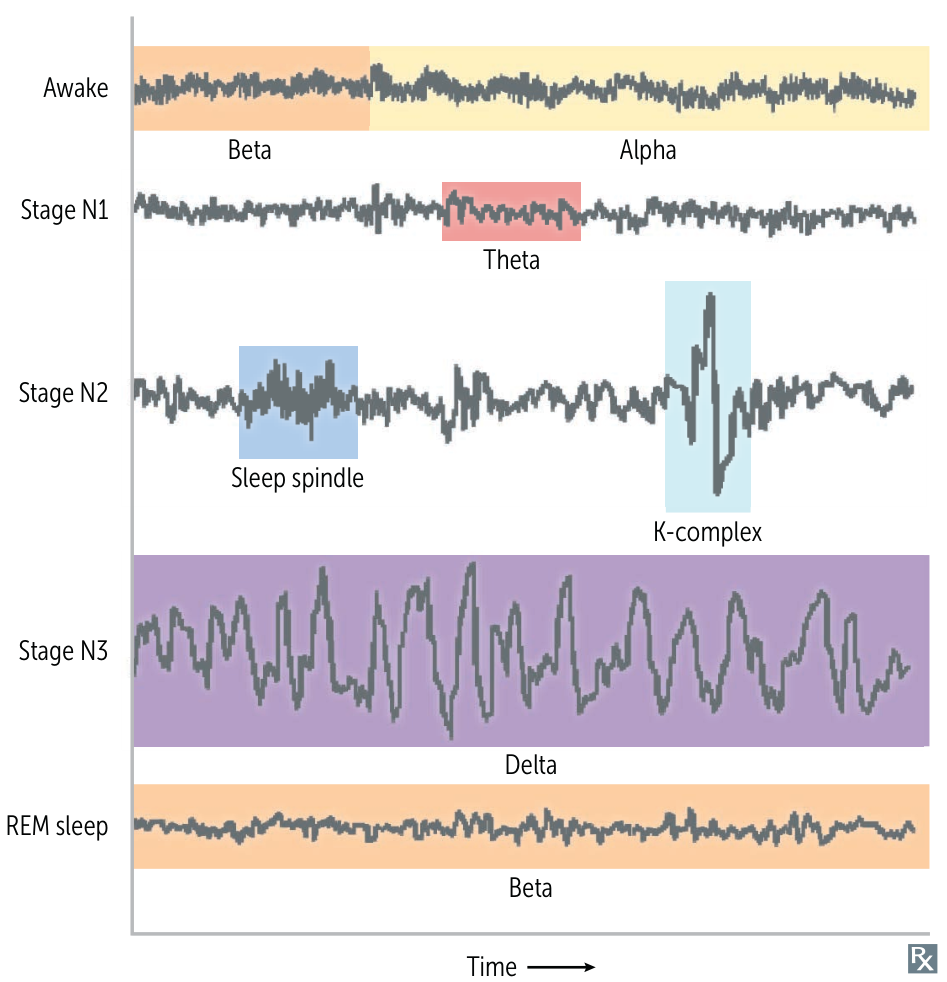
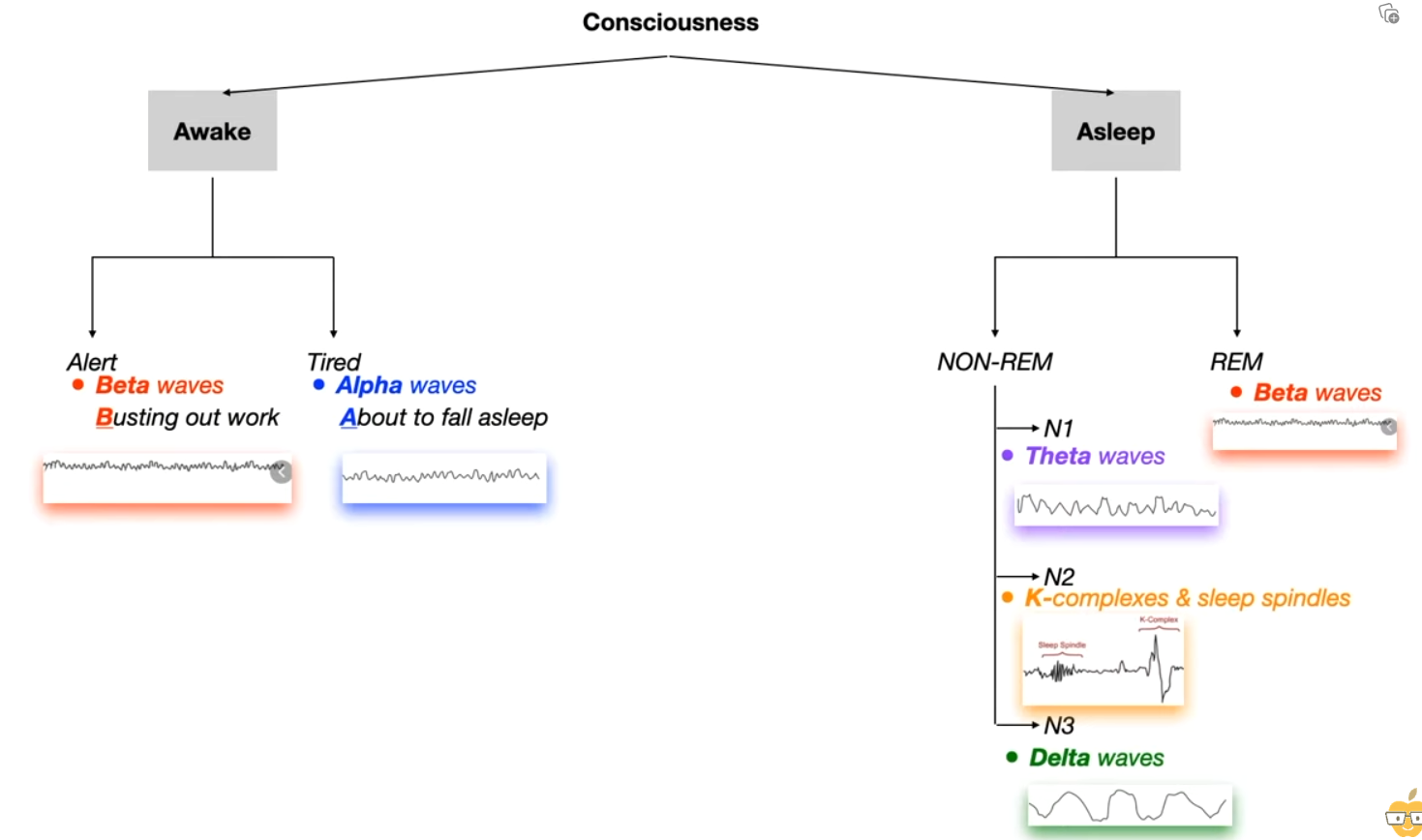
EEG waveforms: Beta, Alpha, Theta, Sleep spindle, Delta, Beta. At night, BATS Drink Blood.
Tip
Alert and REM are both Beta waves.
Non-REM (NREM) Sleep
- N1 (Light Sleep)
- EEG: Theta waves.
- Description: Transition from wakefulness to sleep (5% of total sleep). Very light sleep from which one is easily awakened.
- Physiology: Slow, rolling eye movements.
- N2 (Intermediate Sleep)
- EEG: Sleep spindles and K-complexes on a background of theta waves.
- Description: Largest percentage of total sleep time (~45-55%). Deeper sleep than N1.
- Key Associations: Bruxism (teeth grinding) often occurs during this stage.
- N3 (Deep Sleep / Slow-Wave Sleep)
- EEG: Delta waves (low frequency, high amplitude).
- Description: Deepest stage of sleep (~10-20% of total sleep), most difficult to awaken from. Most prominent in the first half of the night.
- The brain is “asleep” (high arousal threshold), but the motor system is not paralyzed, allowing for complex movements. This is why parasomnias like sleepwalking (somnambulism) and night terrors occur during N3.
- N3 sleep is considered the most physically restorative stage. During this time, the body focuses on repair and growth, such as tissue repair, bone and muscle building, and strengthening the immune system.
- Key Associations: Parasomnias such as somnambulism (sleepwalking), night terrors, and bedwetting (enuresis) occur here.
REM (Rapid Eye Movement) Sleep
- EEG: Beta waves (high frequency, low amplitude), similar to the awake state; “sawtooth waves” are also characteristic.
- Description: “Paradoxical sleep” as the brain is highly active while the body is immobile (~20-25% of total sleep). Duration of REM periods increases with each cycle throughout the night.
- Not the “Deepest”: Although you are paralyzed, your arousal threshold during REM sleep is actually lower than in N3 sleep. It is generally easier to wake someone from REM sleep. When awakened from REM, people often feel alert and can vividly recall their dreams, unlike the grogginess (“sleep inertia”) experienced when woken from N3.
- Physiology:
- Rapid eye movements.
- Atonia: Generalized muscle paralysis (except for extraocular muscles and diaphragm). This is protective, preventing one from acting out dreams.
- Vivid dreaming and nightmares occur.
- Variable heart rate and blood pressure, penile/clitoral tumescence.
- Key Associations:
- Important for memory consolidation.
- Depression is associated with increased total REM sleep and decreased REM latency (earlier onset of REM).
- REM sleep behavior disorder: Loss of atonia leads to dream enactment (e.g., punching, kicking).
Mnemonic
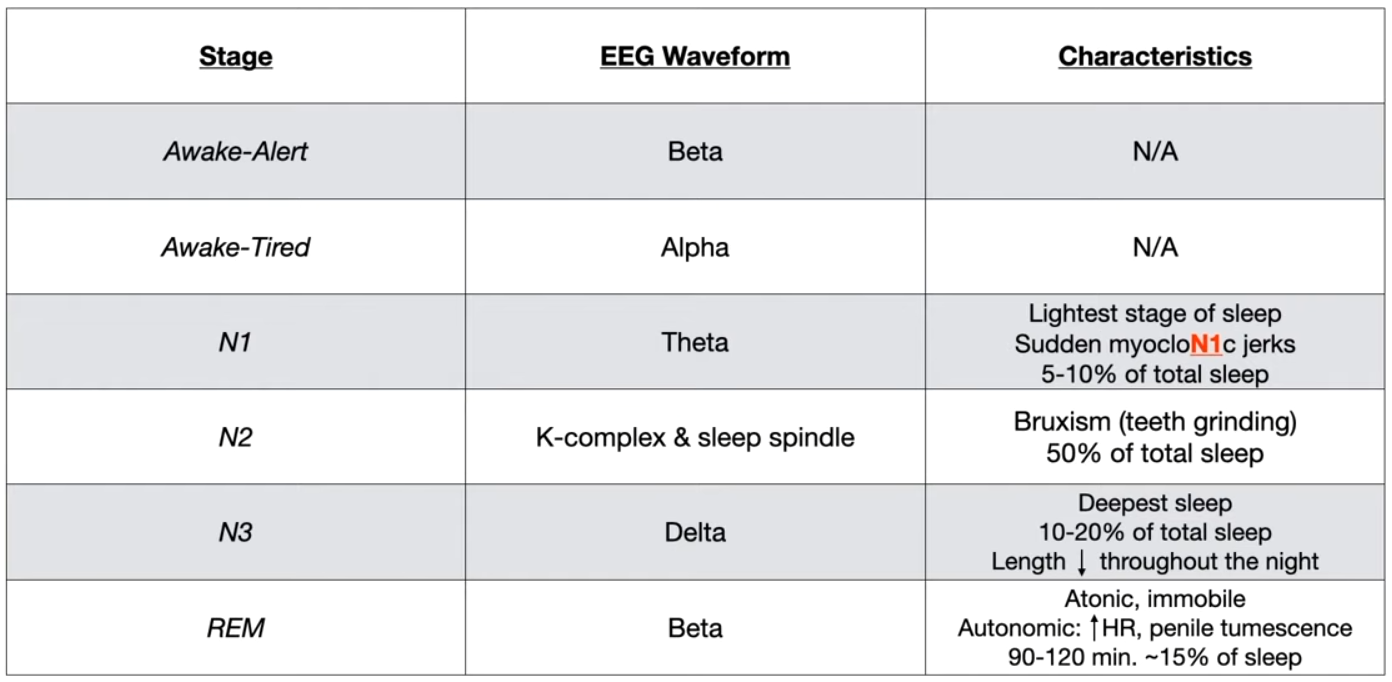
- In REM stage, B for Beta and Boner.
- REMember your dream
- REMain still (so you won’t act like in dreams)
- To remember K complex and Sleep Spindle is N2
- It takes ‘2’ to “KiSS” (also note that kissing involves mouth and hence teeth=Teeth grinding)
- Delta for Deepest sleep
Mnemonic
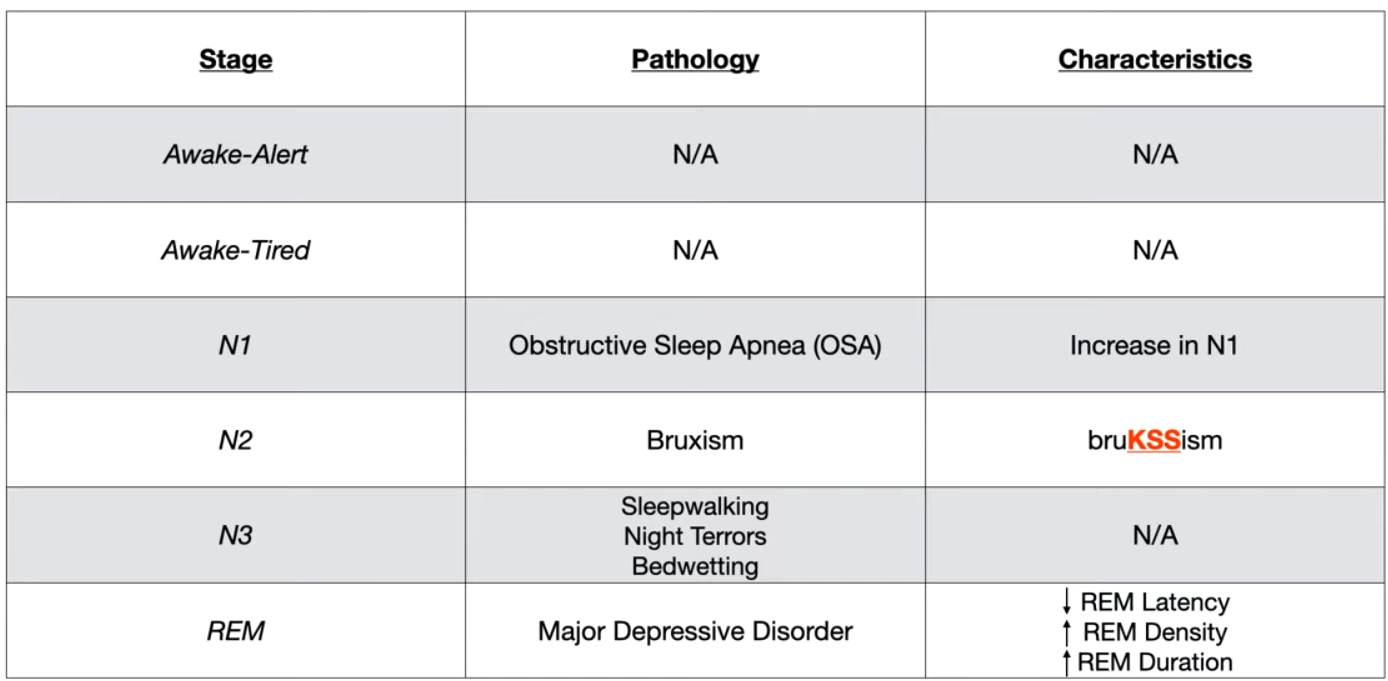
- N1: Obstructive Sleep ApN1a
- N3: wee and flee in N3
- REM: In MDD you have less fine, deep sleep (N3), more REM.
Tip
- Obstructive sleep apnea
- Leads to an increased percentage of N1 sleep
- Because the frequent arousals prevent the individual from consolidating deeper stages of sleep (N2, N3/slow-wave sleep, and REM sleep).
- The most severe individual apnea/hypopnea events (longest duration, greatest oxygen desaturation) are most likely to occur during REM sleep
- Because of loss of muscle tone (atonia) in REM
Sleep disorders
Dyssomnias (Disorders of Sleep Amount/Timing)
Obstructive Sleep Apnea (OSA)
- Patho: Upper airway collapse → apnea/hypopnea → hypoxia.
- Presentation: Obese patient (BMI > 30), excessive daytime sleepiness, loud snoring, morning headaches.
- Dx: Polysomnography.
- Tx: CPAP is first-line; weight loss.
- Complications: Systemic HTN, pulmonary HTN, arrhythmias.
Narcolepsy
- Patho: ↓ Orexin (hypocretin) from lateral hypothalamus.
- Presentation: Excessive daytime sleepiness, cataplexy (sudden muscle tone loss with strong emotion), hypnagogic/hypnopompic hallucinations, sleep paralysis.
- Dx: Multiple Sleep Latency Test (MSLT) shows ↓ sleep latency and sleep-onset REM.
- Tx: Modafinil for sleepiness; SSRIs/SNRIs for cataplexy.
Restless Legs Syndrome (RLS)
- Patho: Associated with iron deficiency and CNS dopamine dysfunction.
- Presentation: Overwhelming urge to move legs, worse at night/rest, relieved by movement.
- Dx: Clinical; check ferritin.
- Tx: Treat iron deficiency. First-line drugs are alpha-2-delta ligands (e.g., Gabapentin) or dopamine agonists (e.g., Pramipexole).
Circadian rhythm sleep-wake disorders
- Pathophysiology:
- Misalignment between the endogenous circadian clock (regulated by the suprachiasmatic nucleus [SCN] of the anterior hypothalamus) and the external 24-hour environment.
- Subtypes & Clinical Presentation:
- Delayed Sleep-Wake Phase Disorder (DSWPD): c
- Typical in adolescents and young adults.
- Inability to sleep until early morning (2:00 AM – 6:00 AM) with severe morning grogginess.
- Hallmark: Normal sleep duration and quality when allowed to sleep on preferred schedule (e.g., weekends/vacations).
- Advanced Sleep-Wake Phase Disorder (ASWPD):
- Typical in older adults / elderly.
- Inability to stay awake in early evening (6:00 PM – 9:00 PM) with early morning awakenings (2:00 AM – 5:00 AM).
- Shift Work Disorder:
- Associated with night or rotating shifts.
- Excessive daytime sleepiness (EDS) during working hours and daytime insomnia at home.
- Non-24-Hour Sleep-Wake Rhythm Disorder:
- Common in totally blind individuals (loss of light perception to reset the SCN).
- Free-running endogenous clock (~24.5 hours) causing progressive daily shifts in sleep-wake times.
- Jet Lag Disorder:
- Rapid travel across ≥ 2 time zones; eastward travel is more severe/slower to adjust than westward.
- Delayed Sleep-Wake Phase Disorder (DSWPD): c
- Diagnosis:
- Initial: Sleep log/diary for ≥ 1–2 weeks.
- Confirmatory / Objective: Wrist actigraphy (≥ 14 days) showing consistent phase shift or free-running cycle.
- Polysomnography (PSG): Not indicated routinely; only used to rule out comorbid Obstructive Sleep Apnea (OSA).
- High-Yield Differentials:
- Chronic Insomnia: Sleep is impaired regardless of timing or setting (does not normalize on weekends).
- OSA: Snoring, daytime somnolence, elevated BMI; confirmed by PSG (AHI ≥ 5).
- Narcolepsy: Characterized by cataplexy, sleep paralysis, and hypnagogic hallucinations; diagnosed via MSLT.
- Management:
- DSWPD: Morning bright light therapy upon waking + low-dose melatonin in early evening (4–5 hours prior to desired bedtime).
- ASWPD: Evening bright light therapy (7:00 PM – 9:00 PM); avoid bright light in early morning.
- Shift Work Disorder: Strategic pre-shift naps, dark sunglasses during morning commute home; Modafinil / Armodafinil for refractory EDS on shift.
- Non-24-Hour Disorder: Fixed nightly melatonin or Tasimelteon (melatonin receptor agonist).
- Jet Lag: Timed light exposure and low-dose melatonin at local destination bedtime.
- Complications:
- Motor vehicle collisions (MVCs) and occupational errors secondary to microsleeps.
- Comorbid secondary depression, anxiety, and alcohol/sedative self-medication.
- Increased long-term risk of metabolic syndrome, DM2, and cardiovascular disease (especially in shift work).
Parasomnias (Abnormal Events During Sleep)
NREM Parasomnias
- Occur during N3 (deep) sleep; person is difficult to arouse and has no memory of event. More common in children.
- Sleep Terrors: Abrupt screaming/fear, inconsolable.
- Sleepwalking (Somnambulism): Motor activity during sleep.
REM Parasomnias
- Occur during REM sleep; person can be aroused and often recalls the event.
- Nightmare Disorder: Frightening dreams followed by full alertness upon waking.
- REM Sleep Behavior Disorder (RBD): Dream-enactment behavior due to lack of muscle atonia. Strong predictor for future α-synucleinopathies (e.g., Parkinson disease).
Parasomnias
Sleep terror disorder
- Epidemiology & Triggers:
- Typical age: 4–12 yo (resolves by puberty). c
- Triggers: Sleep deprivation, fever, acute illness, emotional stress, underlying OSA.
- Clinical Presentation: c2
- Timing: First third of the night during Stage N3 sleep (slow-wave/deep NREM).
- Episode: Abrupt arousal with a piercing scream/cry, motor agitation, and intense autonomic hyperactivity (tachycardia, tachypnea, diaphoresis, mydriasis).
- Behavior: Inconsolable, unresponsive to parents; do not attempt to awaken (worsens agitation).
- Post-episode: Rapid return to sleep; complete amnesia for the event (no dream recall).
- Key Differential (High-Yield NBME Distinction):
- Nightmare Disorder: Occurs during REM sleep (second half of night); patient awakens fully alert, is consolable, and has vivid dream recall.
- Nocturnal Seizures: Stereotyped motor patterns, multiple events per night, abnormal EEG.
- RBD: Dream enactment behavior in older adults (>50 yo) during REM sleep; linked to Parkinson disease/synucleinopathies.
- Diagnosis:
- Clinical diagnosis (sleep diary).
- PSG is not routine; indicated only to rule out seizures or OSA if presentation is atypical.
- Management:
- First-line: Parental reassurance (benign, self-limiting) + safety precautions (secure windows/doors, clear room of hazards) + optimize sleep hygiene (avoid sleep deprivation). c
- Second-line (frequent episodes): Scheduled awakenings 15–30 min prior to typical episode onset.
- Refractory/Severe (rare): Short course of low-dose benzodiazepines (e.g., clonazepam) at bedtime to suppress Stage N3 sleep.
Nightmare disorder
- Core Characteristics:
- Occurs during REM sleep in the second half of the night.
- Features vivid, frightening dreams focused on survival/safety threats.
- Awakening results in immediate alertness and orientation (no postictal/confusional state).
- Pt exhibits detailed recall of the dream content. c
- Motor activity is absent due to normal intact REM atonia.
- Triggers & Risk Factors:
- Prevalence: High in children (3–6 yrs); can persist or develop in adulthood.
- Strongest association with PTSD, acute stress, and mood disorders.
- Meds/Withdrawal: Beta-blockers, cholinesterase inhibitors, and alcohol/sedative withdrawal (REM rebound).
REM sleep behavior disorder
- Definition: a REM-related parasomnia characterized by dream enactment due to loss of REM sleep atonia
- Epidemiology
- Sex: ♂ > ♀
- Usually in older patients (> 50 years)
- Risk factors
- Narcolepsy
- Psychiatric medications (e.g., antidepressants)
- Neurodegenerative disorders (e.g., Parkinson disease, Lewy body dementia)
- Clinical features
- Physically acting out dreams during sleep (e.g., yelling, moving limbs, walking, punching), sometimes leading to injury to self or others
- Patient is alert and orientated after awakening, and remembers the dream.
- Prognosis: Most patients with idiopathic RBD eventually develop a disorder of α-synuclein neurodegeneration, most commonly Parkinson disease. c