Epidemiology & Risk Factors

  • Most common disorder of heme biosynthesis; due to deficiency/inhibition of hepatic uroporphyrinogen decarboxylase (UROD).
    • Type 1 (Sporadic, ~80%): Acquired hepatic UROD inhibition triggered by iron overload, HCV, alcohol, or estrogens.
    • Type 2 (Familial, ~20%): Autosomal dominant mutation with reduced penetrance; affects UROD in all tissues.
  • Strong associations (must screen for these):

Clinical Features

  • Cutaneous Photosensitivity:
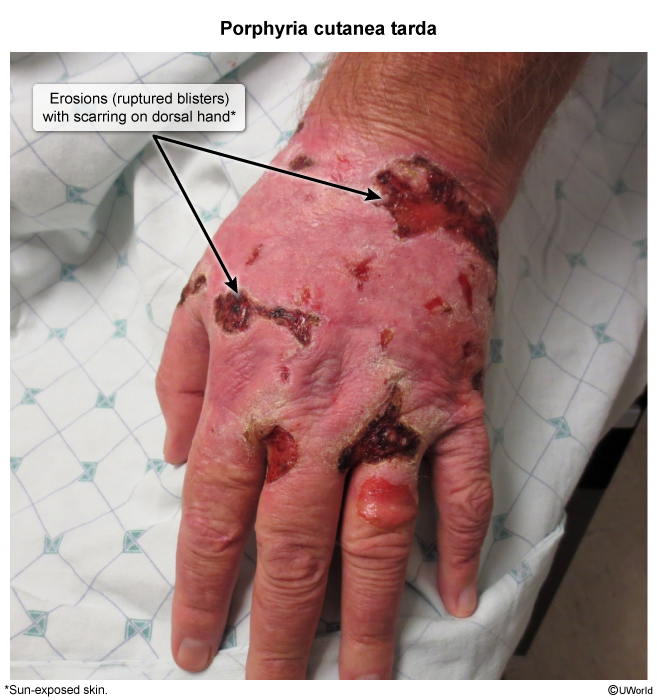
    • Painless vesicles, bullae, and skin fragility on sun-exposed areas (dorsum of hands, forearms, face, neck).
    • Minor trauma triggers erosions, ulcerations, and crusting.
    • Heals with scarring and milia (small white keratinous cysts).
  • Chronic Skin Changes:
    • Facial hypertrichosis / hirsutism (malar/temporal areas).
    • Hyperpigmentation and sclerodermoid (thickened) skin plaques.
  • Urine Changes:
    • Tea-colored or reddish-brown urine (darkens further upon exposure to sunlight/air).
  • Note: Lack of neurovisceral symptoms (no acute abdominal pain or psychosis, distinguishing it from acute porphyrias).

Diagnosis

  • Initial / Screening Test:
    • Total urinary and plasma porphyrins (elevated).
    • Wood’s lamp examination of urine: Displays coral-red fluorescence (due to uroporphyrins).
  • Confirmatory / Gold Standard:
    • Fractionated plasma/urine/fecal porphyrin assay: Shows marked elevation of uroporphyrin (isomer I & III) and heptacarboxyl porphyrin.
  • Essential Secondary Workup (Mandatory in all new diagnoses):
    • HCV Ab and RNA, HIV serology.
    • Iron studies (serum iron, ferritin, TIBC, transferrin saturation) ± HFE genetic testing.
    • LFTs (transaminases, bilirubin).
  • Skin Biopsy (rarely required, done if diagnosis is uncertain):
    • Subepidermal bullae with minimal inflammatory infiltrate and cell-free festooning of dermal papillae.

Differential Diagnostics

  • Pseudoporphyria:
    • Diff by identical clinical lesions but normal urine/plasma porphyrins.
    • Triggered by medications (e.g., naproxen, tetracyclines, furosemide) or chronic hemodialysis.
  • Acute Intermittent Porphyria (AIP):
    • Diff by acute neurovisceral attacks (5 Ps: Painful abdomen, Polyneuropathy, Psychological disturbances, Port-wine urine, Precipitated by drugs/fasting) and NO cutaneous blisters; elevated urinary PBG and ALA.
  • Variegate Porphyria (VP) / Hereditary Coproporphyria (HCP):
    • Diff by presence of both cutaneous blisters and acute neurovisceral attacks; confirmed by fecal porphyrin fractionation (elevated coproporphyrin/protoporphyrin).
  • Bullous Pemphigoid (BP):
    • Diff by tense bullae on normal or erythematous skin (generalized, not sun-limited), pruritus, and direct immunofluorescence (DIF) showing linear IgG/C3 at the dermoepidermal junction; normal porphyrins.
  • Pemphigus Vulgaris (PV):
    • Diff by flaccid bullae, (+) Nikolsky sign, prominent mucosal involvement, and intraepidermal acantholysis; normal porphyrins.

Management

  1. General & Preventive Measures:
    • Strict sun avoidance, broad-spectrum sunscreen (physical blockers like zinc oxide/titanium dioxide), and protective clothing.
    • Complete cessation of alcohol and smoking.
    • Discontinuation of exogenous estrogens (OCPs/HRT).
  2. First-Line Targeted Therapy:
    • Serial Phlebotomy: First-line for pts with iron overload or elevated ferritin; removes hepatic iron stores (target ferritin: 20–50 ng/mL).
    • Low-Dose Antimalarials (Hydroxychloroquine or Chloroquine):
      • Used if phlebotomy is contraindicated (e.g., severe anemia, advanced cardiac disease) or as alternative first-line.
      • Low dose only (e.g., hydroxychloroquine 100 mg twice weekly); high doses can induce acute hepatotoxicity.
  3. Treatment of Underlying Triggers:
    • Direct-acting antivirals (DAAs) for HCV.
    • Antiretroviral therapy (ART) for HIV.
    • Iron chelation (e.g., Deferasirox) if phlebotomy is contraindicated in hemochromatosis.
Complications

  • Secondary bacterial skin infections (cellulitis, impetigo).
  • Permanent scarring, dyspigmentation, and alopecia.
  • Increased long-term risk of Hepatocellular Carcinoma (HCC) (driven by concurrent HCV, iron overload, and chronic hepatic injury).