Epidemiology

  • Peak incidence: older male individuals (70-80 y)
  • Zenker diverticulum is the most common type.

Etiology


Pathophysiology

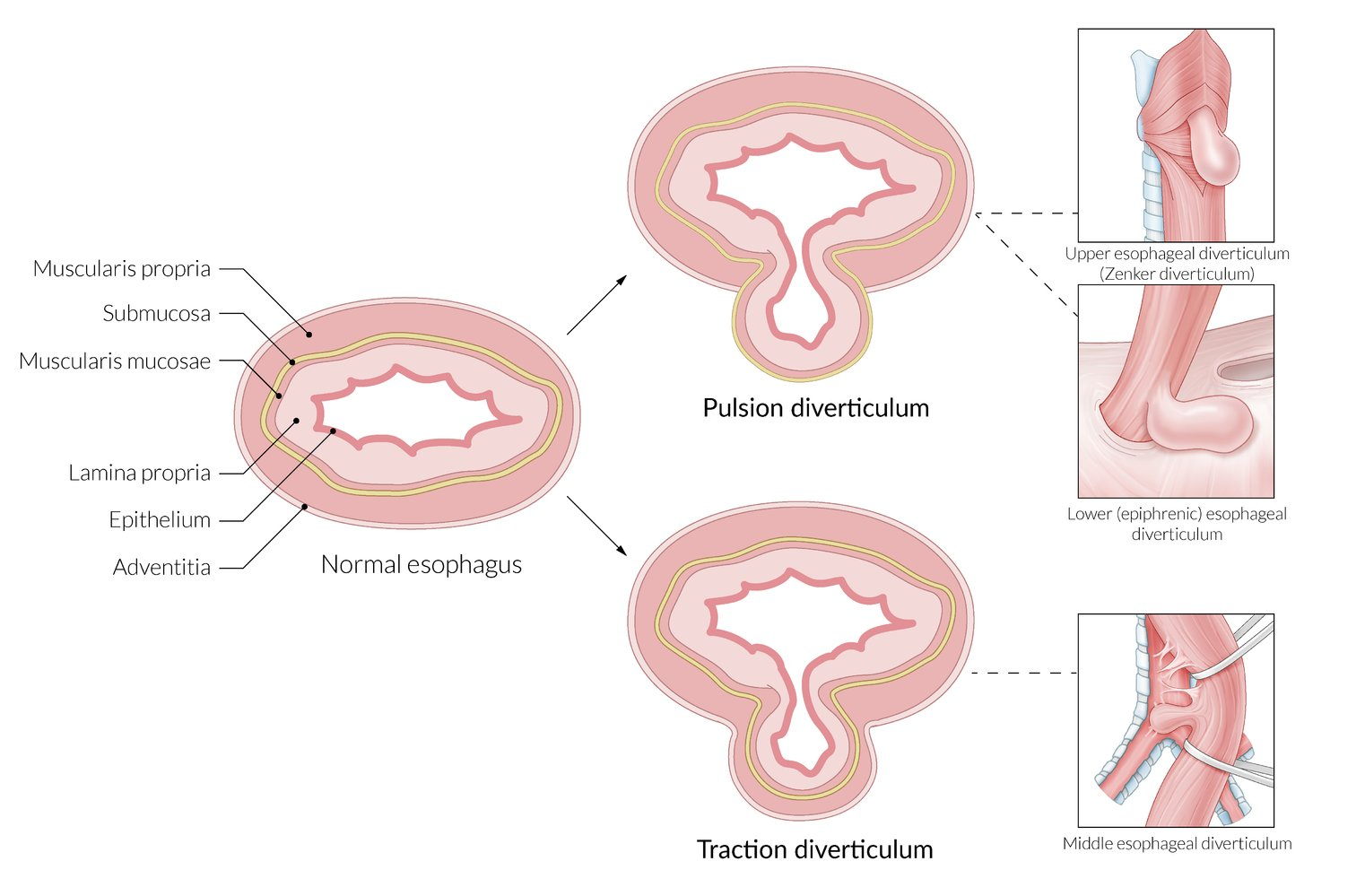
  • Classified by location and mechanism (pulsion vs. traction)
  • Zenker Diverticulum (Pharyngoesophageal)
    • Most common type
    • Pulsion diverticulum (↑ intraluminal pressure)
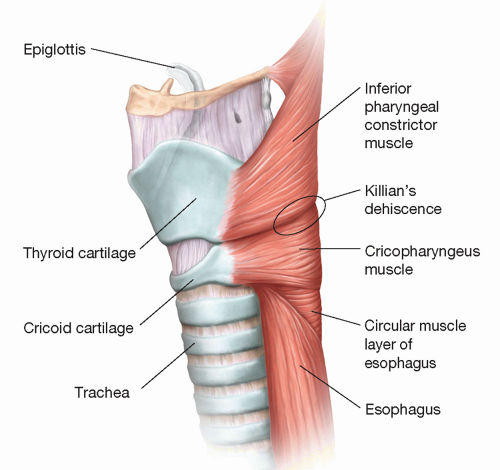
    • Location: Killian triangle (between thyropharyngeus and cricopharyngeus muscles) - posterior hypopharynx
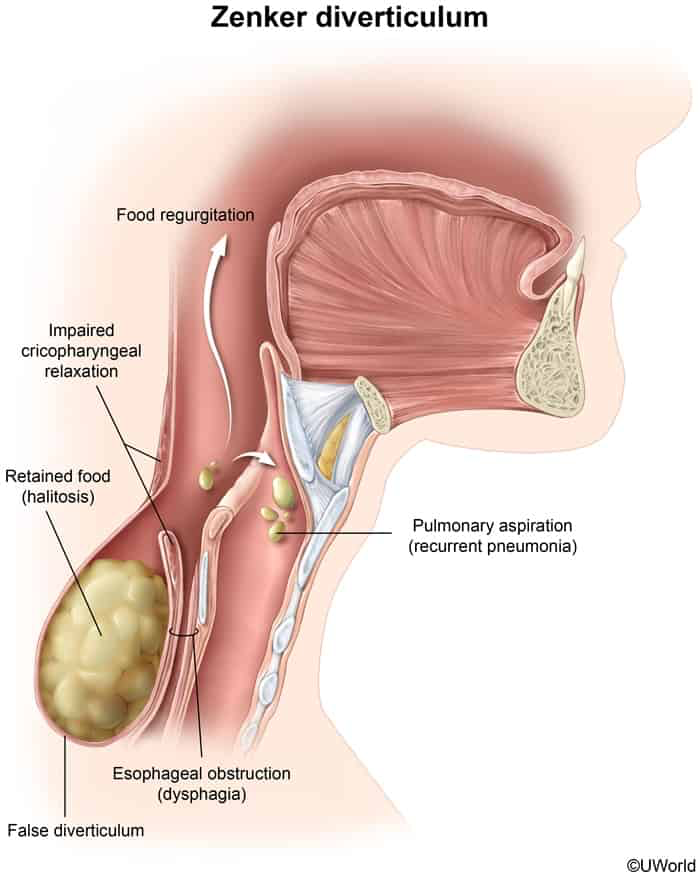
    • Pathophysiology: Failure of cricopharyngeus muscle relaxation → ↑ pressure → herniation through weak point
    • False diverticulum (mucosa/submucosa only, no muscle layer)
  • Traction Diverticulum (Mid-esophageal)
    • Less common
    • Caused by external pulling forces (e.g., mediastinal inflammation, granulomatous disease like TB or histoplasmosis)
    • Location: Mid-esophagus near carina
    • True diverticulum (all layers of esophageal wall)
    • Usually asymptomatic
  • Epiphrenic Diverticulum (Distal esophageal)


Clinical features

  • Zenker: Dysphagia, halitosis, regurgitation of undigested food, gurgling sounds, neck mass, aspiration risk c
  • Traction: Often asymptomatic
  • Epiphrenic: Dysphagia, chest pain, regurgitation

Diagnostics

  • Barium swallow with videofluoroscopy (best initial test)

Treatment

  • Zenker’s Diverticulum (Symptomatic):
    1. Surgery: Treatment of choice.
      • Cricopharyngeal myotomy (essential to relieve the high-pressure outflow obstruction).
      • Combined with diverticulectomy (excision of pouch) or diverticulopexy (suspension of pouch to prevent food stasis).
      • Can be performed via open cervical approach or minimally invasive endoscopic stapling (rigid or flexible).
    2. Asymptomatic Zenker’s: Observation/conservative monitoring if small (<2 cm).
  • Mid-esophageal & Epiphrenic Diverticula:
    1. First-line: Treat the underlying etiology (e.g., anti-mycobacterial therapy for active TB; myotomy/balloon dilation for underlying motility disorders like achalasia).
    2. Surgical Excision: Reserved for severe, refractory symptoms (dysphagia, severe chest pain, recurrent aspiration).