Atrophy of inhibitory neurons in the Auerbach plexus → lack of inhibitory neurotransmitters (e.g., NO, VIP) → inability to relax and increased resting pressure of the LES, as well as dysfunctional peristalsis → esophageal dilation proximal to LES
The myenteric plexus is a collection of enteric ganglia located between the inner circular and outer longitudinal muscle layers.
Clinical features
Diagnostics
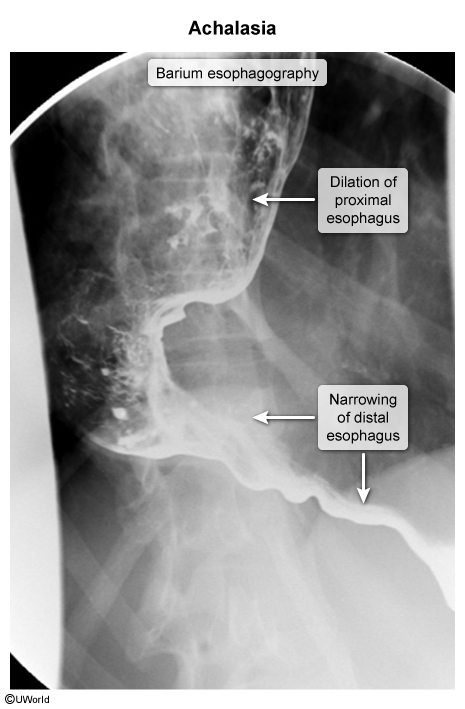
Initial Test: Barium esophagram
Findings: Smooth, symmetric tapering at the gastroesophageal junction (“bird’s beak” sign), dilated proximal esophagus, pooling/stasis of contrast, loss of peristalsis.
Laparoscopic Heller Myotomy: Surgical division of LES muscle fibers; typically combined with partial fundoplication (Dor or Toupet) to prevent post-op GERD. Preferred in young patients (<40–45 yrs).
Pneumatic Balloon Dilation: Disruption of circular muscle fibers by balloon expansion. High efficacy; risk of esophageal perforation (~2–3%).
High Surgical Risk / Poor Procedural Candidates (Second-line):
Endoscopic Botulinum Toxin Injection: Inhibits acetylcholine release at the LES. Effective short-term (~6–12 months); requires repeat injections. Induces scarring that complicates future myotomy.
Refractory / Medical Therapy (Last resort / Bridge):
Oral smooth muscle relaxants before meals: Calcium channel blockers (e.g., nifedipine) or long-acting nitrates (e.g., isosorbide dinitrate). Limited efficacy; high rates of hypotension and headache.