Epidemiology


Etiology


  • Defect in the interatrial septum allowing communication between left and right atria.
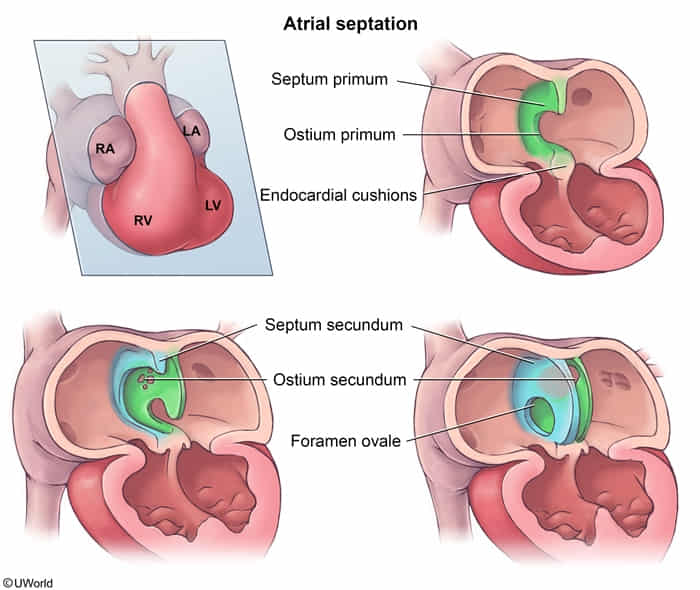
  • Ostium Secundum: Most common type (approx 75%). Defect in central septum.
  • Ostium Primum: Associated with Down syndrome (endocardial cushion defects). Defect in lower septum.
  • Sinus Venosus: Associated with anomalous pulmonary venous return. Defect near SVC/IVC entry.

Pathophysiology


Clinical features


  • Infants/Children: Often asymptomatic; may have FTT or recurrent URIs (rare).
  • Adults (3rd-4th decade): Dyspnea on exertion, fatigue, palpitations (AFib/AFL).
  • Physical Exam:
    • Fixed Split S2: Pathognomonic; delayed pulmonic valve closure due to constant ↑ RV volume regardless of respiration.
    • Mid-systolic murmur: LUSB (pulmonic area) due to ↑ flow across pulmonic valve (not across ASD itself).
      • Relative pulmonary stenosis due to an increase in stroke volume. Not due to the defect! t
    • Mid-diastolic rumble: LLSB (tricuspid area) due to ↑ flow across tricuspid valve.
    • RV heave: Precordial impulse due to RV volume overload/hypertrophy.

Diagnostics


  • InitialTransthoracic Echocardiogram (TTE) w/ Doppler (shows RA/RV dilation, L→R shunt).
  • ConfirmatoryTransesophageal Echocardiogram (TEE); superior for visualizing sinus venosus defects or for pre-op planning.
  • Gold Standard (Rarely needed): Cardiac catheterization (measures Shunt Fraction/Qp:Qs).
  • Ancillary:
    • ECG: RBBB c, Right Axis Deviation (RAD). (Primum defects show Left Axis Deviation/LAD).
      • The physical stretching/dilation of the RV wall stretches the structural fibers of the right bundle branch. Furthermore, the increased RV muscle mass takes longer to depolarize. This mechanical stretch and increased transit time delay the electrical signal through the right ventricle, manifesting as a conduction block (RBBB).
    • CXR: Cardiomegaly (RA/RV), prominent pulmonary arteries, ↑ pulmonary vascular markings.
    • Bubble Study: IV saline contrast; microbubbles seen crossing from LA to RA (especially during Valsalva or if R→L shunt develops).

Treatment


Complications

  • Eisenmenger Syndrome: Chronic volume overload Pulmonary HTN RV hypertrophy Shunt reversal (Right-to-Left). Result: Cyanosis, clubbing, polycythemia. Rare in treated ASD.
  • Right Heart Failure.
  • Atrial Arrhythmias (e.g., Atrial Fibrillation) due to RA dilation.