- Definition: failure of one or both testicles to descend to their natural position in the scrotum
- Testes normally complete their descent into the scrotum by the 4th month of life.
Epidemiology
Etiology
Pathophysiology
Inguinal testis: The testicle is located between the external and internal inguinal ring, preventing adequate mobilization (90% of cases).
Clinical features
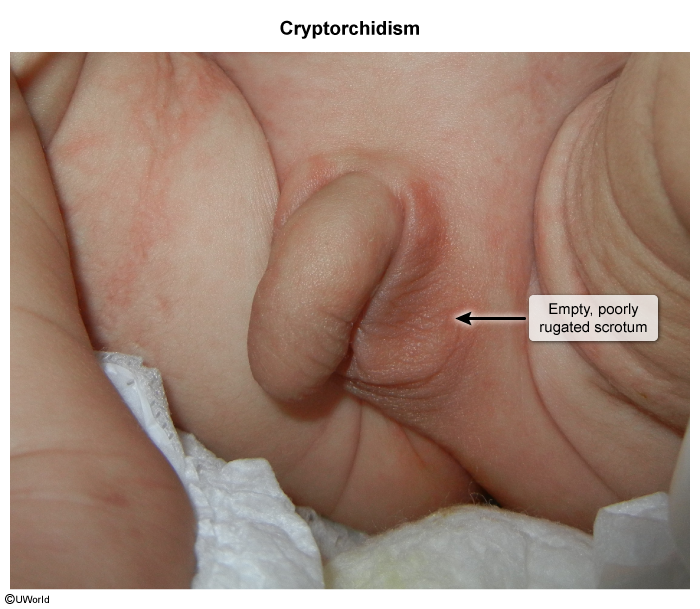
Diagnostics
- Laboratory tests
- Testosterone
- Bilateral cryptorchidism: ↓ testosterone levels
- Unilateral cryptorchidism: normal levels (normal Leydig cell function)
- ↓ Inhibin B
- ↑ FSH, ↑ LH
- Testosterone
Treatment
- Observation:
- Monitor until 6 months of age (corrected for gestational age); spontaneous descent unlikely thereafter.
- First-Line (Definitive):
- Orchiopexy: Recommended between 6 and 12 months of age (definitely completed before 18 months).
- Palpable testis: Inguinal orchiopexy.
- Nonpalpable testis: Diagnostic laparoscopy + laparoscopic orchiopexy (staged Fowler-Stephens if short testicular vessels) vs orchiectomy (if dysplastic/atrophic).
- Early surgery optimizes fertility potential, reduces testicular cancer risk, facilitates future self-examination, and repairs associated patent processus vaginalis.
- Orchiopexy: Recommended between 6 and 12 months of age (definitely completed before 18 months).
- Second-Line / Hormonal Therapy:
- Hormonal therapy (hCG or GnRH agonists) is NOT recommended due to poor long-term efficacy and potential adverse effects on spermatogenesis.
- Post-Pubertal / Adult Presentation:
- Orchiectomy is preferred over orchiopexy for post-pubertal presentation with an atrophic or nonfunctioning undescended testis (due to high malignancy risk and negligible spermatogenic function).
Complications
- Testicular cancer (germ cell tumors): The risk of testicular cancer is not eliminated by surgery. c
- Cryptorchidism may reflect abnormal fetal testicular/germ-cell development
- Orchiopexy prevents further heat-related injury but cannot erase damage accumulated before surgery.
- Infertility: higher temperature of the abdominal cavity is suboptimal for spermatogenesis → oligospermia → infertility
- Testicular torsion
- Inguinal hernia