Epidemiology
Etiology
Pathophysiology
- Tetanospasmin: reaches the CNS through retrograde axonal transport
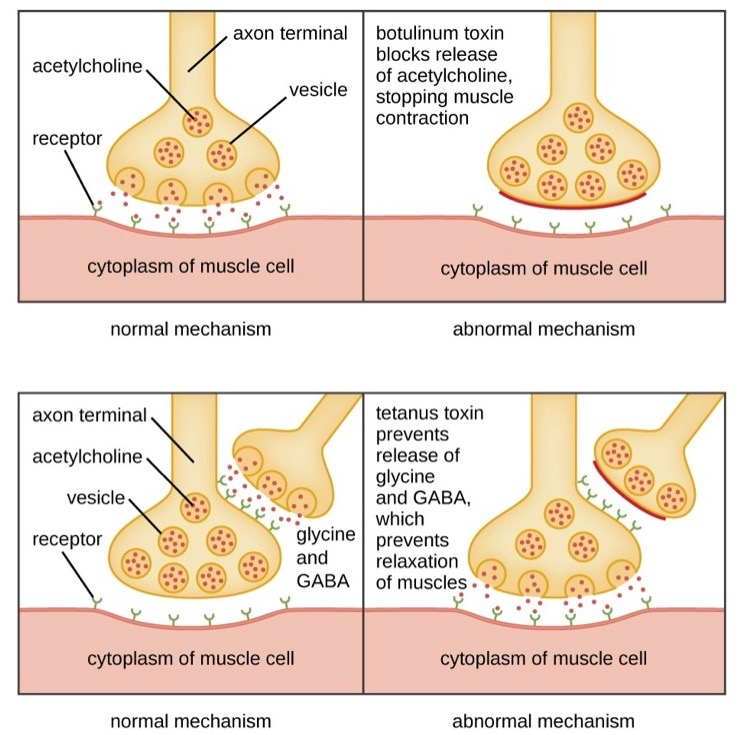
- Toxin binds to receptors of peripheral nerves and is then transported to interneurons (Renshaw cells) in the CNS via vesicles.
- Acts as protease that cleaves synaptobrevin, a SNARE protein → prevention of inhibitory neurotransmitters (i.e., GABA and glycine) release from Renshaw cells in the spinal cord → uninhibited activation of alpha motor neurons → muscle spasms, rigidity, and autonomic instability
- Tetanolysin: causes hemolysis and has cardiotoxic effects
Tetanus vs botulism
Both work on SNARE proteins
Clinical features
- Incubation period: Days to weeks.
- Presents with a descending pattern of muscle rigidity.
- Early signs:
- Trismus (lockjaw): Spasm of masseter muscles. c
- Risus sardonicus: “Sardonic smile” from facial muscle spasm.
- Later signs:
- Opisthotonos: Arching of the back due to severe extensor muscle spasm.
- Painful, generalized muscle spasms, often triggered by minor stimuli (noise, light).
- Autonomic instability: Tachycardia, hypertension, sweating.
- Pt remains conscious throughout.
Diagnostics
- Clinical Diagnosis: Based on physical examination findings and immunization history; no lab or imaging confirmation needed. c
- Key Labs:
- Wound cultures have low sensitivity/specificity (do not wait for culture results to initiate therapy).
- Serum anti-tetanus antibody levels < 0.1 IU/mL support susceptibility but are not routinely used acutely.
- Imaging: Not diagnostic; indicated only to rule out foreign bodies or complications (e.g., vertebral compression fractures).
Treatment
- Initial Stabilization:
- ICU admission in a dark, quiet room (minimize sensory stimuli).
- Early airway protection (endotracheal intubation or tracheostomy) for severe spasms or laryngospasm.
- Targeted Therapy:
- Human Tetanus Immune Globulin (HTIG): IM administration to neutralize unbound circulating toxin (give prior to wound debridement).
- Vaccination: Active immunization with Tdap or Td IM at a separate anatomical site (infection does NOT confer immunity).
- Antibiotic Therapy: Metronidazole IV (1st-line) or Penicillin G IV for 7-10 days to eradicate vegetative bacteria.
- Wound Care: Surgical debridement of necrotic tissue after HTIG administration.
- Symptomatic Control:
- Muscle spasms: Benzodiazepines (e.g., IV diazepam, midazolam).
- Severe refractory spasms: Neuromuscular blockade (e.g., vecuronium) + mechanical ventilation.
- Autonomic dysfunction: IV MgSO4, labetalol, or alpha-2 agonists (clonidine).
- High-Yield Post-Exposure Prophylaxis (PEP) Algorithm: c
- Clean, minor wound:
- Unvaccinated / < 3 doses / Unknown: Tdap/Td (Yes) | HTIG (No).
- ≥ 3 doses: Tdap/Td (Only if > 10 yrs since last dose) | HTIG (No).
- Dirty / contaminated / puncture wound:
- Unvaccinated / < 3 doses / Unknown: Tdap/Td (Yes) | HTIG (Yes).
- ≥ 3 doses: Tdap/Td (Only if > 5 yrs since last dose) | HTIG (No).
- Rationale
- Clean, Minor Wounds: Minimal spore load + well-oxygenated tissue = extremely low risk of rapid toxin production. Incubation period is long enough that vaccine alone suffices; HTIG risk/cost is unnecessary.
- ≥ 3 doses: Toxin exposure or booster vaccine triggers a rapid secondary IgG surge faster than the typical C. tetani incubation period (3–21 days).
- Clean, minor wound: