Epidemiology
Etiology
Pathogens :
Overall most common: Staphylococcus aureus
Sexually active young adults: Neisseria gonorrhoeae
IV drug use (IVDU): S. aureus , Pseudomonas aeruginosa
Sickle cell disease: Salmonella spp., S. aureus .
Prosthetic joints:
Early (< 3 mo): S. aureus , GNB.
Delayed (3–12 mo): Coagulase-negative Staphylococci (S. epidermidis ).
Late (> 12 mo): Hematogenous seeding (S. aureus ).
Risk Factors : Pre-existing joint disease (RA, OA, gout), prosthetic joint, DM, immunosuppression, IVDU, skin breakdown, advanced age.
Pathophysiology
Clinical features
Subtypes and variants
Prosthetic joint infection
Etiology by Timeline : c
<3 mo (Early) : S. aureus , Gram-negative bacilli (P. aeruginosa ).
Intraop contamination with high-virulence organisms
3–12 mo (Delayed) : S. epidermidis C. acnes .
Intraop contamination with low-virulence organisms
>12 mo (Late) : Hematogenous seeding (S. aureus Streptococcus
Diagnosis :
Screening : Serum ESR & CRP (high sensitivity; normal rules out PJI).Best Initial Test : Arthrocentesis Synovial WBC >3,000-10,000/μL , >80% PMNs ).Gold Standard : Intraop tissue culture (3–5 identical positive specimens).Imaging : X-ray showing radiolucency around hardware, periosteal reaction, or loosening.
Management :
Empiric Abx : IV Vancomycin + Cefepime / Zosyn .Early / Acute (<3 wks symptoms) : DAIR (Debridement, Abx, Implant Retention) + oral Rifampin (penetrates Staph biofilm).Delayed / Chronic : 2-stage revision (Hardware removal + Abx cement spacer -> 6 wks IV Abx -> Re-implantation).
Diagnostics
Gram stain
The sensitivity of Gram staining ranges from 29% to 65% in native joints and from 0% to 27% in prosthetic joints. A negative Gram stain does not rule out septic arthritis. c
Culture is the gold standard.
Treatment
Emergent Management
This is an orthopedic emergency requiring immediate action to prevent joint destruction.
Two priorities: Joint Drainage & IV Antibiotics .
ALWAYS aspirate the joint (arthrocentesis ) before giving antibiotics .
Empiric IV Antibiotics (Start immediately after aspiration)
General/Gram (+) cocci: Vancomycin (to cover MRSA, the most common cause).Sexually Active Young Adult: Ceftriaxone (for N. gonorrhoeae ). Also treat for Chlamydia.Gram (-) Rods / Immunocompromised: Vancomycin + Anti-pseudomonal (e.g., Cefepime , Ceftazidime ).Gram Stain Negative: Vancomycin + Ceftriaxone .
Joint Drainage
Serial Needle Aspiration: May be sufficient for easily accessible joints (e.g., knee).Surgical Washout (Arthroscopy or Arthrotomy): Required for hip joint, failure of needle aspiration, or thick purulence.
Duration of Therapy
Nongonococcal: ~3-4 weeks total. Start with IV and can switch to oral agents when improving.Gonococcal: Shorter course of ~7-14 days.
Septic arthritis in children
Clinical features
Presentation:
Acute onset of high fever , chills, systemic toxicity, and irritability.
Refusal to bear weight (inability to walk, limp, or pseudoparalysis in neonates).
Physical Exam (PE):
Affected joint is warm, swollen, erythematous, and exquisitely tender.
Severe pain with both active and passive range of motion (ROM) .Characteristic positioning:
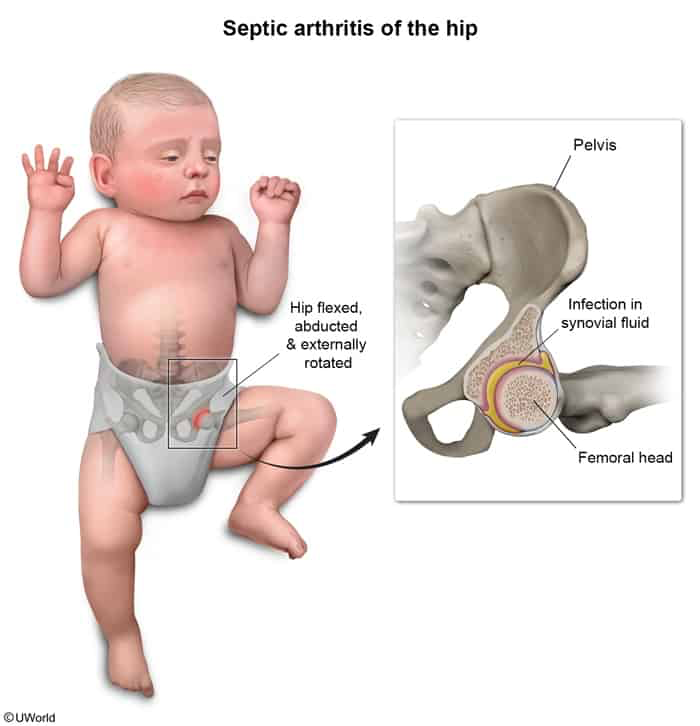
Hip involvement: Held in flexion, abduction, and external rotation to maximize intracapsular space and minimize pain.