Epidemiology
- Age > 50 (most significant risk factor due to immunosenescence).
- Immunocompromised (IC) states (HIV, malignancy, transplant, immunosuppressive meds, radiation therapy).
- Physical trauma or severe psychological stress.
Etiology
Pathophysiology
Clinical features
- Prodrome:
- Burning, tingling, itching, or lancinating pain in a dermatomal distribution.
- Allodynia: a sensation of pain triggered by a stimulus that is not ordinarily considered painful. c
- Precedes the rash by 48-72 hours.
- Fever, malaise, headache may occur.
- Eruptive phase:
- Unilateral, dermatomal erythematous macules/papules.
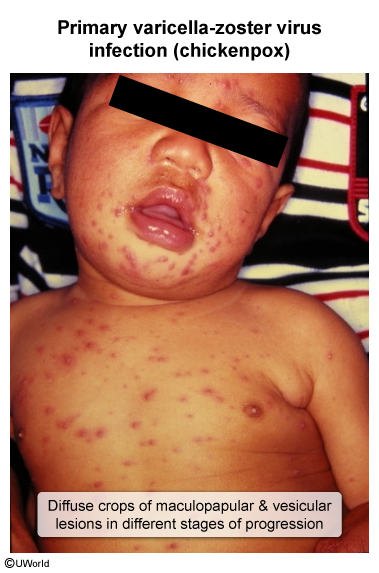
- Progresses to grouped vesicles on an erythematous base (“dewdrops on a rose petal” appearance).
- Does not cross the midline.
- Most common in thoracic and trigeminal dermatomes.
- Vesicles pustulate, ulcerate, and crust over within 7-10 days (no longer infectious once fully crusted).
Subtypes and variants
Herpes zoster ophthalmicus (HZO)
- Definition: reactivation of VZV in the ophthalmic division of the trigeminal nerve
- Clinical features
- Prodrome:
- Fever, malaise, headache.
- Periorbital burning, throbbing pain, paresthesias/hyperesthesia in the V1 dermatome (forehead to vertex).
- Physical Exam:
- Cutaneous: Unilateral, dermatomal, painful, vesicular-pustular rash with erythema and crusting along the V1 distribution (forehead, upper eyelid, scalp). c
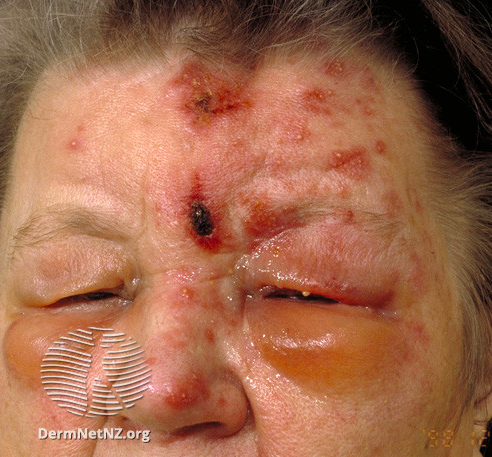
- Hutchinson sign: Vesicles on the tip, side, or root of the nose (involvement of the nasociliary branch; indicates high risk of intraocular involvement, ~75%).
- Ocular: Eye pain, foreign body sensation, photophobia, conjunctival injection, chemosis, decreased visual acuity.
- Slit-Lamp Findings: Pseudodendritic keratitis (linear/branching lesions without distinct terminal bulbs, staining weakly with fluorescein).
- Cutaneous: Unilateral, dermatomal, painful, vesicular-pustular rash with erythema and crusting along the V1 distribution (forehead, upper eyelid, scalp). c
- Prodrome:
Herpes zoster oticus
- Definition: reactivation of VZV in the geniculate ganglion, affecting the seventh (facial) and eighth (vestibulocochlear) cranial nerves (also known as Ramsay Hunt syndrome)
- Clinical features
- Classic Triad:
- Severe otalgia (deep, burning, paroxysmal ear pain).
- Vesicular rash: Erythematous vesicles/crusts on the pinna, external auditory canal (EAC), tympanic membrane (TM), or anterior 2/3 of the tongue / soft palate. c
- Peripheral facial nerve (CN VII) palsy: Ipsilateral upper AND lower facial weakness (inability to furrow forehead, close eye, or smile; loss of nasolabial fold). c
- CN VIII Involvement (frequent due to proximity in the internal auditory canal):
- Sensorineural hearing loss (SNHL).
- Tinnitus.
- Vertigo, nystagmus, nausea, and vomiting.
- Other Associated Features:
- Altered taste (anterior 2/3 of tongue via chorda tympani).
- Decreased lacrimation (dry eye) or salivation.
- Hyperacusis (stapedius muscle paralysis).
- Classic Triad:
Diagnostics
Positive Hutchinson sign of the nose: a vesicular rash on the nasal alae
Treatment
Complications
Postherpetic neuralgia
- Definition: chronic neuropathic pain persisting for at least three months in the area previously affected by the rash
- Postherpetic neuralgia only happens in VZV, not other herpesviruses
- Epidemiology
- Most common complication (occurs in 10–20% of overall herpes zoster cases)
- Strong association with age
- Risk factors
- Age > 50 years
- Severe infection (severe pain or rash)
- Clinical features
- Pain (including allodynia, paresthesias, dysesthesias) in the same dermatome as the rash
- Duration of symptoms > 3 months but can persist for years
- Treatment
- One of the following tricyclic antidepressants:
- Reduces serotonin and norepinephrine at the same time
- Amitriptyline
- Nortriptyline
- Relative contraindications: patients with heart disease, epilepsy, or glaucoma
- Should be used with caution in elderly patients
- One of the following anticonvulsants:
- Pregabalin
- Gabapentin
- Topical treatments
- Capsaicin patch or cream
- One of the following tricyclic antidepressants: