- Impaired copper excretion causes copper to accumulate in the body.
- Early-stage Wilson disease is characterized by the presence of copper deposits in the liver.
- As the disease progresses, copper accumulates in other organs as well, most importantly in the brain and cornea.
Epidemiology
Etiology
- Age of onset: Typically 5–35 years.
- Children/adolescents: Predominantly hepatic presentation (mean age ~10–13). c
- Young adults: Predominantly neuropsychiatric presentation (mean age ~15–25).
Pathophysiology
Tip
- Apoceruloplasmin
- Copper-free precursor synthesized in liver.
- Unstable half-life; degrades rapidly if not loaded with copper.
- Ceruloplasmin
- Copper-bound form (loaded by ATP7B in Golgi).
- Stable half-life; carries 95% of circulating copper.
- Ferroxidase activity (links Cu metabolism to Fe metabolism).
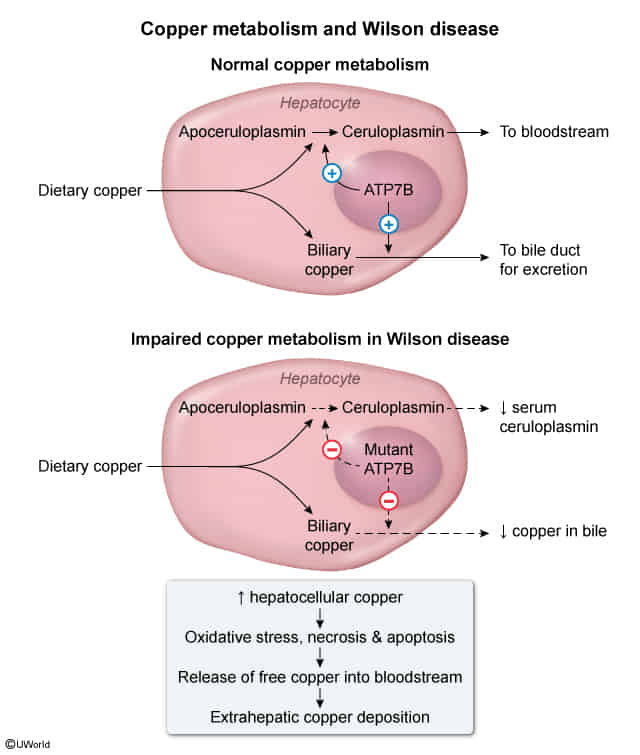
- Autosomal Recessive mutation of ATP7B gene on Chromosome 13.
- Defect in hepatocyte copper-transporting ATPase (ATP7B protein).
- Primary Defects:
- Inability to excrete excess copper into bile (main route of excretion).
- Failure to incorporate copper into apoceruloplasmin to form functional ceruloplasmin.
- Consequences:
- ↓ Serum ceruloplasmin (due to shorter half-life of apoceruloplasmin).
- ↑ Free (unbound) serum copper.
- Accumulation of toxic copper levels in tissues via Fenton reaction (oxidative damage).
- Tissue Deposition Sequence:
- Liver: Accumulates first → hepatocyte necrosis → micronodular cirrhosis.
- Brain: Deposits in Basal Ganglia (specifically Putamen and Globus Pallidus) → parkinsonism, dysarthria, tremor.
- Cornea: Deposits in Descemet membrane → Kayser-Fleischer rings.
- Kidneys: Proximal tubule damage → Fanconi syndrome.
Tip
Don’t mess up with Hemochromatosis
Clinical features
Tip
Hepatic + neurological + psychiatric
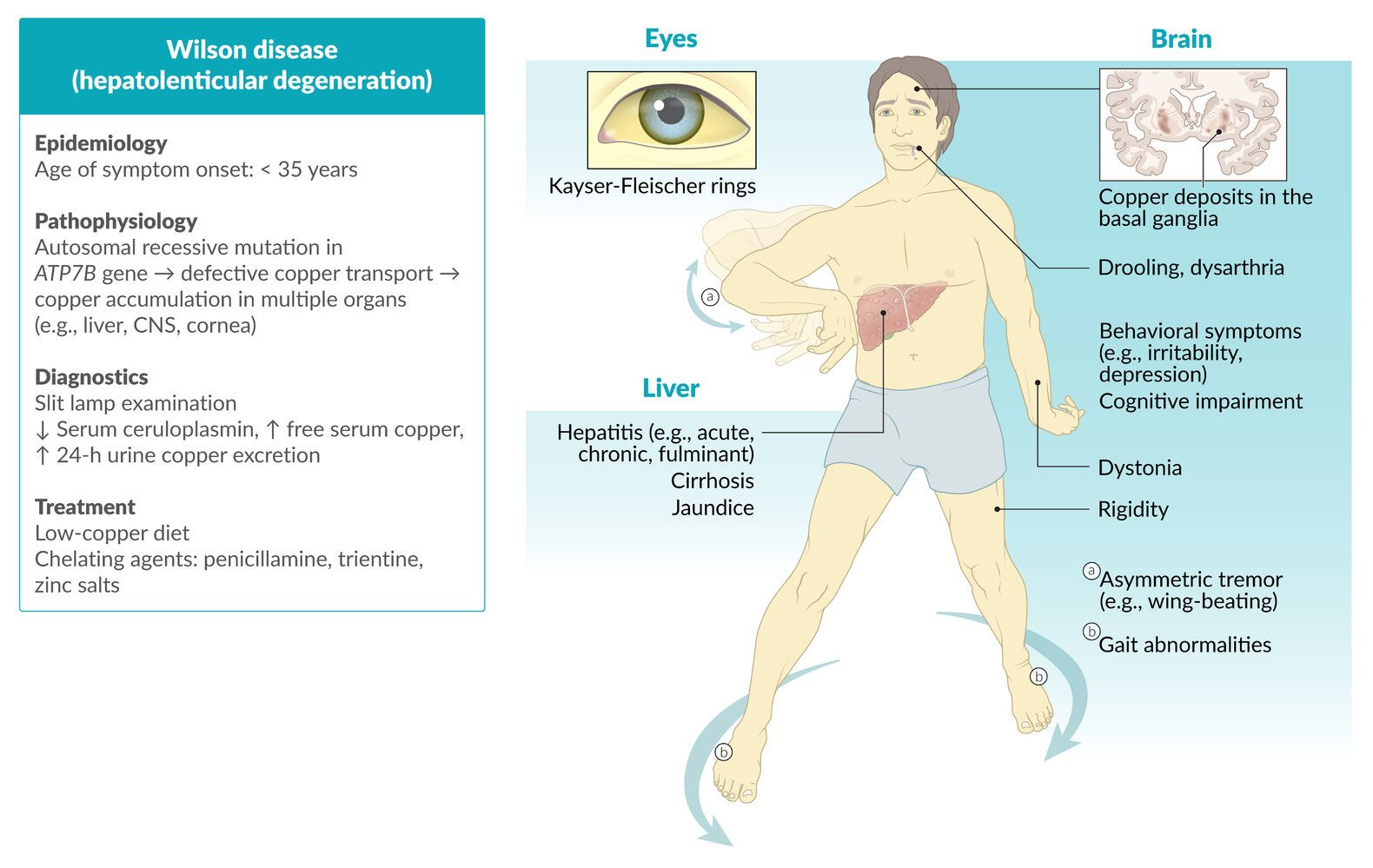
- Hepatic:
- Asymptomatic transaminitis, acute hepatitis, chronic hepatitis, cirrhosis, or acute liver failure (ALF).
- Neurological: c
- Movement disorders: Tremor (resting, postural, or “wing-beating”), ataxia, choreoathetosis, dystonia.
- Parkinsonian features: Rigidity, bradykinesia, mask-like facies.
- Pseudobulbar symptoms: Dysarthria (most common initial neuro sign), dysphagia, drooling.
- Psychiatric:
- Personality changes, depression, emotional lability, psychosis, cognitive decline/dementia.
- Ophthalmologic:
- Kayser-Fleischer (KF) rings: Golden-brown/greenish copper deposition in Descemet membrane of the cornea (seen via slit-lamp; present in >95% with neuro symptoms).
- Sunflower cataracts.
- Other:
- Hematologic: Coombs-negative hemolytic anemia (acute intravascular hemolysis due to free copper toxicity to RBCs).
- Renal: Fanconi syndrome (proximal tubular dysfunction), nephrolithiasis.
- Musculoskeletal: Premature osteoarthritis, chondrocalcinosis.
Wilson disease vs hemochromatosis
- Wilson disease has neurologic symptoms but hemochromatosis doesn’t have
- Think about Wilson from Don’t Starve, the mad scientist

Diagnostics
- Initial/Screening:
- Slit-lamp examination: Specifically to identify KF rings (most cost-effective initial screening step).
- Serum ceruloplasmin: Low (<20 mg/dL).
- 24-hour urinary copper excretion: High (>100 mcg/24h; increased to >1000 mcg/24h after penicillamine challenge).
- Confirmatory/Gold Standard:
- Liver biopsy: Demonstrates elevated hepatic copper concentration (>250 mcg/g of dry weight).
- Genetic testing (ATP7B mutation analysis) can be used for confirmation and screening of first-degree relatives.
- Key Labs:
- Coombs-negative hemolytic anemia (due to direct Cu-induced RBC membrane damage).
- Elevated LFTs (AST, ALT) and signs of liver synthetic dysfunction (prolonged PT/INR, low albumin).
- Imaging:
- Brain MRI: T2-weighted hyperintensities in the basal ganglia (classic but non-specific “giant panda sign” in midbrain).
Treatment
General principles
- Encourage a low-copper diet (e.g., avoidance of organ meats, shellfish, nuts, chocolate, copper-containing dietary supplements).
- Refer patients with refractory decompensated cirrhosis or acute liver failure for liver transplantation.
Pharmacological therapy
- First line: chelating agents, e.g., penicillamine (preferred) or trientine
- Chelating agents facilitate renal excretion of copper by forming water-soluble compounds.
- Adverse effect: Membranous nephropathy
- Maintenance therapy: reduced-dose zinc salts or a chelating agent