Supine hypotensive syndrome
Compression of the vena cava and pelvic veins by the uterus may occur during the third trimester of pregnancy (typically >20 weeks) as a result of the mother lying in a supine position .
Gravid uterus → compression of the abdominal aorta and IVC → impaired venous return and decrease in cardiac output → placental hypoperfusion → fetal hypoxia → deceleration (CTG)
After repositioning the mother in the left lateral position, the fetal heart rate recovers.
In the mother, supine hypotensive syndrome is characterized by tachycardia, dizziness, and nausea, and occasionally causes syncope.
Cervical insufficiency
Definition & Risk Factors
Structural cervical weakness causing painless 2nd-trimester loss (16–24 wks GA).
Risks: Prior LEEP/CKC (conization), mechanical cervical dilation (D&C/D&E), prior 2nd-trimester loss, uterine anomalies, DES exposure .
Clinical Features
Painless cervical dilation/effacement in the 2nd trimester without contractions .
Mild pelvic pressure or increased mucoid/watery vaginal discharge.
PE: Dilated cervix with bulging / “hourglass” membranes prolapsing into the vagina. c
Diagnosis
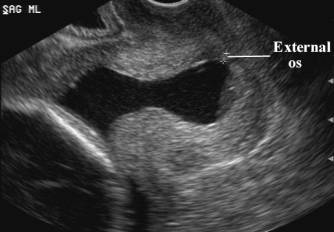
Initial / Screening : TVUS showing cervical length (CL) < 25 mm prior to 24 wks GA.
Ultrasound sign : Cervical funneling (T → Y → V → U-shape ).
Gold Standard / Clinical : History of ≥ 2 consecutive painless 2nd-trimester losses OR painless dilation on exam.
Management Algorithm
Incidental Short Cervix (CL ≤ 20 – 25 mm ) + NO prior PTB :
Vaginal progesterone daily until 36–37 wks (cerclage is not indicated).
Prior sPTB / 2nd-Trimester Loss :
Serial TVUS CL monitoring every 1–2 wks from 16 to 24 wks GA .
If CL < 25 mm before 24 wks : Place Cervical Cerclage + progesterone.
History-Indicated Cerclage :
Elective placement at 12–14 wks GA for pts with ≥ 2 prior 2nd-trimester losses.
Cerclage Removal :
Electively at 36–37 wks GA for planned vaginal delivery.
Urgent removal : Remove immediately if active labor or PPROM develops to avoid cervical laceration/uterine rupture .
Complications
PPROM and extreme preterm birth (PTB) .
Chorioamnionitis / intra-amniotic infection.
Cervical laceration if labor begins with cerclage in place.
Pregnancy dermatoses
Quick Rule-Out Algorithm
No primary rash + itchy palms/soles → Intrahepatic Cholestasis (ICP) (check TBA).
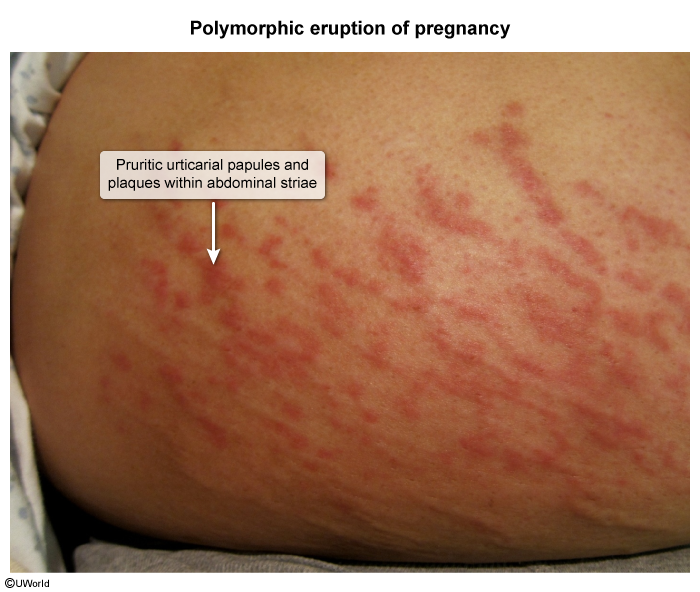
Striae rash + SPARES umbilicus → Pruritic Urticarial Papules and Plaques of Pregnancy (PUPPP) (topical steroids; safe). c
Also known as Polymorphic Eruption of Pregnancy
Pathophysiology: Abdominal wall distension/stretching damaging connective tissue, triggering an inflammatory reaction.
Vesicles/bullae + INVOLVES umbilicus → Pemphigoid Gestationis (autoimmune; DIF positive; fetal risk).
Flexural rash + 1st/2nd trimester → Atopic Eruption of Pregnancy (safe).
Sterile pustules + fever/hypocalcemia → Pustular Psoriasis (systemic steroids).
Comparison Matrix
Condition Timing Key Features Diagnosis Treatment Fetal Risk Intrahepatic Cholestasis (ICP) Late 2nd/3rd Tri Pruritus on palms & soles ; NO primary rash (excoriations only) Serum Bile Acids (TBA) ≥ 10 μ mol/L ; ↑ LFTsUDCA + Deliver at 36–39 wks (≥ 100 μ mol/L → deliver at 36 wks)High (IUFD, preterm birth, meconium)PUPPP Late 3rd Tri / Postpartum Pruritic papules in abdominal striae ; SPARES umbilicus Clinical (DIF negative) Topical steroids + antihistaminesNone Pemphigoid Gestationis (PG) 2nd/3rd Tri Pruritic plaques → tense bullae ; INVOLVES umbilicus Biopsy + DIF : Linear C3 & IgG at BMZOral/systemic corticosteroids Yes (FGR, preterm birth, transient neonatal rash)Atopic Eruption (AEP) 1st/2nd Tri (Earliest)Eczematous rash on flexural areas ; prior atopy history Clinical; ± ↑ IgE Emollients + topical steroids None Pustular Psoriasis (PPP) 3rd Tri Sterile pustules in flexures; fever, leukocytosis, hypocalcemia Sterile pustule culture + Biopsy (spongiform pustules) Systemic corticosteroids or Cyclosporine Yes (Placental insufficiency, IUFD)
Step 2 CK “Must-Know” Distinctions
ICP Delivery Timing :
TBA 10–99 μ mol/L : Deliver at 36 0/7 – 39 0/7 wks .
TBA ≥ 100 μ mol/L : Deliver at 36 0/7 wks .
Umbilicus Rule :
PUPPP : Periumbilical halo spared .
Pemphigoid Gestationis : Periumbilical skin affected first .
Fetal Risk :
Fetal Danger : ICP, Pemphigoid Gestationis, Pustular Psoriasis.
Benign for Fetus : PUPPP, AEP.