Clubfoot (talipes equinovarus)
-
Pathology & Clinical Features (“CAVE”):
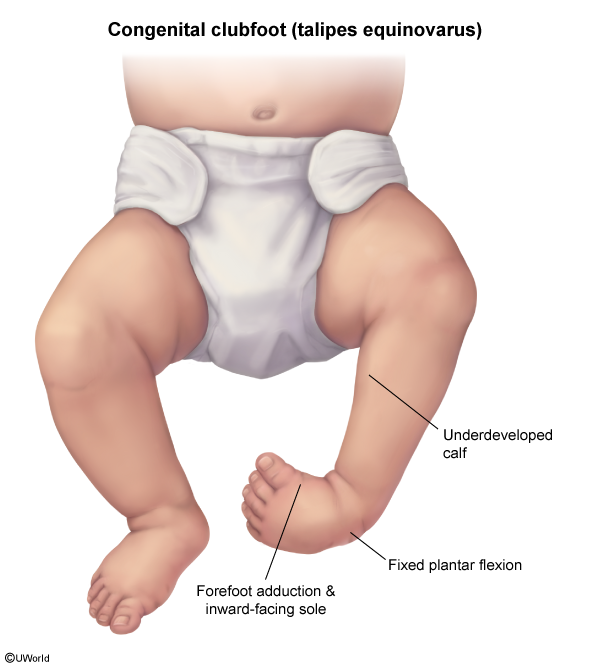
- Cavus: Elevated medial longitudinal arch.
- Adductus: Forefoot turned inward.
- Varus: Hindfoot (calcaneus) inverted.
- Equinus: Fixed plantarflexion due to tight Achilles tendon.
- Hallmark: Rigid deformity that cannot be passively dorsiflexed/corrected to neutral.
- Associations: Myelomeningocele (spina bifida), arthrogryposis, oligohydramnios, and developmental dysplasia of the hip (DDH) (requires hip and spine exam).
-
Diagnosis:
- Clinical exam at birth (screening via 2nd-trimester prenatal US; imaging not routinely required).
-
Key Differential Diagnoses:
- Metatarsus adductus: Forefoot adduction only, hindfoot normal; fully flexible / passively correctable (reassurance/observation).
- Positional clubfoot: Flexible deformity 2/2 intrauterine crowding; easily reduced to neutral passively.
- Congenital vertical talus (“rocker-bottom foot”): Rigid midfoot dorsiflexion with convex sole; associated with Trisomy 18.
-
Management Hierarchy:
- 1st-Line: Ponseti method (serial manipulation and weekly long-leg casting started immediately after birth). c
- Adjunct: Percutaneous Achilles tenotomy (needed in ~90% of cases for residual equinus prior to final cast).
- Maintenance: Foot abduction orthosis (boots and bar) worn up to age 4–5 to prevent relapse.
- Refractory/Late: Surgical soft tissue release / tendon transfer.
-
High-Yield Exam Pearl:
- The most common cause of recurrence/relapse is non-adherence to the post-casting bracing regimen.
Metatarsus adductus, curved foot (metatarsus varus)
- Etiology & Associations:
- Most common congenital foot anomaly; caused by intrauterine crowding (primigravida, oligohydramnios, breech).
- Must screen for associated Developmental Dysplasia of the Hip (DDH) with hip exam (Barlow/Ortolani).
- Clinical Features:
- Medial forefoot deviation with a convex, “C-shaped” lateral border and prominent 5th metatarsal base.
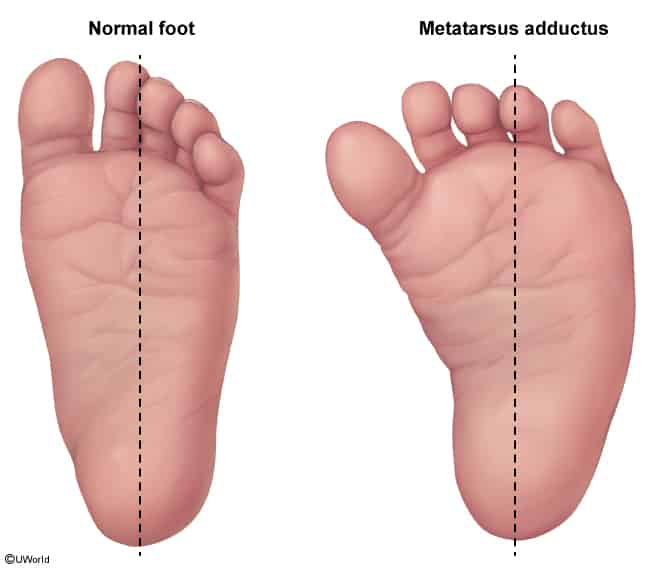
- Hindfoot is completely normal (neutral or valgus) with full, unrestricted ankle ROM (normal dorsiflexion).
- Medial forefoot deviation with a convex, “C-shaped” lateral border and prominent 5th metatarsal base.
- Key Differential (Clubfoot / Talipes Equinovarus):
- Clubfoot involves forefoot adduction plus hindfoot varus and fixed equinus (plantarflexion) contracture; cannot be passively dorsiflexed.
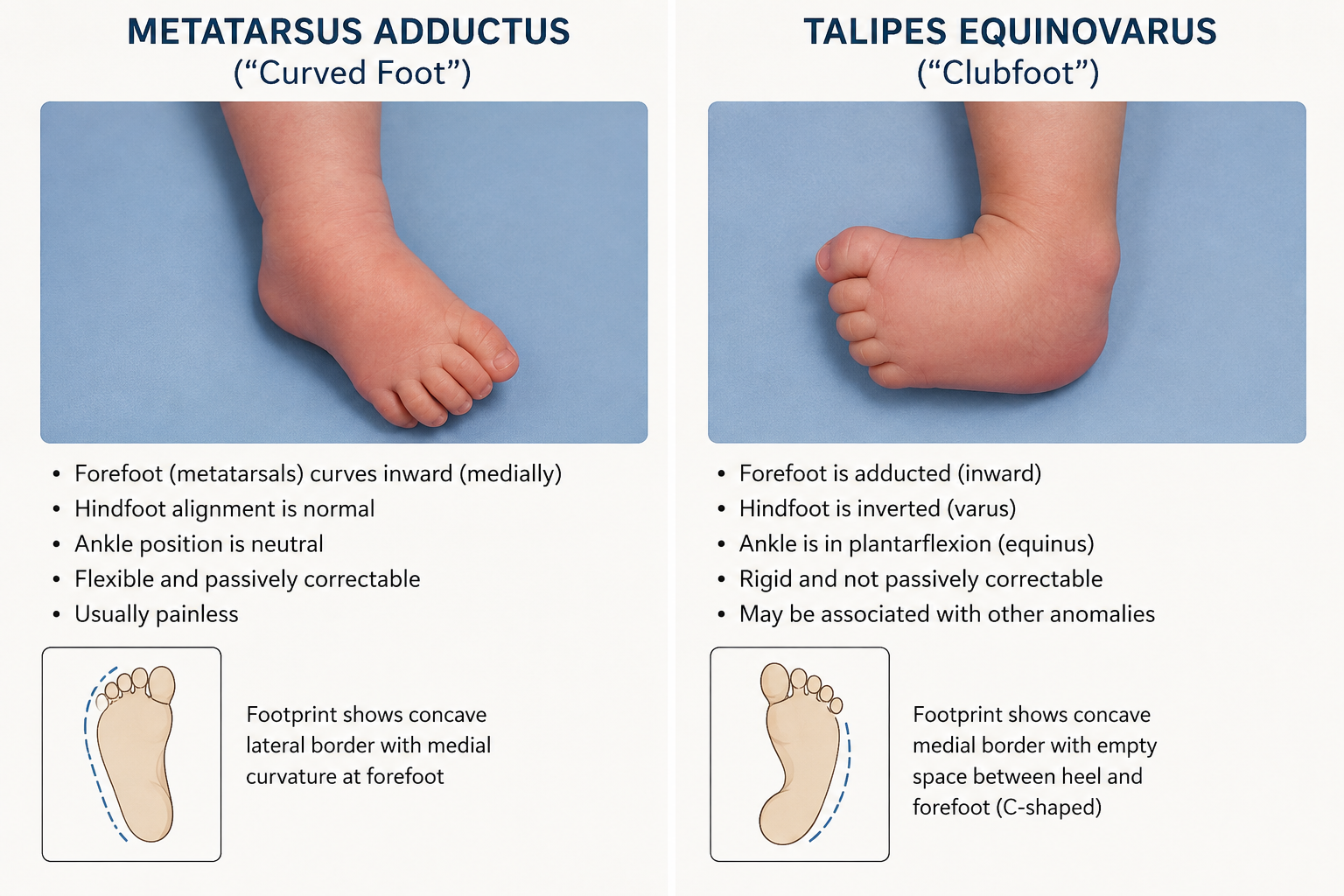
- Clubfoot involves forefoot adduction plus hindfoot varus and fixed equinus (plantarflexion) contracture; cannot be passively dorsiflexed.
- Diagnosis:
- Purely clinical; heel bisector line deviates lateral to the 2nd/3rd interdigital space.
- XR unnecessary unless rigid, surgical candidate, or evaluating for alternative bony pathology.
- Management (Algorithm by Flexibility):
- Flexible (overcorrects past midline): Observation & reassurance (85-90% resolve spontaneously by age 1).
- Partially flexible (corrects to midline only): Passive stretching exercises by parents at each diaper change ± corrective shoes.
- Rigid (cannot reach midline) or persistent after 6–9 months: Serial below-knee casting (best if initiated before 12 months).
- Refractory/Late presentation (>3–4 years): Delayed surgical correction (metatarsal osteotomy).