Defective decidual layer of the placenta leading to abnormal attachment and separation during postpartum period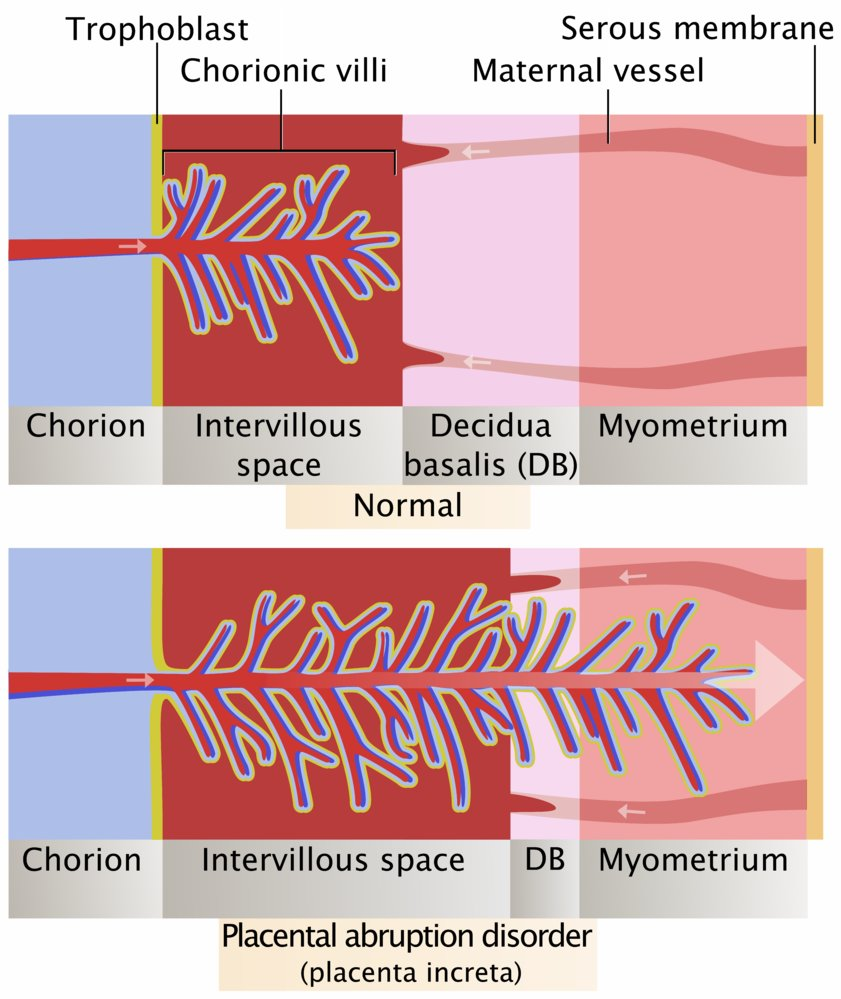
Epidemiology
Classification
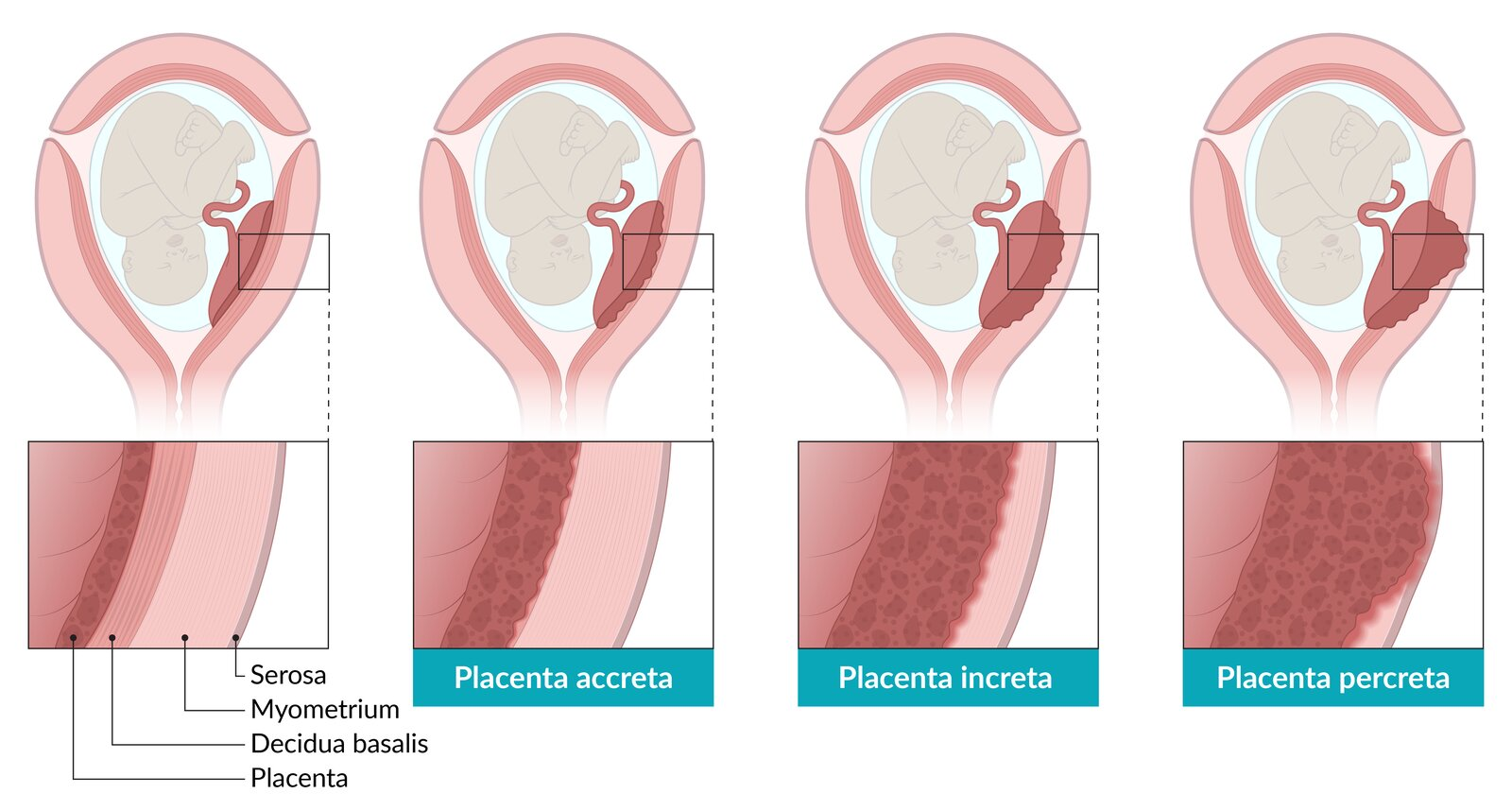
- Placenta accreta: chorionic villi attach to the myometrium (but do not invade or penetrate the myometrium) rather than the decidua basalis (up to 75% of cases)
- Placenta increta: chorionic villi invade or penetrate into the myometrium (approx. 20% of cases)
- Placenta percreta: chorionic villi penetrate the myometrium, penetrate the serosa, and in some cases, adjacent organs/structures (approx. 5% of cases)
- Like bladder
Mnemonic
The types of abnormal placental attachment: Placenta Accreta “Attaches” to the myometrium, placenta Increta “Invades” the myometrium, and placenta Percreta “Perforates” the myometrium.
Pathophysiology
Risk factors
- History of uterine surgery (e.g., endometrial ablation, hysteroscopic removal of intrauterine adhesions, dilatation, curettage)
- Prior births by cesarean delivery
- Placenta previa
- Placenta previa generally manifests with placenta accreta.
- Multiparity
- Advanced maternal age
Clinical features
- Typically diagnosed after fetal delivery
- Abnormal uterine bleeding
- Postpartum hemorrhage at the time of attempted manual separation of the placenta
Diagnostics
- Ultrasound
- Thinning of uterine myometrial wall c
- Placental lacunae (particularly irregularly shaped), giving the placenta a moth-eaten appearance
- Disruption of the junction between the bladder wall and uterine serosa
- Loss of clear space behind the placenta
Treatment
-
Emergency Stabilization (Active Hemorrhage / Unstable):
- Airway/Breathing/Circulation: Two large-bore IVs (16-18 gauge), rapid IVF resuscitation.
- Transfusion: Activate Massive Transfusion Protocol (MTP) if indicated (PRBCs : FFP : Platelets = 1:1:1).
- Continuous Monitoring: Maternal vitals and continuous FHR monitoring.
- Immediate Emergency Cesarean Delivery: If maternal hemodynamic instability, refractory hemorrhage, or non-reassuring fetal status, regardless of GA.
-
Placenta Previa (Hemodynamically Stable):
- Antenatal Care: Pelvic rest (strict avoidance of sexual intercourse, DVE, and tampon use); outpatient management only if stable with immediate hospital access.
- Delivery Timing: Planned Cesarean delivery at 36 0/7 to 37 6/7 weeks GA.
- Antenatal Corticosteroids (Betamethasone): If bleeding occurs <37 weeks GA or prior to scheduled early delivery.
-
Placenta Accreta Spectrum (Stable / Diagnosed Antenatally):
- Multidisciplinary Planning: Delivery at a tertiary center with MFM, Gyn-Onc, Uro, Interventional Radiology (IR), and blood bank.
- Delivery Timing: Planned delivery at 34 0/7 to 35 6/7 weeks GA (administer antenatal corticosteroids at 34 wks).
- Primary Surgical Intervention: Planned Cesarean Hysterectomy.
- Do NOT attempt manual removal of the placenta (drastically increases maternal mortality and hemorrhagic shock).
- Deliver fetus via hysterotomy avoiding the placenta, close uterine incision with placenta in situ, and proceed directly to hysterectomy.
-
Refractory Postpartum Hemorrhage / Fertility-Sparing Options:
- Uterine artery embolization (IR).
- Internal iliac (hypogastric) artery ligation.
- Uterine compression sutures (e.g., B-Lynch) or intrauterine balloon tamponade (Bakri balloon) for low-grade focal adherent tissue.