Clinical Features

  • Focal Aware Seizure (formerly Simple Partial):
    • Consciousness/awareness remains intact.
    • Motor: Unilateral jerking, Jacksonian march (marching of motor activity over body parts).
    • Sensory: Paresthesias, flashing lights, olfactory/gustatory auras.
    • Autonomic: Epigastric rising sensation, diaphoresis, pupillary dilation.
    • Psychic: Déjà vu, jamais vu, sudden fear/affective changes.
  • Focal Seizure with Impaired Awareness (formerly Complex Partial):
    • Altered consciousness, responsiveness, or amnesia for the event.
    • Most commonly originates in the temporal lobe (followed by frontal lobe).
    • Automatisms: Involuntary motor behaviors (e.g., lip-smacking, chewing, swallowing, manual fumbling).
    • Ictal dystonic posturing of the contralateral arm.
    • Postictal phase: Confusion, disorientation, fatigue, headache.
  • Focal to Bilateral Tonic-Clonic (Secondary Generalization):
    • Focal onset progressing to diffuse tonic-clonic activity with postictal state.
  • Todd Paralysis: c
    • Transient unilateral weakness / hemiparesis (or monoparesis) contralateral to the epileptogenic focus, immediately post-seizure.
    • Resolves spontaneously within 24–48 hours; mimics acute ischemic CVA.

Temporal lobe epilepsy


  • Epidemiology: most common form of epilepsy
  • Etiology
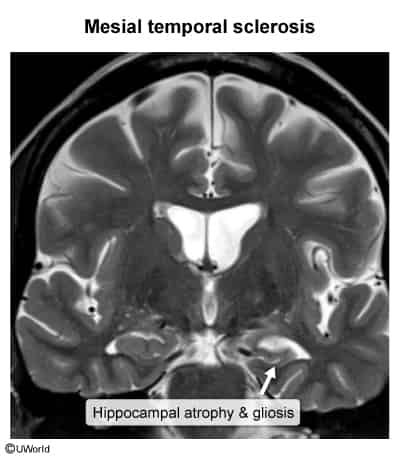
    • Hippocampal sclerosis: found in approx. 70% of patients suffering from temporal lobe epilepsy that is resistant to pharmacotherapy
      • Histopathology: atrophy of the hippocampal neurons with marked reactive gliosis (astrocyte proliferation in response to injury). t
    • Encephalitis (e.g., herpes simplex encephalitis)
    • Developmental disorders
    • Neurodegenerative disorders
    • Tumors
  • Clinical features: Seizures commonly occur in clusters, last approx. 30 seconds to 2 minutes, and follow a specific sequence.
    1. Aura
      • Visceral, olfactory, or auditory
      • Feelings of familiarity or unfamiliarity and “dreamy states”
    2. Focal seizure with impaired awareness (complex partial seizure)
      • Motor symptoms
        • Typically oral alimentary automatisms (e.g., lip-smacking)
      • Autonomic symptoms
      • Altered mental status
        • Children appear absent-minded (e.g., staring ahead, unresponsive when spoken to)
        • No loss of consciousness
    3. Postictal phase
      • Confusion and tiredness (common)
  • Diagnosis: EEG shows temporal lobe spikes

Frontal lobe epilepsy

  • Jacksonian March: A specific type of focal aware motor seizure where symptoms start in one area (e.g., thumb) and spread sequentially to adjacent areas (e.g., hand, arm), reflecting the seizure’s progression along the motor homunculus.