Epidemiology
- Most common motor disability in children
Etiology
- Prematurity (< 32 wks): Single greatest risk factor.
- Very low birth weight (< 1500 g).
- Periventricular leukomalacia (PVL), IVH, chorioamnionitis, neonatal kernicterus.
Pathophysiology
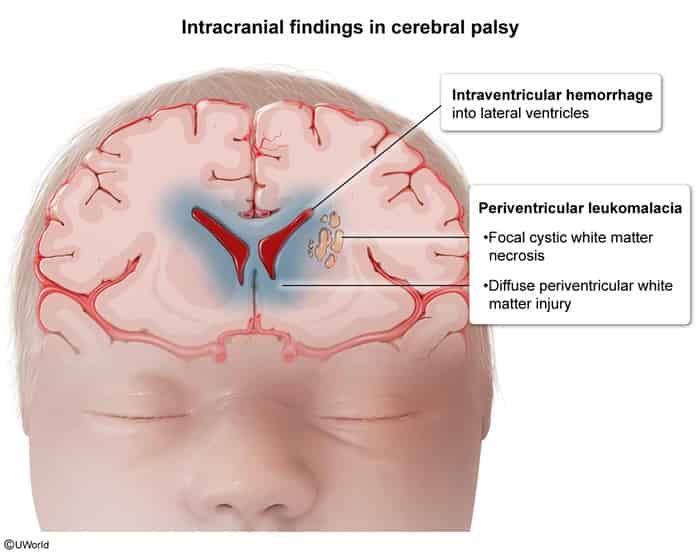
Spastic cerebral palsy may be caused by white matter necrosis (seen in this patient as periventricular leukomalacia), which leads to a loss of descending inhibitory control from the upper motor neurons. This results in muscle overactivity, leading to increased tone and hyperreflexia.
Clinical features
- Core Hallmark: Static, non-progressive motor and tone dysfunction.
- Early signs: Hand preference < 1 yo, delayed motor milestones, persistent primitive reflexes (e.g., Moro > 6 mo).
- Spastic Diplegia (most common):
- Bilateral LE > UE; “scissor gait”, toe-walking.
- UMN signs: Hyperreflexia, sustained clonus, (+) Babinski.
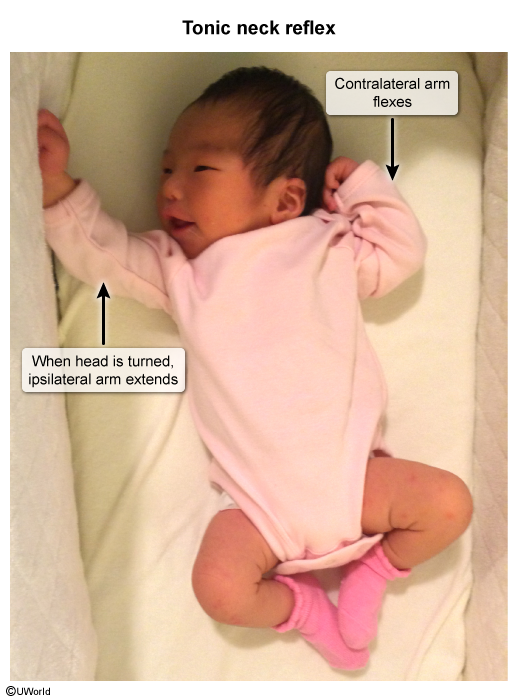
- Dyskinetic: Choreoathetosis and dystonia secondary to basal ganglia injury (kernicterus).
- Associated: Seizures (~50%), intellectual disability (~50%), strabismus, dysphagia.
Warning
Definite hand preference before 1 year of age suggests one-sided muscle weakness and is a red flag for hemiplegia.
Diagnostics
- Initial / Screening:
- Clinical evaluation: Serial neurodevelopmental examinations demonstrating non-progressive motor deficits, tone abnormalities, and persistent primitive reflexes.
- Confirmatory / Neuroimaging:
- Brain MRI (neuroimaging of choice): Identifies underlying structural etiology (e.g., periventricular leukomalacia, focal ischemic stroke, cerebral dysgenesis).
- Brain MRI (neuroimaging of choice): Identifies underlying structural etiology (e.g., periventricular leukomalacia, focal ischemic stroke, cerebral dysgenesis).
- Key Labs & Adjuncts:
- Metabolic/Genetic testing: Indicated if MRI is normal, atypical features are present, or signs of disease progression/neuroregression appear.
- EEG: If clinical seizures or altered sensorium suspected.
- Vision and Audiologic Screening: Indicated in all newly diagnosed pts.
Differential Diagnostics
- Spinal Muscular Atrophy (SMA):
- Diff by progressive Lower Motor Neuron (LMN) signs (hypotonia, diffuse muscle weakness, tongue fasciculations, absent deep tendon reflexes [DTRs]); CP displays UMN signs/hyperreflexia.
- Inborn Errors of Metabolism / Leukodystrophies (e.g., Krabbe, Metachromatic Leukodystrophy):
- Diff by neuroregression (loss of previously acquired milestones) and progressive neurodegeneration; CP is static and non-progressive.
- Hereditary Spastic Paraplegia:
- Diff by positive family history, later onset (childhood/adolescence), and progressive bilateral LE spasticity.
- Duchenne Muscular Dystrophy (DMD):
- Diff by elevated serum CK, calf pseudohypertrophy, Gowers sign, and progressive proximal muscle weakness without spasticity.
Treatment
- First-line: Multidisciplinary PT/OT, ankle-foot orthoses (AFOs).
- Spasticity Pharmacotherapy:
- Oral: Baclofen or Tizanidine (generalized).
- Local: Botulinum toxin injections (focal dynamic contractures).
- Refractory: Intrathecal baclofen pump, Selective Dorsal Rhizotomy.
- Orthopedic Surgery: Tendon lengthening, hip reconstruction for fixed contractures.
- Supportive: Anticonvulsants for epilepsy, G-tube for severe dysphagia/FTT.