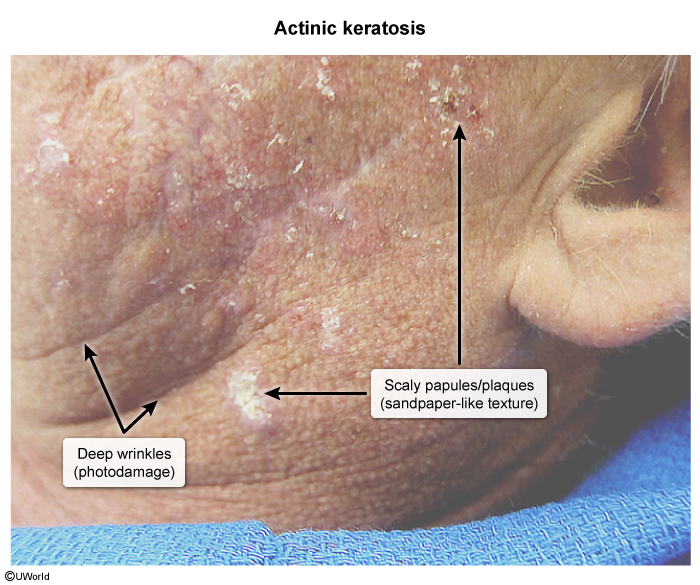
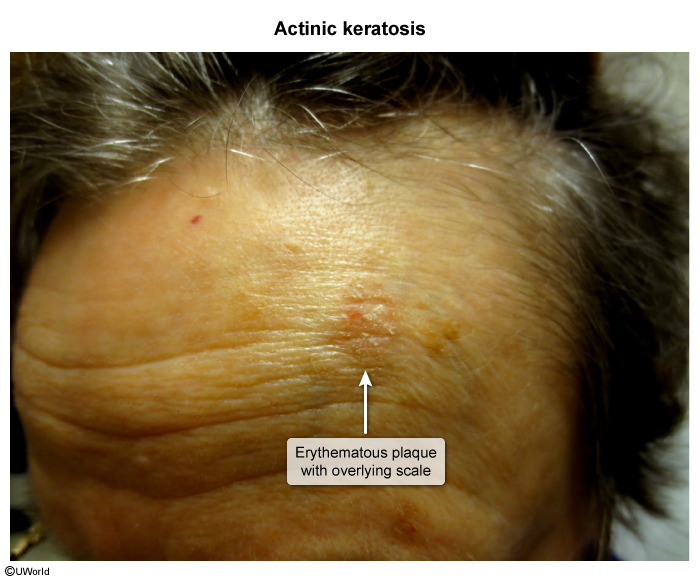
Actinic keratosis


  • Definition: UV-induced precancerous skin lesion that may progress to skin cancer.
  • Epidemiology: occurs especially in individuals with light skin who are over the age of 50
  • Etiology: sun exposure (e.g., from working outdoors)
  • Clinical features
    • History: Asymptomatic or mild pruritus, burning, or tenderness; history of chronic sun exposure.
    • Physical Exam:
      • Classic appearance: Erythematous, rough, scaly macule or papule.
      • Key tactile sign: “Felt better than seen” (palpable sandpaper-like texture).
      • Size: Typically < 1 cm.
      • Distribution: Sun-exposed areas (face, balding scalp, ears, dorsal hands, forearms, lower lip [actinic cheilitis]).
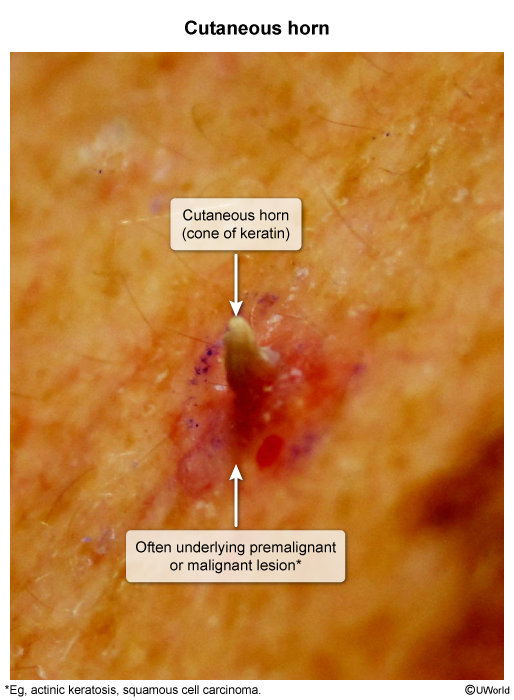
      • Variant: May develop a prominent keratin projection (cutaneous horn).
  • Pathology
    • Parakeratosis: Retention of nuclei in the stratum corneum. t
    • Atypical keratinocytes: Confined to the basal layer of the epidermis (partial thickness dysplasia).
      • Note: If full-thickness dysplasia → Squamous Cell Carcinoma in situ (Bowen disease).
    • Solar elastosis (blue-gray degeneration of collagen) in the dermis.
  • Management:
    • Isolated / Few lesions: Cryotherapy (liquid nitrogen) or surgical curettage/shave.
    • Multiple / Field cancerization: Topical 5-Fluorouracil (5-FU) or topical imiquimod (warn pts about expected erythema/crusting); photodynamic therapy (PDT) is second-line.
    • Prevention: Daily broad-spectrum sunscreen (SPF ≥ 30) and sun avoidance.
  • Prognosis