Intermittent UV exposure is the most significant risk factor
As opposed to cumulative UV exposure, which is a recognized risk factor for cSCC.
Pathophysiology
Clinical features
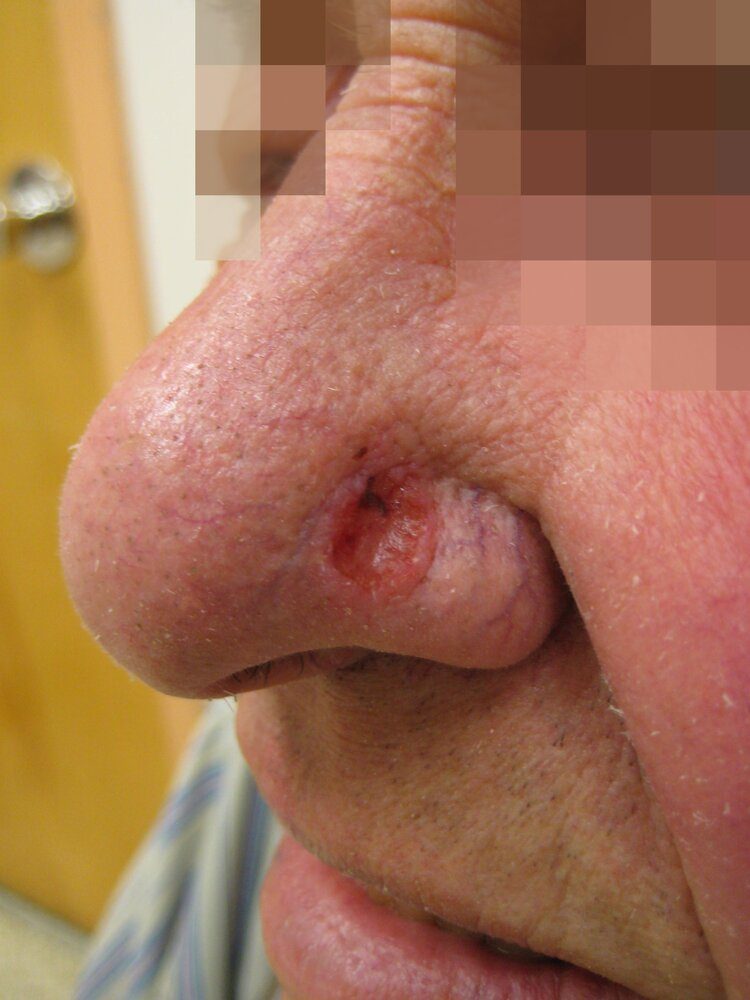
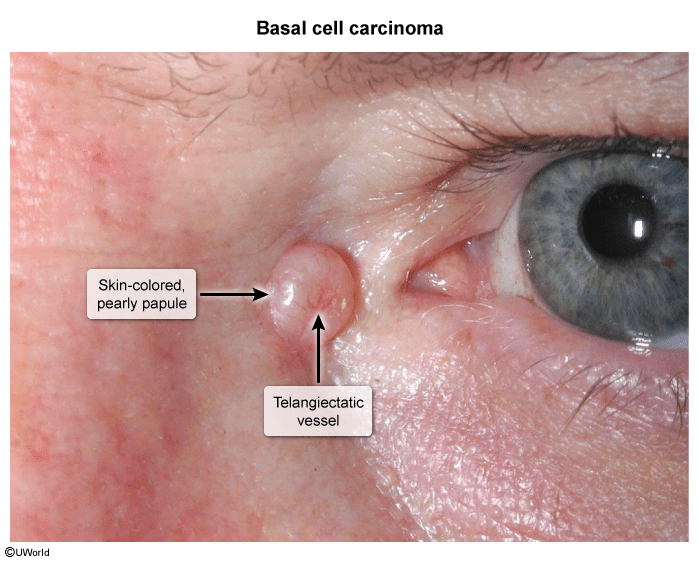
Nonhealing well-circumscribed pearly papule, nodule, or plaque with rolled borders, telangiectasia, and/or central umbilication
Typically located in areas with sun exposure; most commonly on the face and neck
Often painless
Lesions gradually increase in size (indolent growth)
Metastasizes rarely (< 1%); if lack of treatment, can spread to lymph nodes, soft tissue, lungs, and bone
Subtypes
Nodular basal cell carcinoma
Papule or nodule with the following:
Pink or skin-colored papule, shiny with a pearl-like appearance
Rolled borders
Central depression, erosion, or ulceration (rodent ulcer)
Superficial telangiectasias with arborizing pattern (tree-like branching)
Most commonly located on the face, especially the nose
Superficial basal cell carcinoma
Thin and scaly
Raised border with a pearl-like appearance
Most commonly located on the trunk and legs
Diagnostics
Pathology
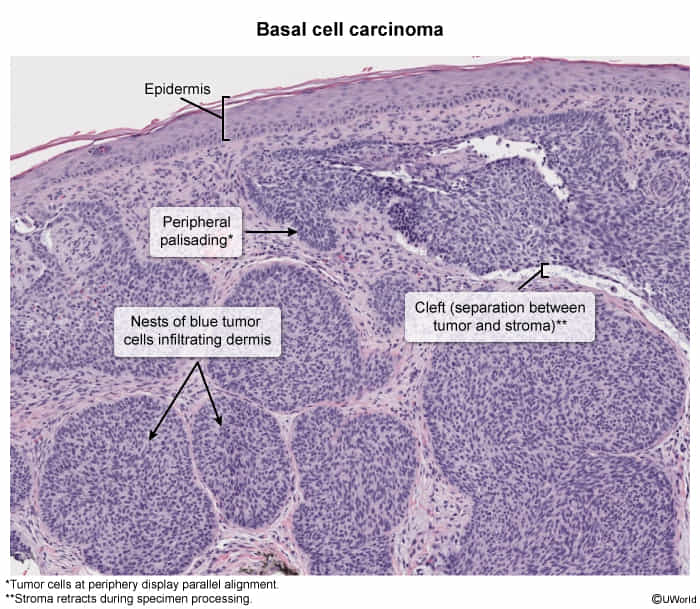
Palisading nuclei: Nuclei appear aligned.
Treatment
Risk Stratification:
High-Risk Features: “Mask area” of face (eyes, nose, lips, ears), genitalia, hands/feet; size >2 cm (trunk/extremities) or >1 cm (cheeks/forehead/scalp) or >0.6 cm (central face); morpheaform/infiltrative subtype; perineural invasion; recurrent lesion; immunosuppressed pt.
Low-Risk Features: Trunk/extremities; size <2 cm; nodular or superficial subtype; well-defined borders; primary lesion in immunocompetent pt.
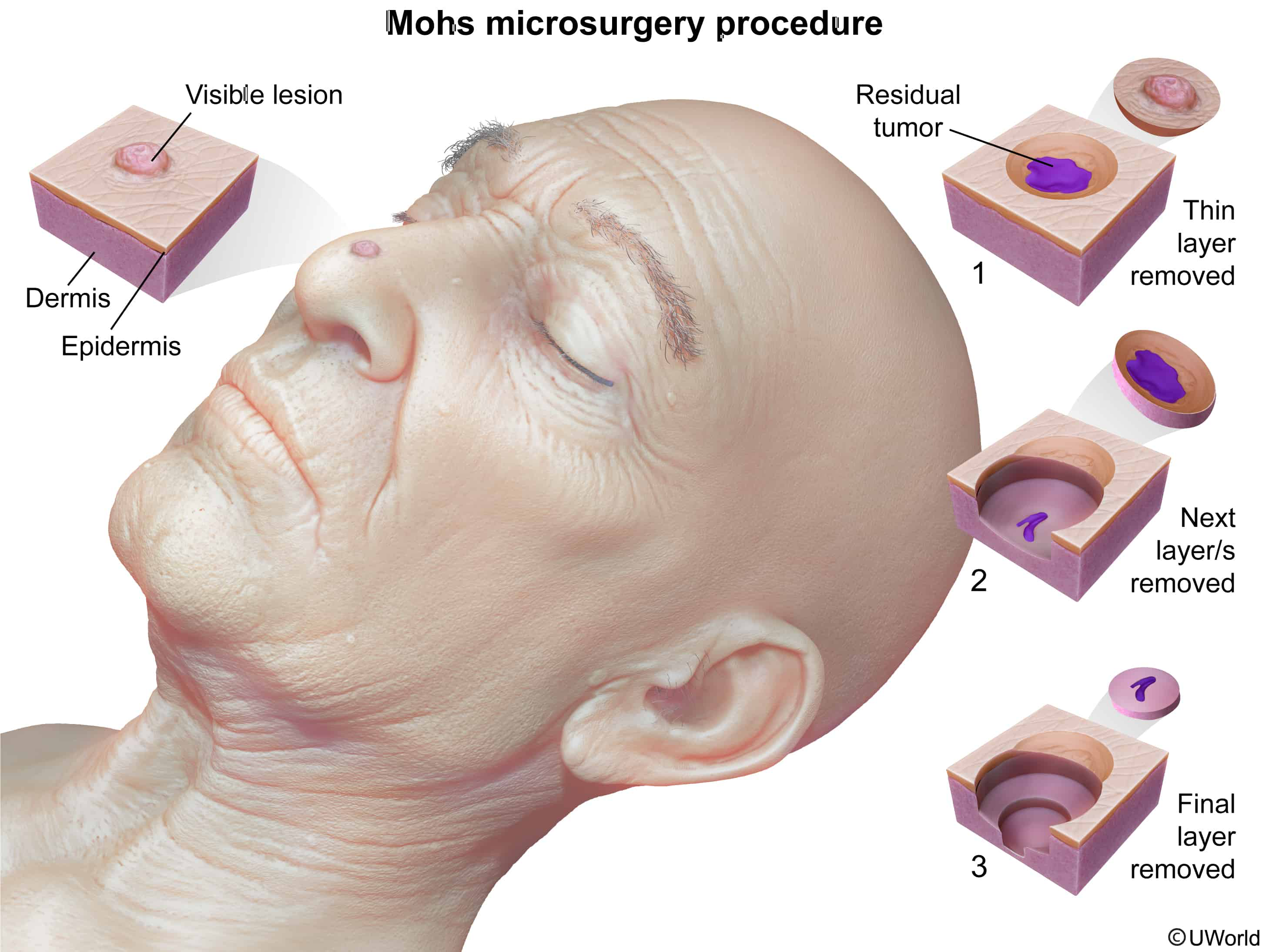
Treatment of choice for high-risk lesions (highest cure rate >99%, maximal tissue preservation).
Indications: Central face/cosmetically sensitive zones, morpheaform/aggressive histopathology, poorly defined borders, or recurrent disease.
Standard Surgical Excision:
Margin of 4–5 mm of normal tissue.
Preferred for low-risk primary lesions on trunk or extremities.
Electrodesiccation and Curettage (ED&C):
Reserved for small, low-risk, superficial or nodular BCC on non-cosmetically critical areas (trunk/extremities).
Contraindicated on the face/eyelids, terminal hair-bearing areas (scalp/beard), or aggressive/recurrent subtypes.
Second-Line / Non-Surgical Candidates:
Indicated if surgery is contraindicated or for superficial lesions in low-risk locations:
Topical 5-Fluorouracil (5-FU) or Imiquimod (superficial BCC only).
Cryotherapy or Photodynamic therapy (PDT).
Definitive Radiation Therapy (RT): For nonsurgical candidates, or adjuvant RT for positive margins/perineural invasion where re-excision is impossible.
Refractory / Locally Advanced / Metastatic:
Hedgehog Pathway Inhibitors:
Vismodegib or Sonidegib (oral Smoothened [SMO] inhibitors).
Immunotherapy:
Cemiplimab (anti-PD-1 mAb) if Hedgehog inhibitors are contraindicated or disease progresses.