Epidemiology
Etiology
Pathophysiology
- Spirochetes invade the body → disseminate systemically within hours → bind to endothelial cells → inflammatory reaction → endarteritis and perivascular inflammatory infiltrates
- May be obliterating if reactive endothelial hyperproliferation occurs and results in ischemia and necrosis.
Clinical features
Primary syphilis
- Primary lesion (chancre)
- Typically starts out as a solitary, raised papule (usually on the genitals)
- Evolves into a painless, firm ulcer with indurated borders and smooth base
- Resolves spontaneously within 3–6 weeks, typically without scarring
- Nontender regional lymphadenopathy (e.g., involvement of the inguinal lymph nodes in genital primary syphilis)
Secondary syphilis
Secondary syphilis resolves spontaneously within weeks to months without treatment, entering the latent phase.
- Systemic dissemination (weeks to months post-primary infection).
- Diffuse maculopapular rash (classically includes palms and soles). c
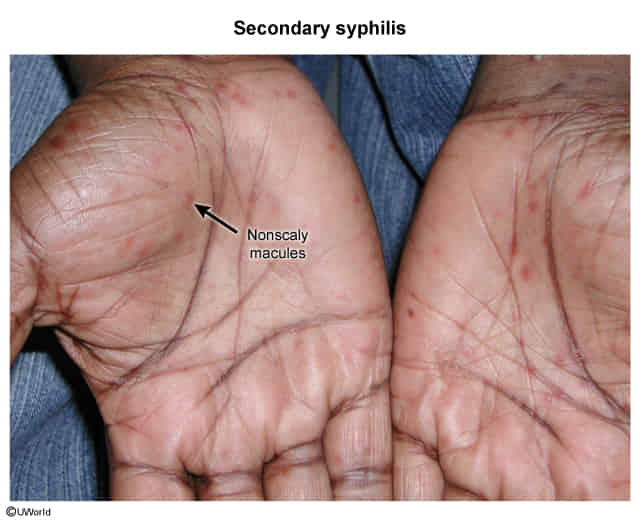
- Condyloma lata (flat, broad-based, moist, verrucous papules in intertriginous/anogenital areas).
- Generalized painless lymphadenopathy (especially epitrochlear). c
- It is rumored that sailors would routinely perform a 2-handed “sailor’s handshake” (with one hand on the elbow) to determine if potential partners had epitrochlear nodes prior to engaging their company.

- It is rumored that sailors would routinely perform a 2-handed “sailor’s handshake” (with one hand on the elbow) to determine if potential partners had epitrochlear nodes prior to engaging their company.
Tertiary syphilis
Develops years to decades later; each symptom can occur on isolation
- Cardiovascular: Thoracic/ascending aortic aneurysm, aortic regurgitation (due to endarteritis of the vaso vasorum causing “tree-bark” aorta).
- Gummata: Destructive, granulomatous, necrotic lesions of skin, subcutaneous tissue, and bones.
Subtypes and variants
Neurosyphilis
- Epidemiology & Risk Factors:
- Cause: Treponema pallidum (CNS invasion can occur at any stage).
- High-risk: HIV coinfection (especially CD4 < 350/mm³), MSM, unprotected sexual contact.
- Clinical Features:
- Early Neurosyphilis (months to years):
- Syphilitic meningitis: Fever, HA, CN palsies (esp. CN VII & VIII).
- Meningovascular: Endarteritis leading to ischemic stroke/TIA in a young patient. c
- Ocular / Otosyphilis: Uveitis, optic neuritis, vision loss, sensorineural hearing loss, tinnitus.
- Late Neurosyphilis (decades):
- General Paresis: Progressive dementia, psychosis, personality changes, dysarthria (“PARESIS”).
- Tabes Dorsalis: Dorsal column/root degeneration → sensory ataxia, positive Romberg, lancinating pains, Charcot joints (neuropathic arthropathy), hyporeflexia.
- Argyll Robertson pupil: Bilateral, small pupils that accommodate to near targets but do NOT react to light. c
- Early Neurosyphilis (months to years):
Diagnostics
| VDRL / RPR | FTA-ABS | Interpretation |
|---|---|---|
| (+) | (+) | Active Syphilis |
| (+) | (-) | False-Positive (Pregnancy, IVDU, HIV, SLE/antiphospholipid, liver dz) |
| (-) | (+) | • Prior treated syphilis (most common if asymptomatic) • Early primary syphilis (if chancre present; pre-seroconversion) • Neurosyphilis (if neuro sx present do LP for CSF-VDRL) |
Nontreponemal Tests
- Examples: RPR, VDRL
- Antibody: to cardiolipin-cholesterol-lecithin antigen
- Titers correlate with active infection/disease burden and revert to negative (or low “serofast” titers) following successful treatment.
- Sensitivity: Lower sensitivity in early infection
Treponemal Tests
- Examples: FTA-ABS, TP-EIA
- Antibody: to treponemal antigens
- Once positive, they typically remain positive for life (“serologic scar”), even after effective treatment.
- Sensitivity: Greater sensitivity in early infection
Neurosyphilis Evaluation:
- Lumbar Puncture (LP) indicated if: Neurologic, ocular, or auditory symptoms; tertiary syphilis; or serologic failure after treatment.
- CSF-VDRL: Highly specific (diagnostic); low sensitivity (negative does NOT rule out).
- CSF FTA-ABS: Highly sensitive (negative rules out neurosyphilis).
- CSF findings: Lymphocytic pleocytosis (>5 WBCs/mm³), elevated protein.
Treatment
- Primary, Secondary, or Early Latent (<1 yr):
- Benzathine Penicillin G: 2.4 million units IM x 1 dose.
- Penicillin-allergic (non-pregnant): Doxycycline 100 mg BID x 14 days. c
- Late Latent (>1 yr), Unknown Duration, or Gummatous/Cardiovascular:
- Benzathine Penicillin G: 2.4 million units IM weekly x 3 doses (Weeks 1, 2, and 3).
- Neurosyphilis / Ocular Syphilis:
- Aqueous Crystalline Penicillin G: 18–24 million units IV daily (3-4 million units q4h or continuous infusion) x 10–14 days.
- Special Populations:
- Pregnant Patients: Penicillin G is the ONLY acceptable treatment. If penicillin-allergic -> desensitization is mandatory, followed by penicillin therapy. c