Definition
- Thyrotoxicosis: a hypermetabolic condition caused by an inappropriately high level of circulating thyroid hormones irrespective of the source.
- Hyperthyroidism: a condition characterized by the overproduction of thyroid hormones by the thyroid gland; can cause thyrotoxicosis
- Overt hyperthyroidism
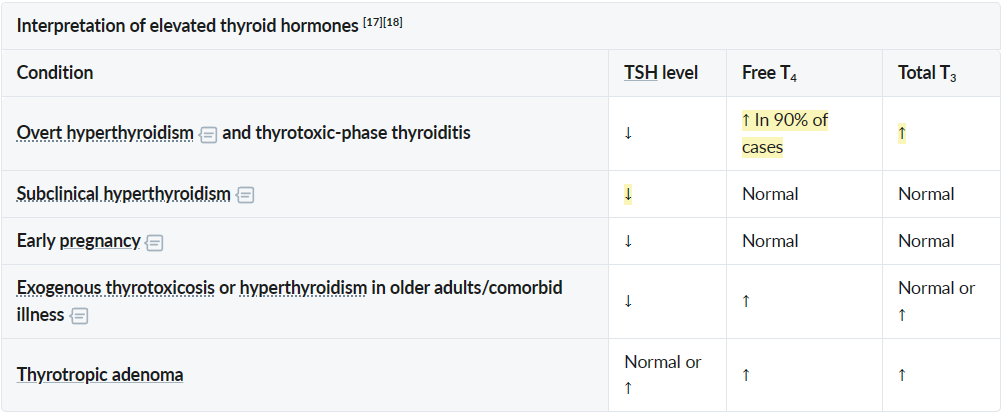
- ↓ Serum TSH levels with ↑ serum free T4 and/or T3 levels
- Patients typically experience symptoms of thyrotoxicosis.
- E.g., Graves disease, toxic MNG, and toxic adenoma
- Subclinical hyperthyroidism
- ↓ Serum TSH levels with normal serum free T4 and T3 levels
- Patients are normally asymptomatic or mildly symptomatic.
- May progress to overt hyperthyroidism
- If the negative feedback regulation mechanism is intact, increased T3 and T4 lead to TSH suppression, which in turn leads to reduced stimulation of thyroid follicular cells. Thyroid hormone levels may then be normal.
- Overt hyperthyroidism
Epidemiology
Etiology
- Secondary Causes (Rare)
- TSH-secreting pituitary adenoma: High TSH, High T3/T4 (TSH usually suppressed in primary causes).
- hCG-mediated: High hCG concentrations (e.g., Choriocarcinoma, Hydatidiform mole, Multiple gestation) cross-react with TSH receptors due to structural homology (alpha-subunit).
Pathophysiology
Thyroid hormone synthesis
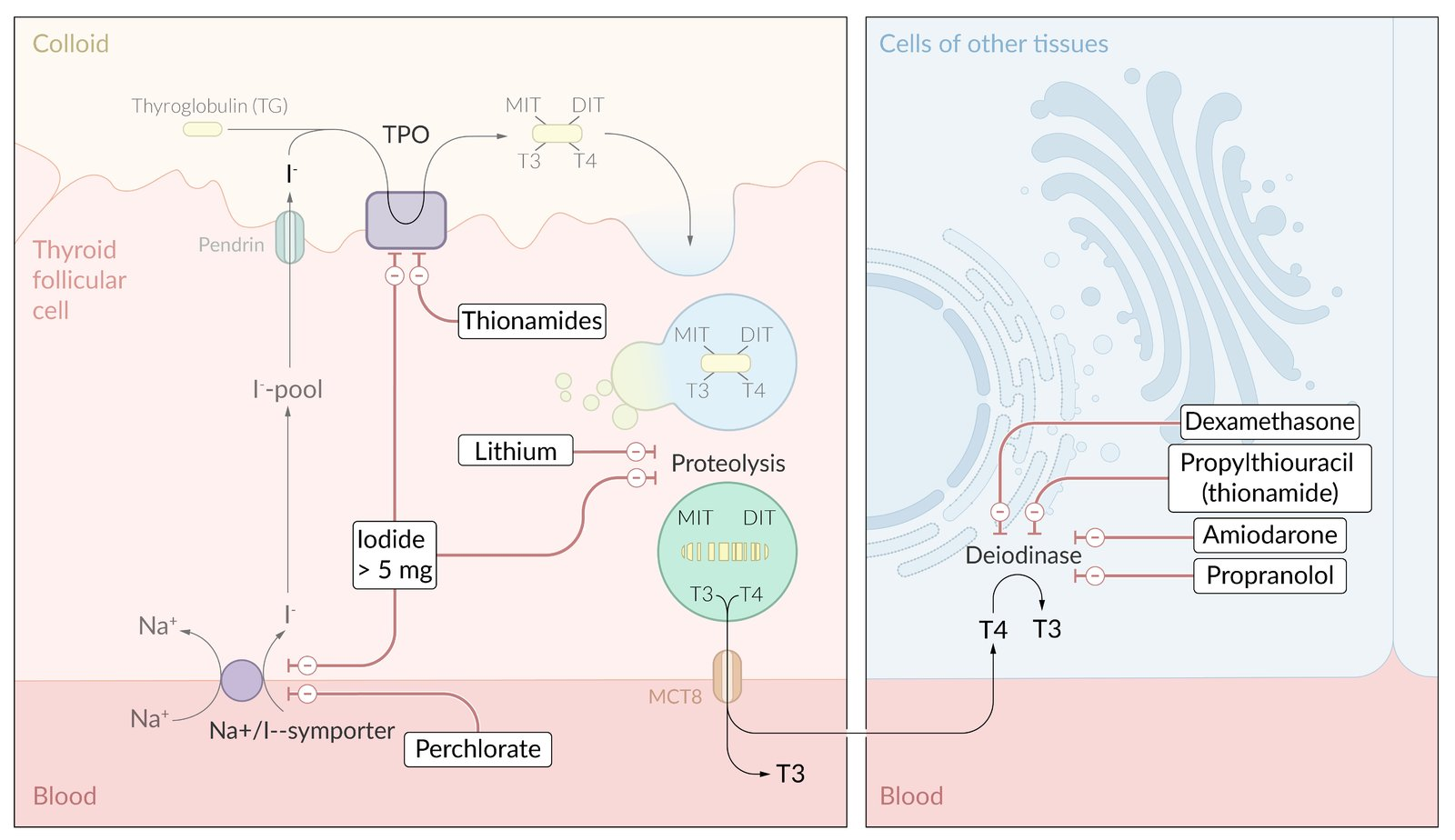
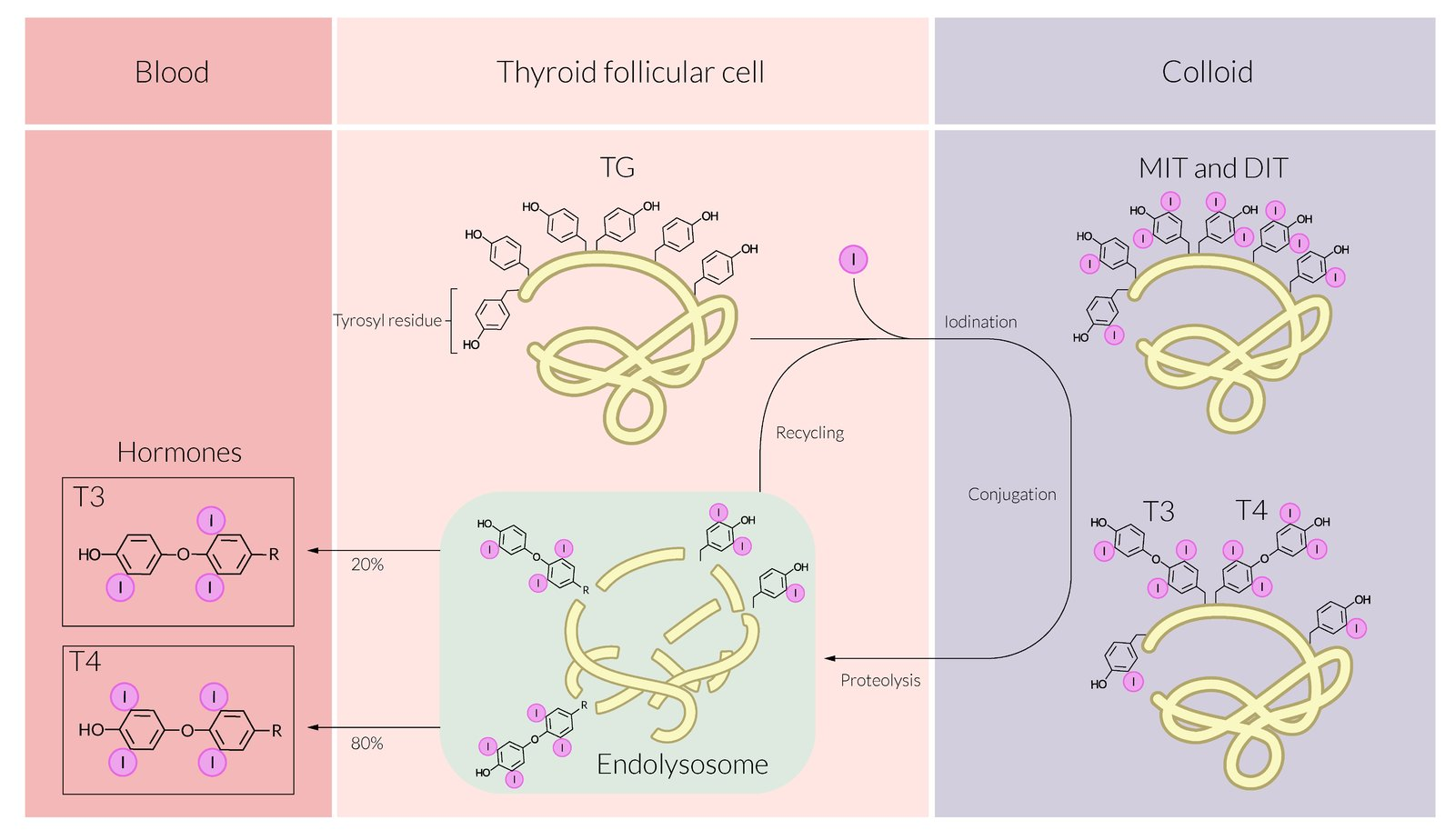
- Synthesis of thyroglobulin (TG)
- Uptake of iodide
- Iodination of thyroglobulin
- Thyroid peroxidase (TPO)
- Oxidation of iodide (I- → I2)
- Organification of the generated I2 by covalently linking it with the tyrosine residues present in TG.
- Generates single (TG + H2O2 + I2 = monoiodotyrosine, MIT) or double-iodinated species of tyrosine (TG-MIT + H2O2 + I2 = diiodotyrosine, DIT)
- Coupling reaction: conjugation of iodinated tyrosine residues
- Two DIT molecules form tetraiodothyronine: DIT + DIT = T4
- One MIT and one DIT form triiodothyronine: MIT + DIT = T3
- Thyroid peroxidase (TPO)
- Storage
- Release
- Transport
- Bound vs. Free: >99% of circulating thyroid hormone is bound to proteins (mainly TBG); <1% is free and physiologically active.
- Total T4 = Bound T4 + Free T4.
- Free T4 = Biologically active fraction; feedback inhibits TSH.
- Thyroxine-Binding Globulin (TBG): Main carrier (binds ~70% of T4).
- TBG (Estrogen/Pregnancy/OCP) Total T4, Normal Free T4.
- TBG (Liver failure, nephrotic syndrome) Total T4, Normal Free T4.
- Transthyretin (Prealbumin): Binds T4 and Retinol.
- USMLE Buzzword: Amyloidosis.
- Senile Cardiac Amyloidosis: Deposition of wild-type transthyretin in heart (elderly).
- Familial Amyloid Polyneuropathy: Deposition of mutated transthyretin.
- Albumin: High capacity, low affinity carrier.
- Bound vs. Free: >99% of circulating thyroid hormone is bound to proteins (mainly TBG); <1% is free and physiologically active.
Tip
- Changes in TBG alter Total T4/T3 but Free T4/T3 usually remains normal (euthyroid state) due to feedback regulation. t
- Patients remain clinically euthyroid.
Thyroid hormone functions
- Metabolism:
- Cardiovascular:
- ↑ HR and contractility (CO) via beta-1 receptor upregulation and SERCA2 expression. c
- ↓ SVR due to vasodilation (causes wide pulse pressure / systolic HTN in hyperthyroidism).
- Growth & Neurodevelopment:
- Synergizes with GH for bone growth/maturation.
- Critical for fetal/neonatal brain myelination; deficiency causes irreversible congenital hypothyroidism (cretinism).
- Neuromuscular & GI:
- Speeds synaptic transmission (hypothyroidism causes delayed deep tendon reflex relaxation; hyperthyroidism causes hyperreflexia/tremor).
- Stimulates gut motility (deficiency = constipation; excess = hyperdefecation).
- Feedback Axis: TRH (hypothalamus) -> TSH (pituitary) -> T3/T4 (thyroid). Free T3/T4 exert direct negative feedback on TSH and TRH.
- TBG Alterations:
- Pregnancy/Estrogen -> ↑ TBG -> ↑ Total T4, but normal Free T4/TSH (euthyroid).
- Liver failure/Steroids -> ↓ TBG -> ↓ Total T4, but normal Free T4/TSH.
Clinical features
- Musculoskeletal
- Fine tremor of the outstretched fingers
- Hyperthyroid myopathy: a condition of muscle weakness, pain, and atrophy associated with hyperthyroidism (e.g., from Graves disease, thyroiditis)
- Predominantly affects individuals > 40 years of age
- Can develop acutely or several weeks to months after the onset of hyperthyroidism.
- Typically affects proximal muscles (e.g., hip flexors, quadriceps) more than distal muscles
- Tendon reflexes (DTRs) are preserved or brisk/hyperreflexic (crucial differentiator from hypothyroid myopathy). c
- Serum creatine kinase levels are most often normal
- Osteopathy: osteoporosis due to the direct effect of T3 on osteoclastic bone resorption, fractures (in the elderly) c
- In long-standing hyperthyroidism
- Endocrinological
- Female: oligo/amenorrhoea, anovulatory infertility, dysfunctional uterine bleeding
- Serum sex hormone-binding globulin (SHBG) levels are high in hyperthyroidism → low serum free (unbound) estradiol concentrations
- Male: gynecomastia, decreased libido, infertility, erectile dysfunction
- Female: oligo/amenorrhoea, anovulatory infertility, dysfunctional uterine bleeding
Subtypes and variants
Exogenous thyrotoxicosis
- Etiology
- Purposeful ingestion for weight loss (often obtained OTC or online). c
- Accidental over-replacement of levothyroxine in hypothyroid pts.
- Factitious disorder (e.g., healthcare workers, psychiatric pts).
- “Hamburger thyrotoxicosis” (accidental ingestion of thyroid-gland contaminated ground beef).
- Clinical Presentation:
- Sxs of hyperthyroidism (tachycardia, weight loss, heat intolerance, tremor, anxiety).
- No goiter, thyroid tenderness, or orbitopathy (thyroid gland is non-palpable/atrophic due to TSH suppression).
- Diagnostics:
- Labs: ↓ TSH, ↑ Free T4 (or T3).
- RAIU: Low/suppressed uptake (< 5%).
- Serum Thyroglobulin (Tg): Low/undetectable (crucial differentiator; endogenous hyperthyroidism/thyroiditis has ↑ Tg).
- Differential:
- Silent/Subacute Thyroiditis: Low RAIU but ↑ Tg (due to release of preformed hormone). c
- Graves Disease: ↑ diffuse RAIU, goiter, (+) TRAb, and ↑ Tg.
- Management:
- Decrease or discontinue exogenous thyroid hormone.
- Beta-blockers (e.g., Propranolol) for symptomatic cardiac control.
Diagnostics
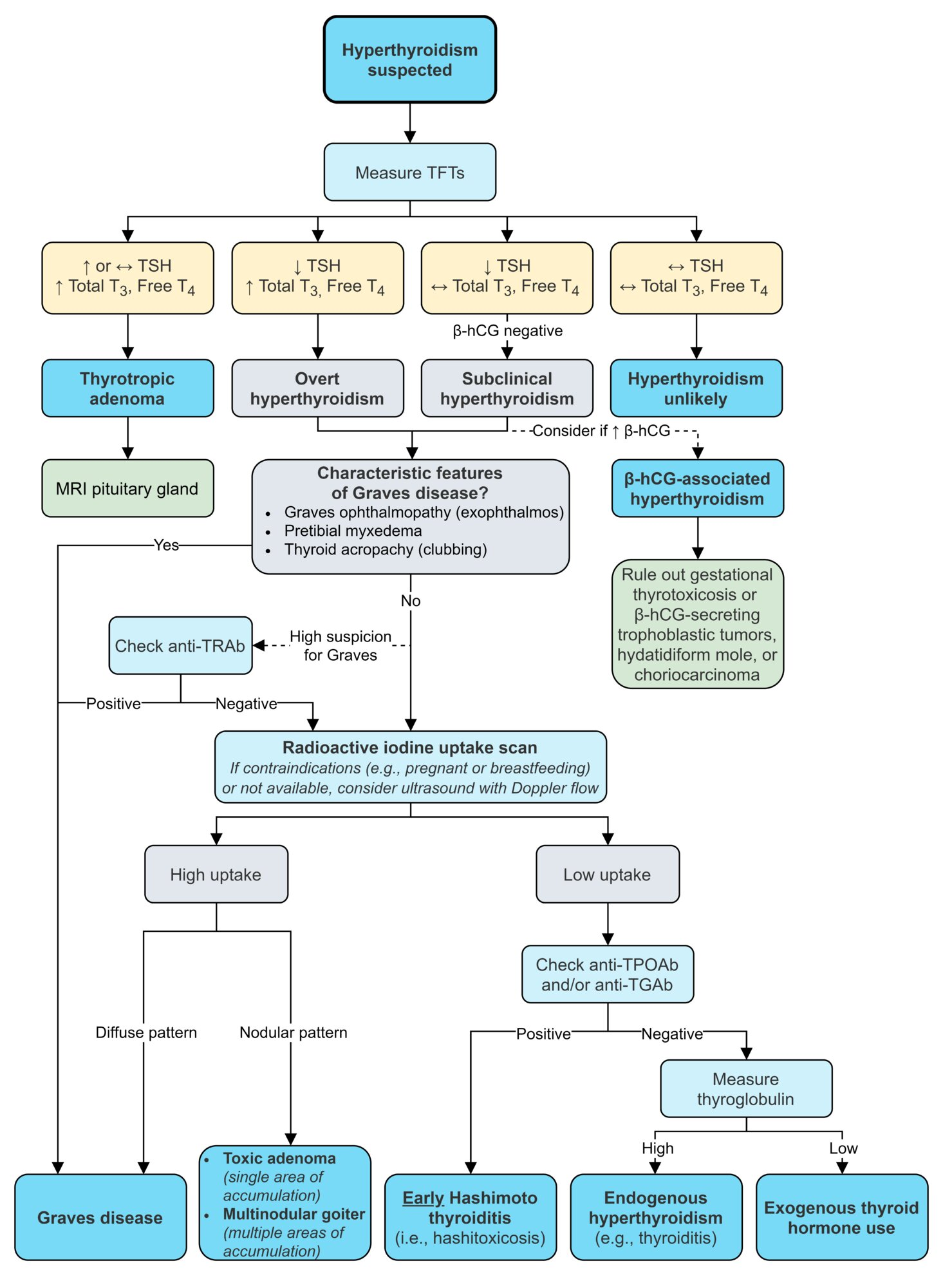
Nuclear medicine thyroid scan and radioactive iodine uptake measurement
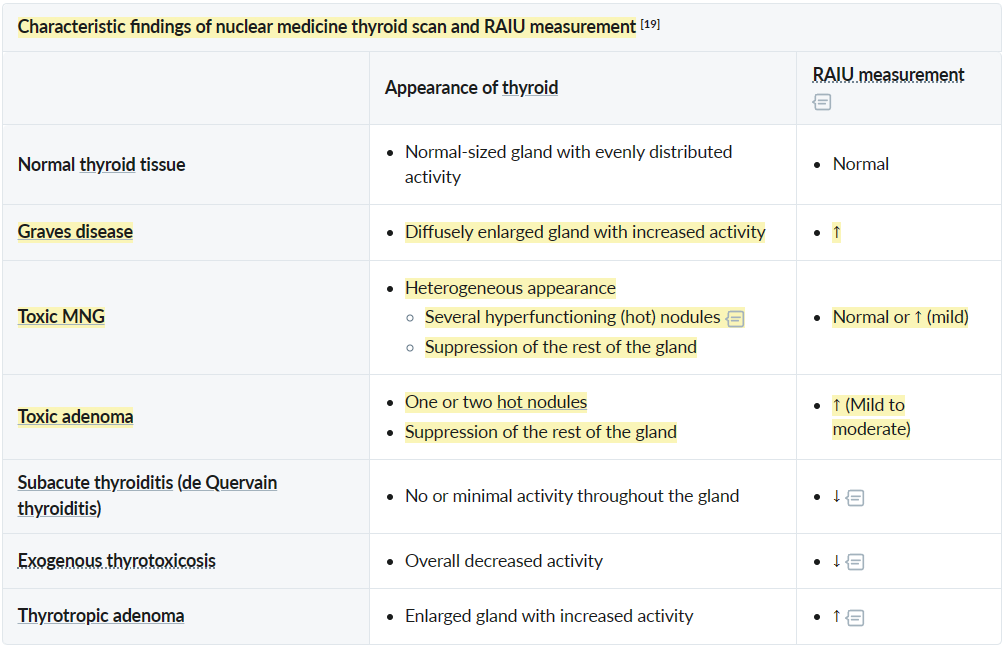
- Subacute thyroiditis: The inflammatory disruption of the follicle membranes inhibits the transport of iodine across the thyroid cells.
Treatment
- Symptomatic Relief (Immediate): Beta-blockers (Propranolol or Atenolol) to control tachycardia, tremor, and anxiety. Propranolol also inhibits peripheral T4-to-T3 conversion.
- Antithyroid Drugs (ATDs):
- MoA: Both inhibit thyroid peroxidase (TPO), blocking the organification and coupling steps of thyroid hormone synthesis. PTU additionally inhibits peripheral 5’-deiodinase, which decreases the conversion of T4 to the more active T3. t
- Methimazole (MMI): First-line for most pts. Avoid in 1st trimester of pregnancy (teratogenic: aplasia cutis).
- Propylthiouracil (PTU): Preferred in 1st trimester of pregnancy and Thyroid Storm (blocks peripheral T4->T3 conversion). Black box warning: severe hepatotoxicity.
- Side Effects (Both): Agranulocytosis (sudden fever/sore throat -> stop drug immediately, check CBC; do not routinely monitor CBC). c
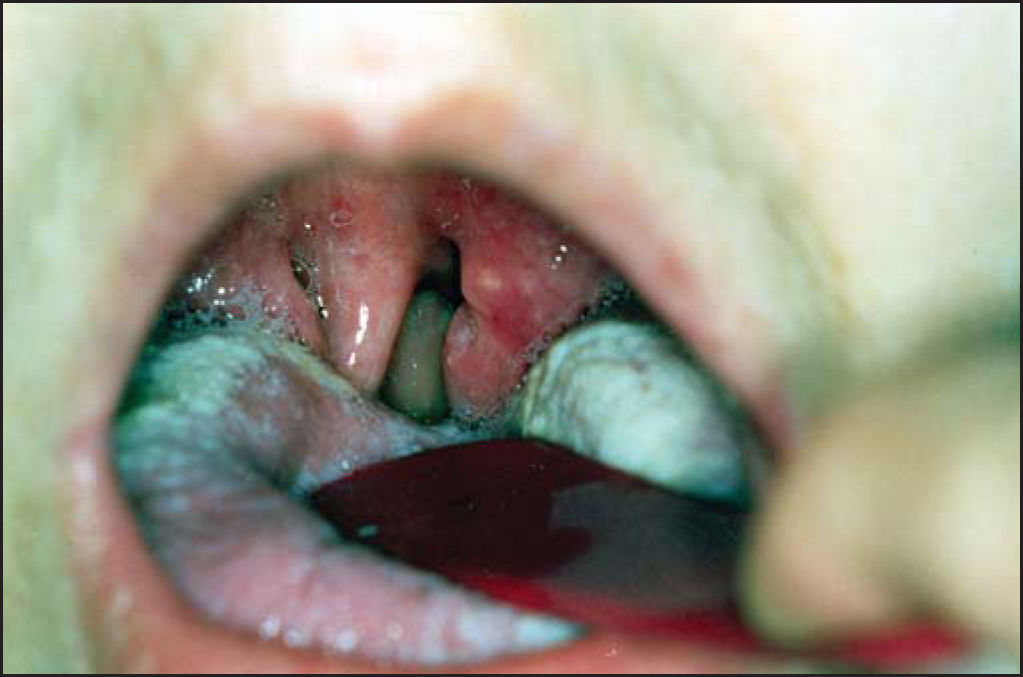
- MMI and PTU are both thionamide drugs. They carry a risk of cross-reactivity that can lead to agranulocytosis, so should this severe adverse reaction occur, both medications should be contraindicated.
- Definitive Treatment:
- Radioactive Iodine (131-I) Ablation: Preferred for TMG/Adenoma and most GD. Contraindicated in pregnancy, lactation, and severe Graves ophthalmopathy (can worsen eye disease).
- Thyroidectomy: Indicated for large compressive goiters, coexisting thyroid cancer, moderate-to-severe Graves ophthalmopathy, or pregnant pts allergic to ATDs.
Management in Special Situations
-
Thyroid Storm
- A life-threatening medical emergency requiring ICU admission.
- Treatment (The “4 P’s”):
- Propranolol (or other beta-blockers) to control adrenergic symptoms.
- Propylthiouracil (PTU) is often preferred as it blocks both hormone synthesis and peripheral T4-T3 conversion.
- Potassium Iodide (SSKI or Lugol’s solution) given at least 1 hour after ATD administration to block the release of pre-formed hormone.
- Prednisone (or other corticosteroids like hydrocortisone) to decrease peripheral T4-T3 conversion and treat potential relative adrenal insufficiency.
-
Pregnancy
- RAI is absolutely contraindicated.
- 1st Trimester: Propylthiouracil (PTU) is the preferred drug. Methimazole is associated with teratogenicity, including aplasia cutis and choanal atresia. t
- 2nd & 3rd Trimesters: Often switched to Methimazole (MMI) due to PTU’s higher risk of causing maternal hepatotoxicity.
- The goal is to maintain the mother’s free T4 at the high-normal range using the lowest possible dose of ATD.