ABO Antigens: Found on RBCs AND other tissues (endothelium, platelets, fetal tissues).
Result: Maternal Anti-A/B antibodies crossing the placenta bind to these other tissues, effectively “soaking up” or neutralizing the antibodies before they can significantly destroy RBCs.
Rh Antigens: Found ONLY on RBCs.
Result: Every maternal Anti-D antibody that crosses the placenta targets red blood cells specifically, leading to focused and massive hemolysis.
2. Antigen Maturity
ABO Antigens:Weakly expressed on fetal RBCs compared to adult RBCs.
Result: Less binding sites for antibodies → less hemolysis.
Rh Antigens:Fully expressed at birth.
Result: High density of binding sites allows for rapid destruction (extravascular hemolysis in the spleen).
ABO incompatibility
Highest risk: mother with blood group O; newborn with blood group A or B
Maternal antibodies (anti-A and/or anti-B) against nonself antigens of the ABO system are present even if sensitization has not occurred, so fetal hemolysis may occur during the first pregnancy.
Combination of predominantly IgM antibodies and late expression of fetal ABO antigens reduces the chances of significant disease.
Administer within 72 hours postpartum if neonate is Rh(D)-positive.
Administer after any potential feto-maternal hemorrhage event (spontaneous abortion, antepartum hemorrhage, ectopic pregnancy, CVS, amniocentesis, abdominal trauma, external cephalic version). c2
This leads to fetal blood flowing back into the maternal circulation, so more globulin is needed.
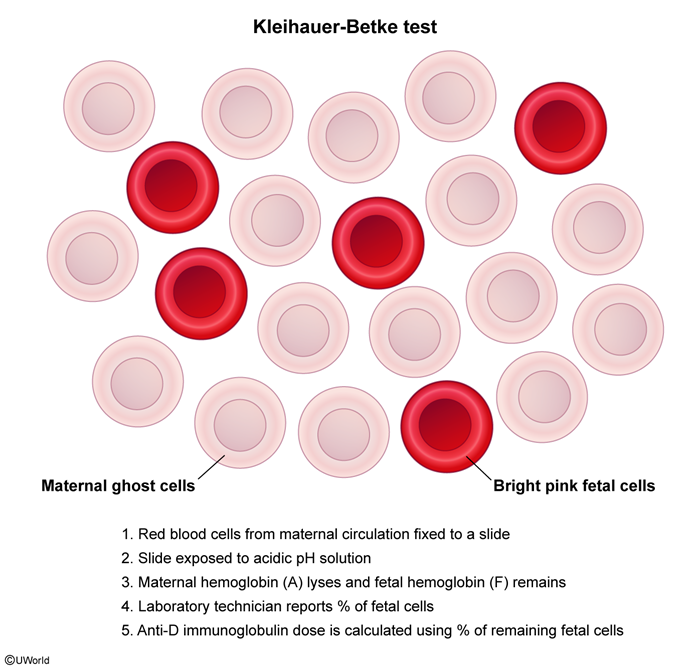
Kleihauer-Betke (KB) Test / Flow Cytometry:
Perform postpartum or post-trauma to quantify feto-maternal hemorrhage volume and calculate required additional doses of RhoGAM.
Note: RhoGAM is ineffective once maternal alloimmunization (sensitization) has occurred.
Antenatal Management (Sensitized Pregnancies):
Surveillance: Serial MCA-PSV Doppler every 1–2 weeks starting at 16–20 weeks gestation.
If MCA-PSV > 1.5 MoM:
<35 weeks: Intrauterine Erythrocyte Transfusion (IUET) via PUBS into umbilical vein using O-negative, CMV-negative, irradiated, leukoreduced packed RBCs.
≥35 weeks: Proceed to delivery.
Neonatal Management:
First-line: Intensive Phototherapy (converts hydrophobic unconjugated bilirubin into water-soluble photoisomers/lumirubin).
Second-line / Adjunct: Intravenous Immune Globulin (IVIG) to block neonatal Fc receptors and decrease hemolysis in immune-mediated hyperbilirubinemia.
Refractory / Severe Hyperbilirubinemia: Double-volume Exchange Transfusion if total serum bilirubin exceeds exchange thresholds or if acute bilirubin encephalopathy signs appear. c