OET Writing: 14 sample letters and case notes
Source: original DOCX. Screenshot text was recognised with OCR; names, dates, doses and numerical results should be checked against the linked images. The source’s draft comments and example letters are preserved, not endorsed as official OET model answers.
Referral letter – obesity
Case notes
Screenshot image1.png — OCR
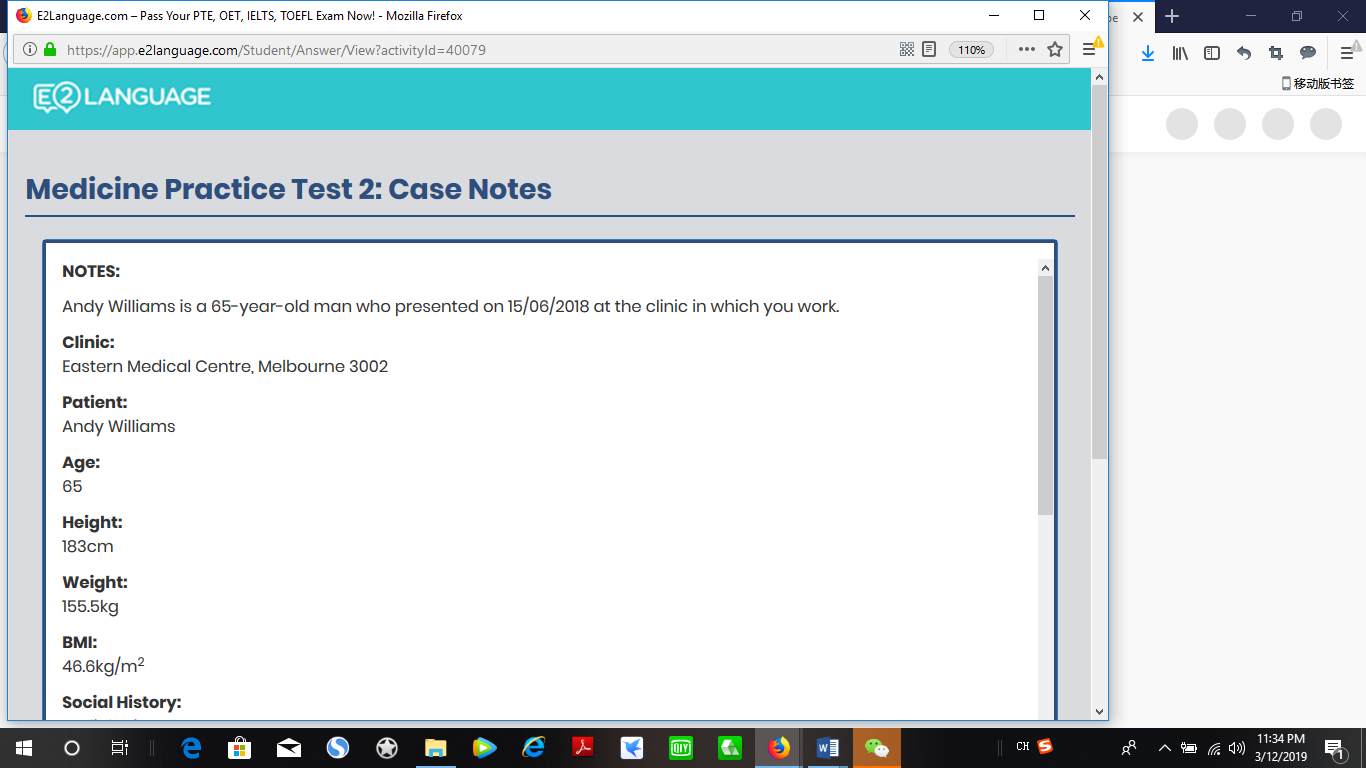
Medicine Practice Test 2: Case Notes
NOTES:
Andy Williams is a 65-year-old man who presented on 15/06/2018 at the clinic in which you work.
Clinic:
Eastern Medical Centre, Melbourne 3002
Patient:
Andy Williams
Age:
65
Height:
183cm
Weight:
155.5kg
BMI:
46.6kg/m-
Social History:
Screenshot image2.png — OCR
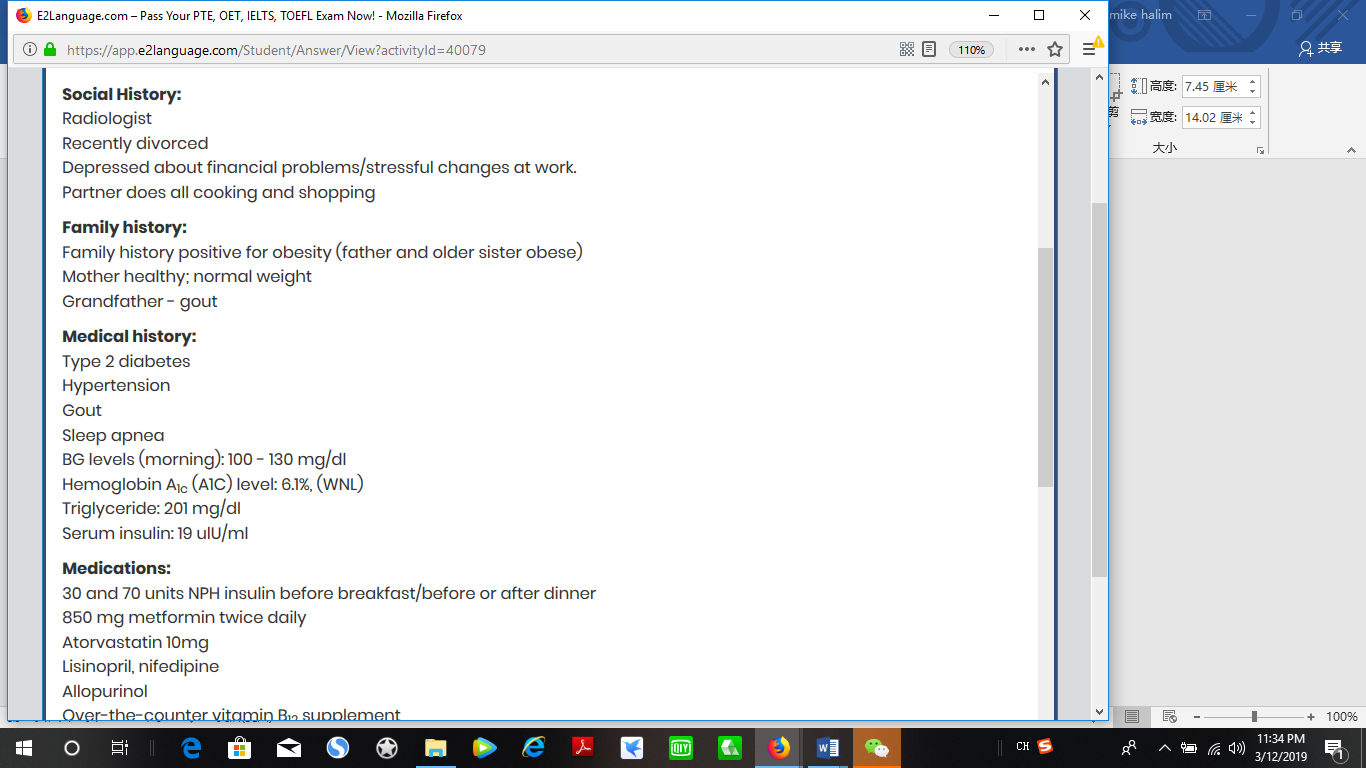
Social History:
Radiologist
Recently divorced
Depressed obout financial problems/stressful changes at work.
Partner does all cooking and shopping
F1mily history:
Family history positive for obesity (father and older sister obese)
Mother healthy; normal weight
Grandfather - gout
Medical history:
Type 2 diabetes
Hypertension
Gout
Sleep apnea
BG levels (morning): 100 - 130 mg/dl
Hemoglobin Alc (A1C) level: 6.1%, (WNL
Triglyceride: 201 mg/dl
Serum insulin: 19 ulU/ml
Medications:
30 and 70 units NPH insulin before breakfast/before or after dinner
850 mg metformin twice daily
Atorvastatin 10mg
Lisinopril, nifedipine
Allopurinol
Over-the-counter vitamin Be supplement
Screenshot image3.png — OCR
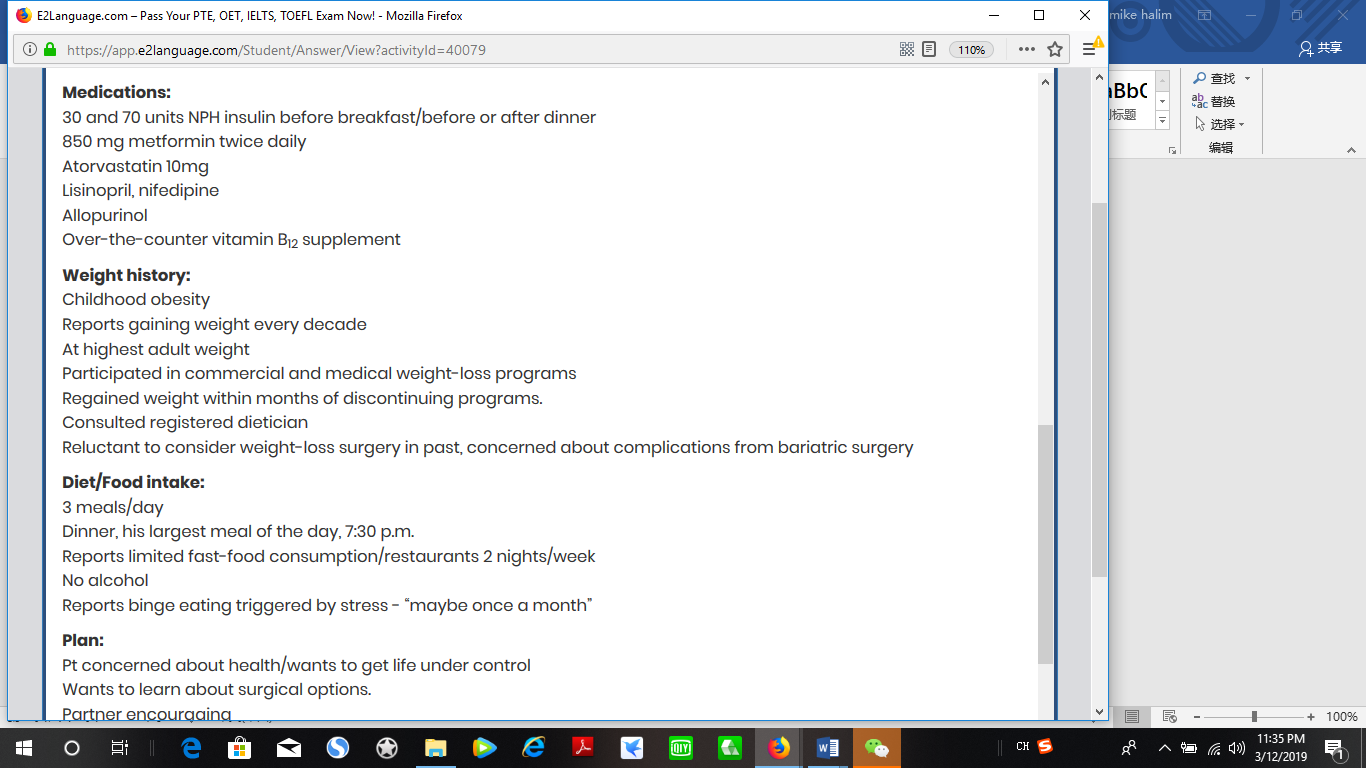
Medications:
30 and 70 units NPH insulin before breakfast/before or after dinner
850 mg metformin twice daily
Atorvastatin 10mg
Lisinopril, nifedipine
Allopurinol
Over-the-counter vitamin B12 supplement
Weight history:
Childhood obesity
Reports gaining weight every decade
At highest adult weight
Participated in commercial and medical weight-loss programs
Regained weight within months of discontinuing programs.
Consulted registered dietician
Reluctant to consider weight-loss surgery in past, concerned about complications from bariatric surgery
Diet/Food intake:
3 meals/day
Dinner, his largest meal of the day, 7:30 p.m.
Reports limited fast-food consumption/restaurants 2 nights/week
No alcohol
Reports binge eating triggered by stress - maybe once a month”
Plan:
Pt concerned about health/wants to get life under control
Wants to learn about surgical options.
Partner encouraaina
Screenshot image4.png — OCR
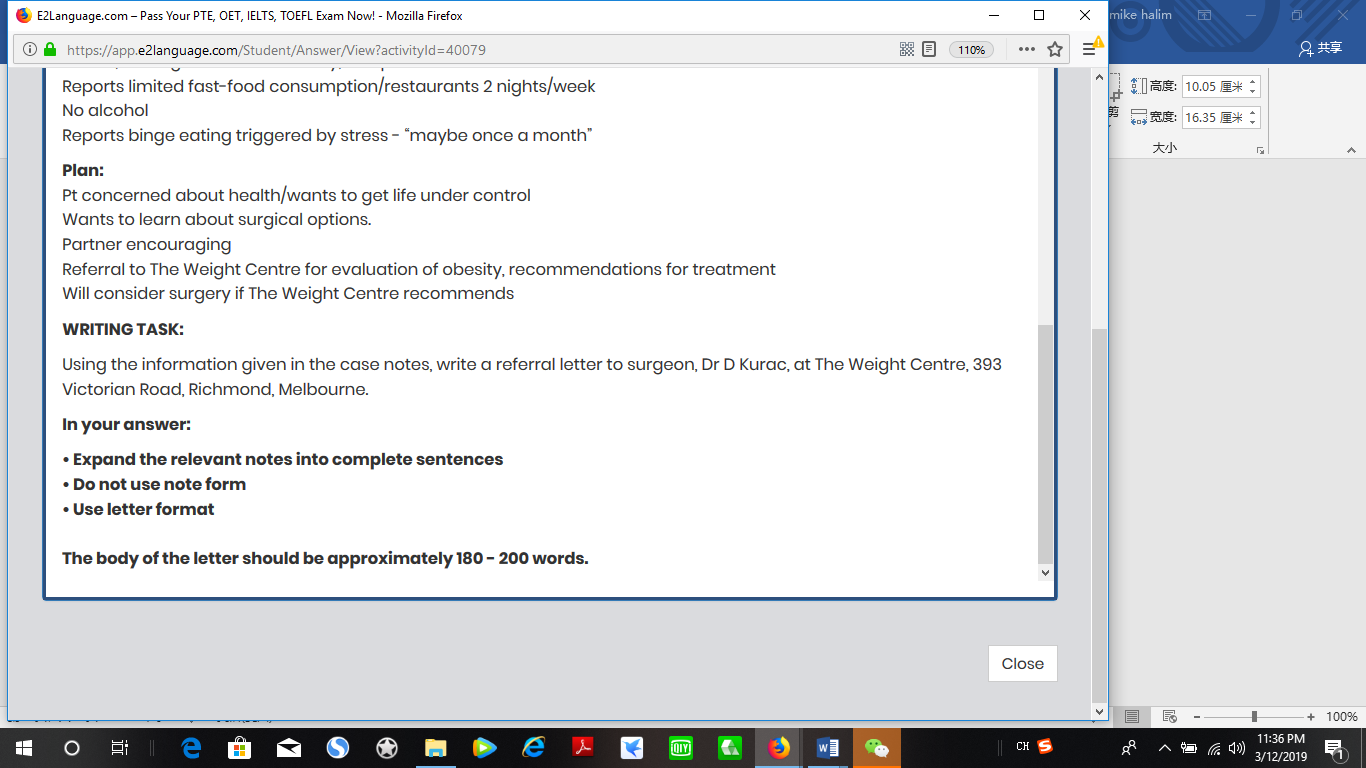
Reports limited fast-food consumption/restaurants 2 nights/week
No alcohol
Reports binge eating triggered by stress - maybe once a month”
Plan:
Pt concerned about health/wants to get life under control
Wants to learn about surgical options.
Partner encouraging
Referral to The Weight Centre for evaluction of obesity, recommendations for treatment
Will consider surgery if The Weight Centre recommends
WRITING TASK:
Using the information given in the case notes, write a referral letter to surgeon, Dr D Kurac, at The Weight Centre, 393
Victorian Road, Richmond, Melbourne.
In your answer:
• Expand the relevant notes into complete sentences
• Do not use note form
• Use letter format
The body of the letter should be opproximotely 180 - 200 words.
Model letter sample 1
Screenshot image5.png — OCR
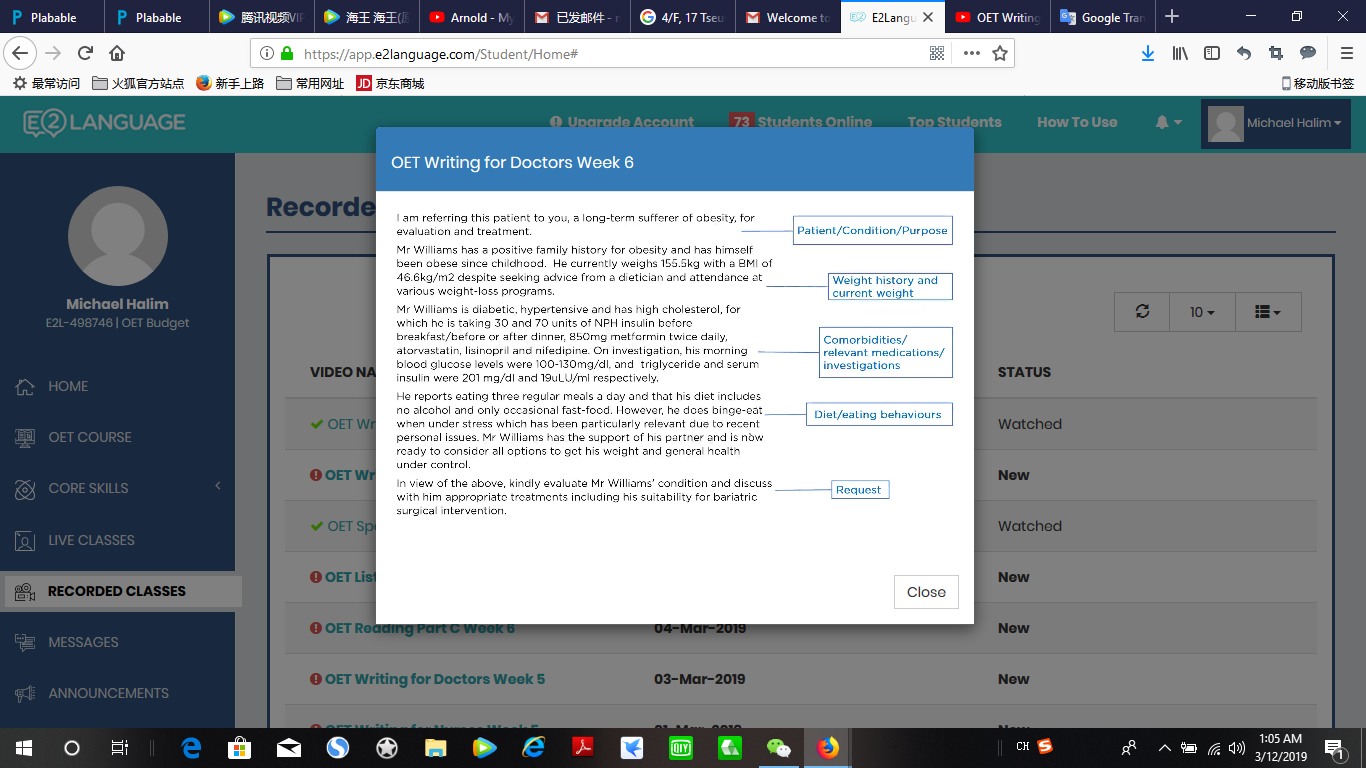
I am referring this patient to you, a long-term sufferer of obesity, for evaluation and treatment. Mr Williams has a positive family history for obesity and has himself been obese since childhood. He currently weighs 155.5kg with a BMI of 46.6kg/m2 despite seeking advice from a dietician and attendance at various weight-loss programs. Mr Williams is diabetic, hypertensive and has high cholesterol, for which he is taking 30 and 70 units of NPH insulin before breakfast/before or after dinner, 850mg metformin twice daily, atorvastatin, lisinopril and nifedipine. On investigation, his morning blood glucose levels were 100-130mg/dl, and triglyceride and serum insulin were 201 mg/dl and 19uLU/ml respectively. He reports eating three regular meals a day and that his diet includes no alcohol and only occasional fast-food. However, he does binge-eat when under stress which has been particularly relevant due to recent personal issues. Mr Williams has the support of his partner and is now ready to consider all options to get his weight and general health under control. In view of the above, kindly evaluate Mr Williams’ condition and discuss with him appropriate treatments including his suitability for bariatric surgical intervention.
Model letter sample 2
Screenshot image6.png — OCR
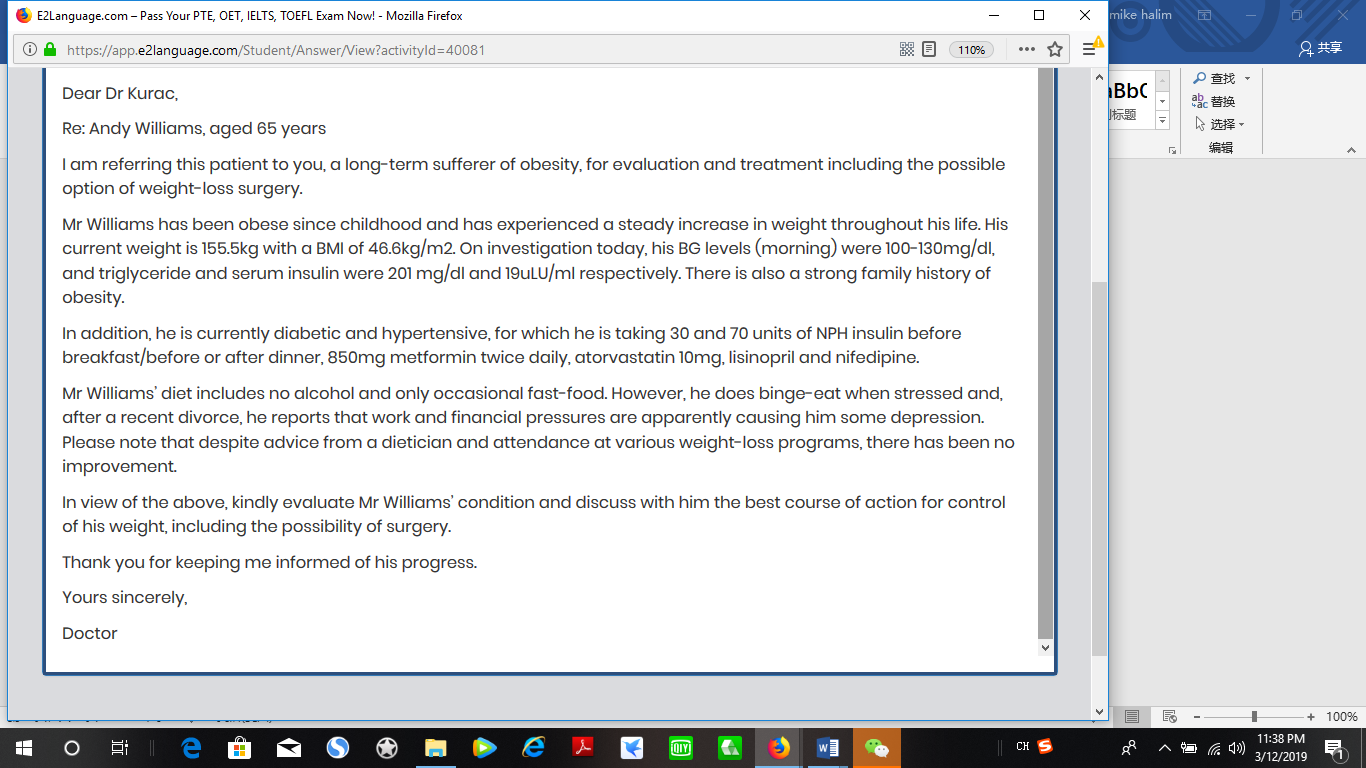
Dear Dr Kurac, Re: Andy Williams, aged 65 years I am referring this patient to you, a long-term sufferer of obesity, for evaluation and treatment including the possible option of weight-loss surgery.
Mr Williams has been obese since childhood and has experienced a steady increase in weight throughout his life. His current weight is 155.5kg with a BMI of 46.6kg/m2. On investigation today, his BG levels (morning) were 100-130mg/dl. and triglyceride and serum insulin were 201 mg/dl and 19uLU/ml respectively. There is also a strong family history of obesity.
In addition, he is currently diabetic and hypertensive, for which he is taking 30 and 70 units of NPH insulin before breakfast/before or after dinner, 850mg metformin twice daily, atorvastatin 10mg, lisinopril and nifedipine. Mr Williams’ diet includes no alcohol and only occasional fast-food. However, he does binge-eat when stressed and, after a recent divorce, he reports that work and financial pressures are apparently causing him some depression. Please note that despite advice from a dietician and attendance at various weight-loss programs, there has been no improvement.
In view of the above, kindly evaluate Mr Williams’ condition and discuss with him the best course of action for control of his weight, including the possibility of surgery.
Thank you for keeping me informed of his progress. Yours sincerely, Doctor
Dr D Kurac (name of doctor you are referring the patient to)
Surgeon
Weight center (address)
393 Victorian Road
Richmond, Melbourne
15 June 2018 (Date – format doesn’t matter)
Dear Dr Kurac (Dear name of doctor.)
Re: Andy Williams, aged 65 years old (Re: patient and age / DOB. If age and DOB are both given, write DOB instead)
Paragraph one: Patient / Condition / Purpose – formats are more or less fixed for all referral letters
Patient – Andy Williams. Condition – obesity. Purpose - Evaulation of obesity and recommendation for treatment (but in paragraph 1, lets keep it brief – evaluation and treatment. We will save the details - Evaulation of obesity, recommendation for treatment for the last paragraph aka request)
-
I am referring Andy Williams (*Patient), who has been suffering from obesity (*Condition**), to you for evaluation and treatment (*Purpose)**
-
I am writing to refer Andy Williams (*Patient) to you. He has been suffering from obesity (*Condition**). Your evaluation and treatment (*Purpose)** would be highly appreciative.
-
Thankyou for seeing Andy Williams (*Patient), who has been suffering from obesity (*Condition**). for evaluation and treatment (*Purpose)**
Paragraph 2
Details: 163 cm, 155.5 kg, BMI 46.6, family history of obesity, medical history (type 2 diabetes, hypertension, sleep apnea, BG levels 100-130 mg/dl, triglycerides 201 mg/dl, serum insulin insulin 19 IU/ml). Medications (30 and 70 units of NPH insulin before breakfast / before or after dinner, 850 mg metformin twice daily, atorvastatin, lisinopril and nifedipine)
Mr Williams has a family history of obesity. He weighs 155.5 kg and his BMI is around 46.6 kg/m2. He presents with diabetes, hypertension and sleep apnea. Lab reports showed (revealed) that his blood glucose was within 100-130 mg/dl and serum insulin and triglycerides were 19 IU/ml and 201 mg/dl respectively. His medications included 30 and 70 units of NPH insulin before breakfast / before or after dinner, 850 mg metformin twice daily, atorvastatin, lisinopril and nifedipine.
Paragraph 3
Details: Childhood obesity, gains weight every decade, at highest adult weight, participated in commercial and medical weight loss programs, consulted registered dietician,
Mr Williams has been suffering from obesity since he was a child. He participated in various weight loss programs and even consulted a dietician. However, these failed to tackle his obesity problem (failed to reduce his weight to an acceptable range)
*Alternatively, it might be better to combine: family history of obesity, weighs 155.5 kg, childhood obesity together into one paragraph and diabetes / hypertension, lab reports, medications into one paragraph
Paragraph 2
Mr Williams has a family history of obesity. He has been suffering from obesity since childhood. Despite participating in various weight loss programs and consulting a dietician, he continues to put on weight and currently weighs 155.5 kg with a BMI of 46.6 kg / m2.
Paragraph 3
Mr Williams presents with diabetes, hypertension and sleep apnea, for which he is taking 30 and 70 units of NPH insulin before breakfast / before or after dinner, 850 mg metformin twice daily, atorvastatin, lisinopril and nifedipine. Lab reports showed that his blood glucose fell within 100-130 mg/dl and serum insulin and triglycerides were 19 IU/ml and 201 mg/dl respectively.
Paragraph 4 Details: Diet - 3 meals / day. Reports limited fast food consumption 2 nights / weeks, no alcohol, reports binge eating triggered by stress,plan - Concerned about health / wants to get life under control, wants to learn about surgical options, partner encouraging.
Mr Williams eats 3 regular meals per day. He limits fast food consumption and doesn’t drink any alcohol. However, he claims (reports / said that) to binge eat occasionally due to stress. He has the support of his partner and is considering surgical treatments that may help him get his weight and general health under control.
Paragraoh 5 - Request: more or less the same format for all referall lettes - In the view of above, kindly evaluate ……
Details - Evaulation of obesity, recommendation for treatment
In the view of above, kindly evaluate Mr William’s condition and suggest him the most appropriate treatment regime. Should you have any questions, please do not hesitate to contact me.
Referral letter – Allergies
Case notes
Screenshot image7.png — OCR
NOTES:
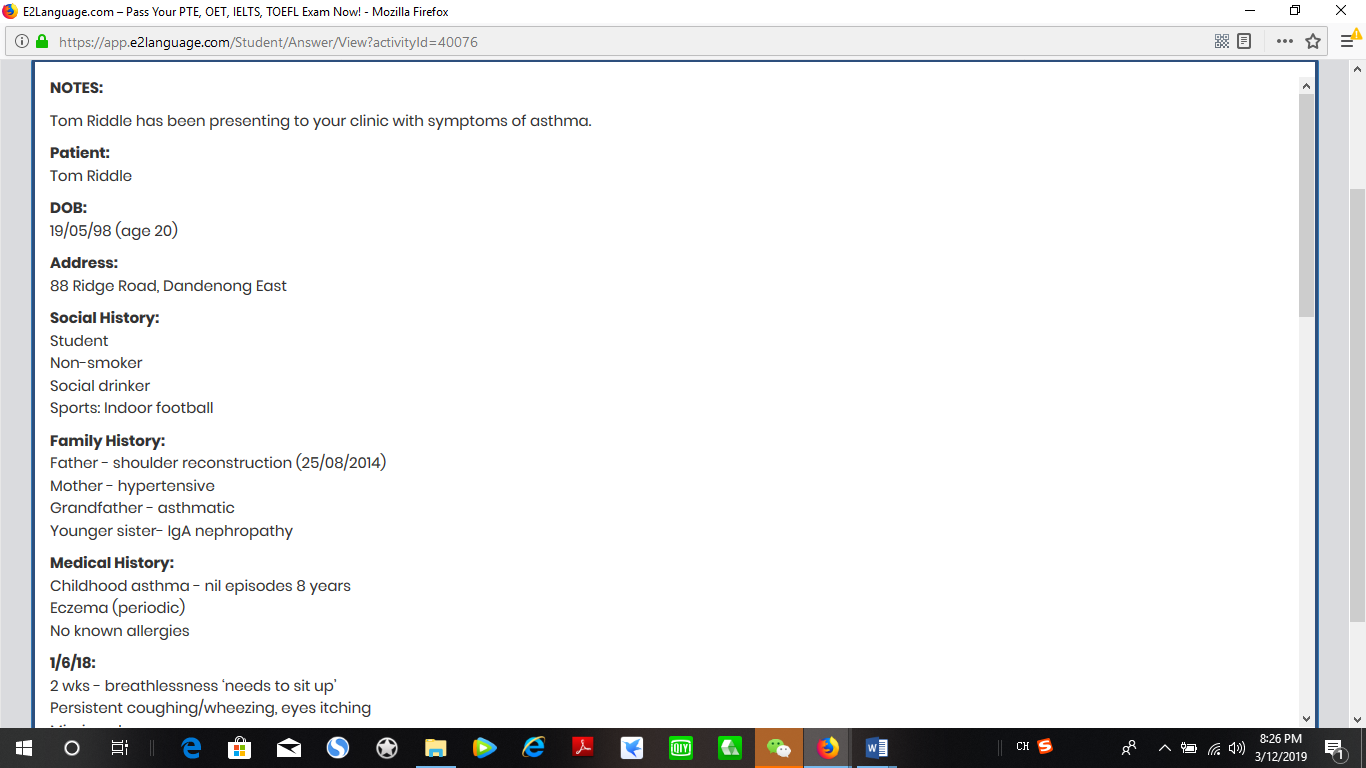
Tom Riddle has been presenting to your clinic with symptoms of osthma.
Patient:
Tom Riddle
DOB:
19/05/98 (age 20)
Address:
88 Ridge Road, Dandenong East
Social History:
Student
Non-smoker
Social drinker
Sports: Indoor football
F1mily History:
Father - shoulder reconstruction (25/08/2014)
Mother - hypertensive
Grandfather - asthmatic
Younger sister- IgA nephropathy
Medical History:
Childhood asthma - nil episodes 8 years
Eczema (periodic)
No known allergies
1/6/18:
2 wks - breathlessness ‘needs to sit up’
Persistent coughing/wheezing, eyes itching
Screenshot image8.png — OCR
1/6/18:
2 wks - breathlessness ‘needs to sit up’
Persistent coughing/wheezing, eyes itching
Missing classes
Notes:
New accommodation-two cats, dusty old carpet, sleeps on floor
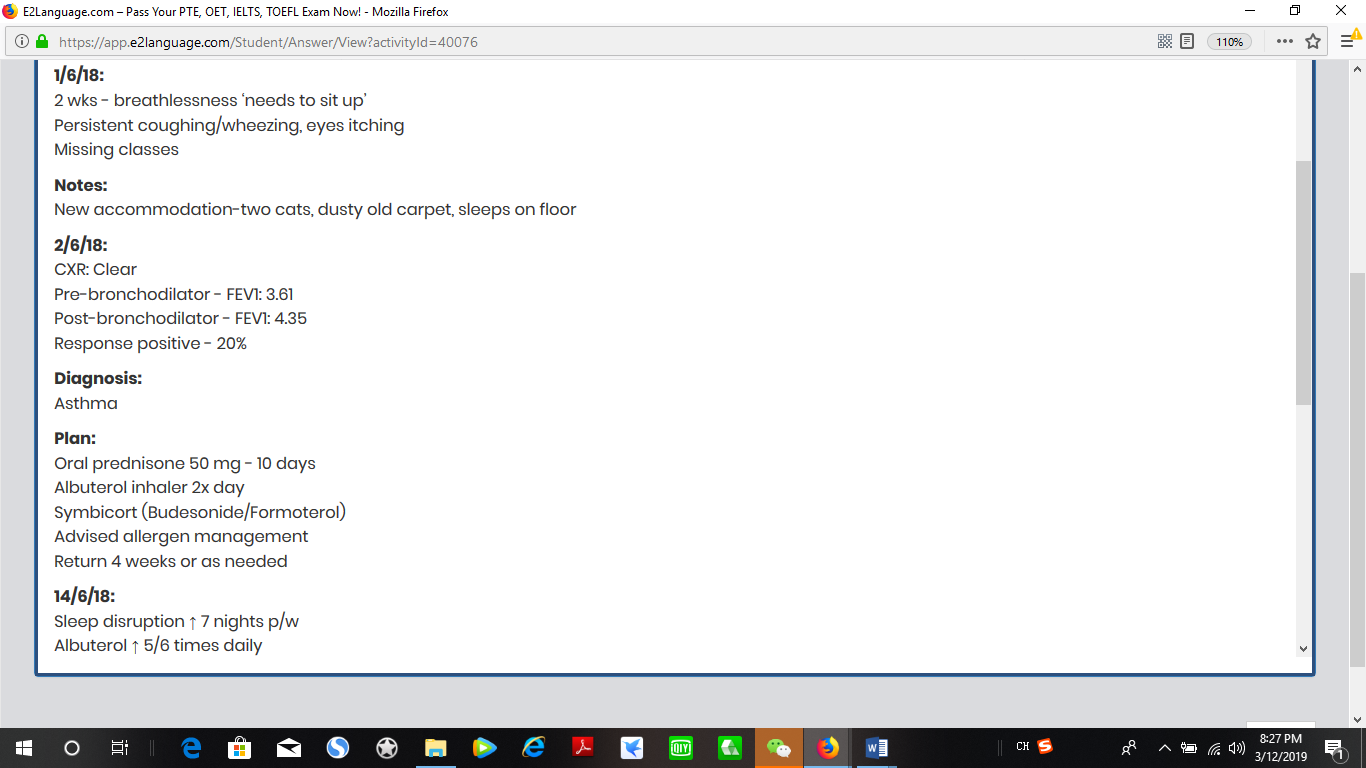
2/6/18:
CXR: Clear
Pre-bronchodilator - FEVI: 3.61
Post-bronchodilator - FEVI: 4.35
Response positive - 20%
Diagnosis:
Asthma
Plan:
Oral prednisone 50 mg - 10 days
Albuterol inhaler 2x day
Symbicort (Budesonide/Formoterol)
Advised allergen management
Return 4 weeks or as needed
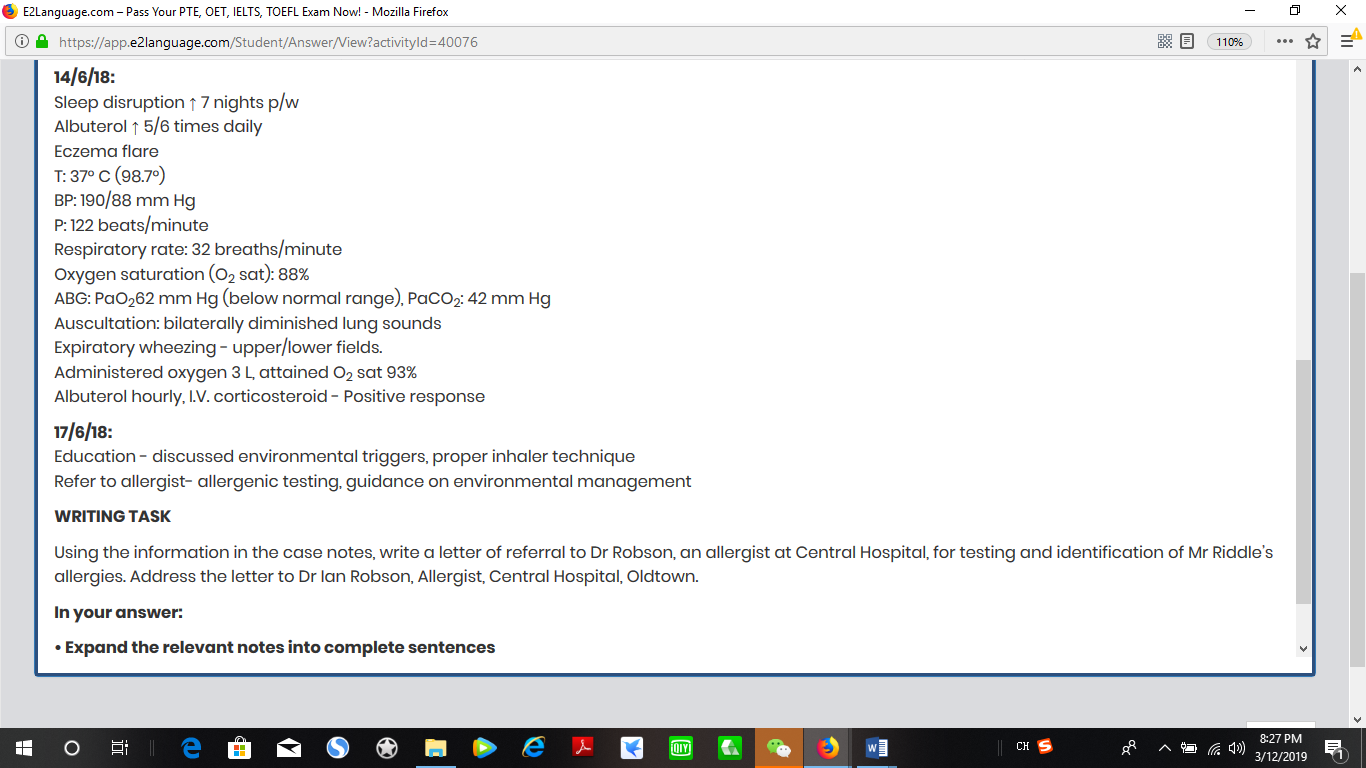
14/6/18:
Sleep disruption 1 7 nights p/w
Albuterol 1 5/6 times daily
Screenshot image9.png — OCR
14/6/18:
Sleep disruption 1 7 nights p/w
Albuterol 1 5/6 times daily
Eczema flare
T: 37° C (98.7°)
BP: 190/88 mm Hg
P: 122 beats/minute
Respiratory rate: 32 breaths/minute
Oxygen saturation (02 sat): 88%
ABG: Pa0262 mm Hg (below normal ronge), PaCO2: 42 mm Hg
Auscultation: bilaterally diminished lung sounds
Expiratory wheezing - upper/lower fields.
Administered oxygen 3 L, attained 02 sat 93%
Albuterol hourly, I.V. corticosteroid - Positive response
17/6/18:
Eduction - discussed environmental triggers, proper inhaler technique
Refer to allergist- allergenic testing, guidance on environmental management
WRITING TASK
Using the information in the case notes, write a letter of referral to Dr Robson, an allergist at Central Hospital, for testing and identification of Mr Riddle’s
allergies. Address the letter to Dr lan Robson, Allergist, Central Hospital, Oldtown.
In your answer:
• Expand the relevant notes into complete sentences
Model letter
Screenshot image10.png — OCR
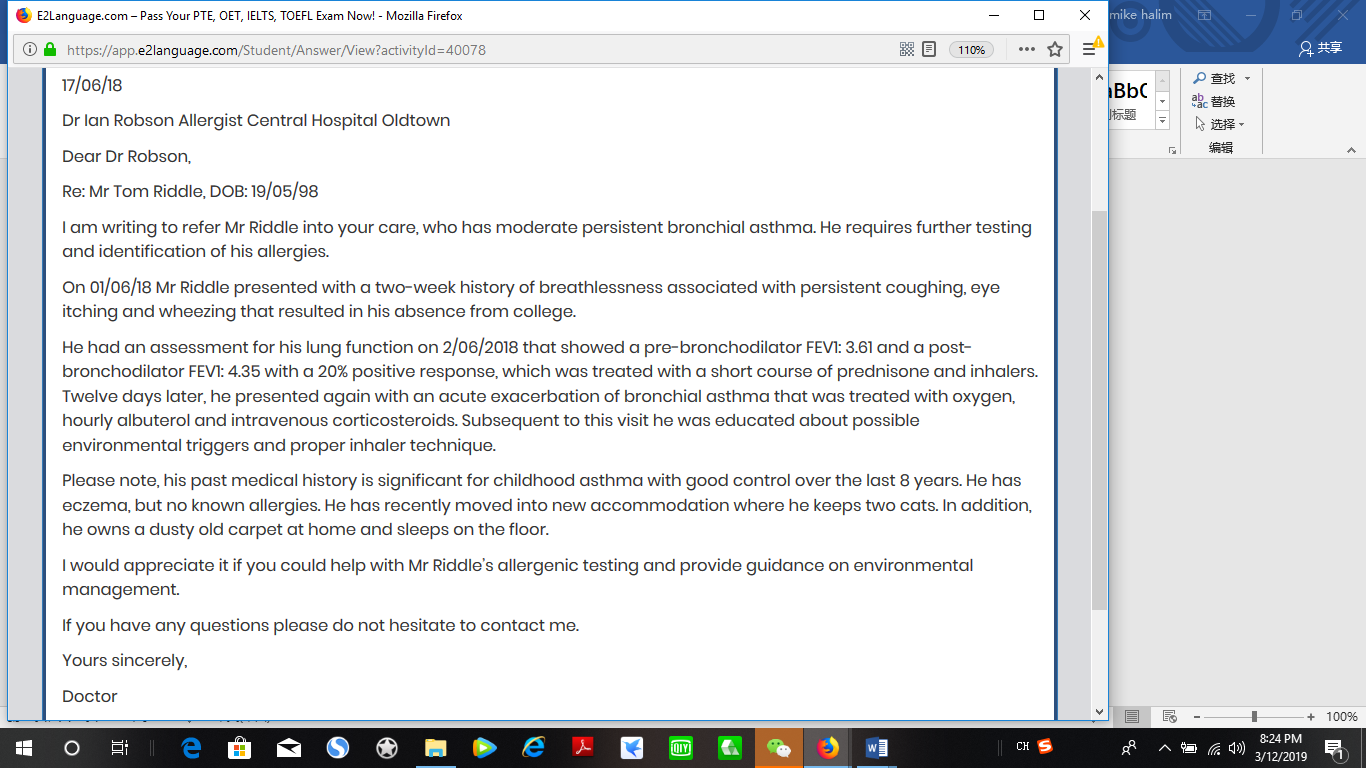
17/06/18
Dr lon Robson Allergist Central Hospital Oldtown
Dear Dr Robson,
Re: Mr Tom Riddle, DOB: 19/05/98 I am writing to refer Mr Riddle into your care, who has moderate persistent bronchial asthma. He requires turther testing and identification of his allergies.
On 01/06/18 Mr Riddle presented with o two-week history of breathlessness associated with persistent coughing, eye itching and wheezing that resulted in his absence from college.
He had an assessment for his lung function on 2/06/2018 that showed a pre-bronchodilator FEVI: 3.61 and a post- bronchodilator FEVI: 4.35 with a 20% positive response, which was treated with a short course of prednisone and inhalers. Twelve days later, he presented again with an acute exacerbation of bronchial asthma that was treated with oxygen, hourly albuterol and intravenous corticosteroids. Subsequent to this visit he was educated about possible environmental triggers and proper inhaler technique.
Please note, his past medical history is significant for childhood asthma with good control over the last 8 years. He has eczema, but no known allergies. He has recently moved into new accommodation where he keeps two cats. In addition, he owns a dusty old carpet at home and sleeps on the floor.
I would oppreciate it if you could help with Mr Riddle’s allergenic testing and provide guidance on environmental management.
If you have any questions please do not hesitate to contact me.
Yours sincerely, Doctor
Dr Ian Robson
Allergist
Central Hospital Oldtown
17/06/18
Dear Dr Robson
Re: Mr Tom Riddle (DOB: 19/05/08)
Paragraph one
I am referring Mr Riddle, who is presenting with asthmatic symptoms, to you for further testing and identification of his allergies.
Paragraph 2
Details: family history of asthma, childhood asthma – nil episodes 8 years, eczema (periodic), no known allergies
Mr Riddle has a family history of asthma. He was diagnosed with childhood asthma, which was well controlled for the past 8 years (which didn’t show any symptoms for the past 8 years). He has eczema but no known allergies.
Paragraph 3:
Details:
1/6/18 - 2 weeks breathlessness “needs to sit up”, persistent coughing / wheezing, eyes itching, missing classes. Notes: new accommodation – two cats, dusty old carpet, sleeps on floor
2/6/18 – CXR clear, Pre-bronchodilator – FEV1: 3.61, Post-bronchodilator – FEV1: 4.35, response positive – 20%. Diagnosis: asthma, Plan: oral prednisolone 50 mg – 10 days, albuterol inhaler,
Mr Riddle presented at my clinic on 1/6/18. He complained about breathlessness for 2 weeks, persistent coughing and itchy eyes, which resulted in his absence from college. He also mentioned that he moved into a new accommodation where he had two cats, a dusty old carpet and slept on the floor. In the subsequent visit on 2/6/18 (*Too long winded, we can simply use “1 month later”), Mr Riddle’s Pre-bronchodilator – FEV1: 3.61, Post-bronchodilator – FEV1: 4.35, and response positive – 20% indicated that he had asthma (showed that he was diagnosed with asthma), and for that, I administered him with oral prednisolone (*omit 50 mg – 10 days. Such details aren’t necessary) and albuterol inhaler.
*?? Perhaps it might be alright if I made the following alterations: 1 month later, Mr Riddle’s Pre-bronchodilator and post-bronchodilator values and response positive percentage indicated an asthma episode, which was treated with oral prednisolone and albuterol inhaler.
Paragraph 4
Details: 14/6/18 - sleep disruption, albuterol increased, eczema flare, vitals (BP, pulse, respiratory rate) above normal levels, Oxygen saturation and PaO2 below normal level. Auscultation – bilaterally diminished lung sounds, expiratory wheezing, administered oxygen 3L, attained O2 sat 93%, albuterol hourly, IV corticosteroid – positive response. 17/8/18 – discussed environmental triggers, proper inhaler technique
On 14/6/18, he presented with sleep difficulties and eczema. His blood pressure, pulse respiratory rate were above normal levels, whereas, his oxygen saturation and PaO2 were below normal levels. Auscultations revealed diminished lung sounds and expiratory wheezing. 3L of oxygen, albuterol (hourly) and IV corticosteroid were administered. 2 months later, I educated him about environmental triggers and proper inhaler technique.
*Alternatively, we can omit details such as: “His vitals such as: blood pressure, pulse respiratory rate were above normal levels, whereas, his oxygen saturation and PaO2 were below normal levels.” Because 3 L of oxygen, albuterol and IV corticosteroid managed to deal with them.
Modified answer: on 14/6/18, he presented with sleep difficulties and eczema. His vitals such as blood pressure, oxygen saturation, were not within normal levels. Diminished lung sounds and expiratory wheezing were heard during auscultation. Oxygen, hourly albuterol and IV corticosteroid were administered. On subsequent visits, I educated him on environmental triggers and proper inhaler technique.
So: Model answer: Twelve days later, he presented again with an acute exacerbation of bronchial asthma that was treated with oxygen, hourly albuterol and intravenous corticosteroids. Subsequent to this visit, he was educated about possible environmental triggers and proper inhaler technique.
Paragraph 5:
Details: further testing and identification of his allergies, provide guidance on environmental management.
In view of the above, kindly conduct the necessary allergenic tests and provide guidance on environmental management. Should you have any questions, please do not hesitate to contact me.
Referral letter – arrhythmia (heart flutter)
Read the cases notes below and complete the writing task which follows:
Time allowed: 40 minutes
Today’s Date
08.08.09
Patient History
Dulcie Wood
DOB 15.07.43
New patient in your General Practice. Moved recently to be near family.
03.07. 09
*Subjective*
Widowed January 06, three children, wants regular check up, has noticed uncomfortable feeling in her chest several times in the last few weeks like a heart flutter.
Mother died at 52 of acute myocardial infarction, non smoker, rarely drinks alcohol
Current medication: zocor 20mg daily, calcium caltrate 1 daily
No known allegeries
Objective
BP 145/75 P 80 regular
Ht 160cm Wt 61kg
Cardiovascular and respiratory examination normal ECG normal
Plan
Prescribe Noten 50 gm ½ tablet daily in am. Advise to keep record of frequency of fibrillation sensation.
Review in 2 weeks if no increase in frequency.
17.07.09
Subjective
Reports sensations less but woke up twice at night during last 2 weeks
Objective
BP 135/75 P70 regular
Assessment
Increase Noten to 50 gm daily ½ tablet am and ½ tablet pm
Advise review in one month.
08.08.09
*Subjective*
Initial improvement but in last 3 days heart seems to be fluttery several times a day and also at night. Very nervous and upset. Wants a referral to a cardiologist Dr.Vincent Raymond who treated her sister for same condition
*Objective* BP 180/90 P70
Action
Contact Dr Raymond’s receptionist and you are able to arrange an appointment for Mrs Wood at 8am on 14/08/09
Writing Task
Write a letter addressed to Dr. Vincent Raymond, 422 Wickham Tce, Brisbane 4001 describing the situation.
In your answer:
-
Expand the relevant case notes into complete sentences
-
Do not use note form
-
The body of the letter should not be more than 200 words
-
Use correct letter format
Last modified: Tuesday, 12 January 2010, 05:16 PM
Sample Model Letter 3
08/08/09
Dr Vincent Raymond
422 Wickham Tce
Brisbane, 4001
Dear Dr Raymond,
Re: Dulcie Wood
DOB: 15/07/43
As arranged with your receptionist, I am referring this patient a 66 year old widow, who has been demonstrating symptoms suggestive of heart arrhythmia.
Mrs. Woods has seen me on several occasions in the past five months, during which time she has had frequent episodes of heart flutter and her blood pressure has been fluctuating.
The patient initially responded to Noten 50mg ½ tablet daily in the morning, but she still had episodes of disturbed sleep during the night. Therefore the dose of Noten was increased to 50mg ½ tablet in the morning and ½ tablet at night, but unfortunately her heart flutter has increased recently, especially over the last three days. Other current medications are Zocor 20mg and Calcium Caltrate 1 daily.
Today’s examination revealed a nervous and upset woman with a pulse rate of 70 and blood pressure of 180/90.
Please note that her mother died of acute myocardial infarction and her sister, who is a patient of yours, has a similar condition.
In view of the above, I would appreciate it if you provide an assessment of Mrs. Wood and advise regarding treatment and management of her condition.
Yours sincerely,
Dr Z
Word Length: 191 words
Last modified: Friday, 20 August 2010, 11:26 AM
Referral letter - asthma
Case notes
Screenshot image11.png — OCR
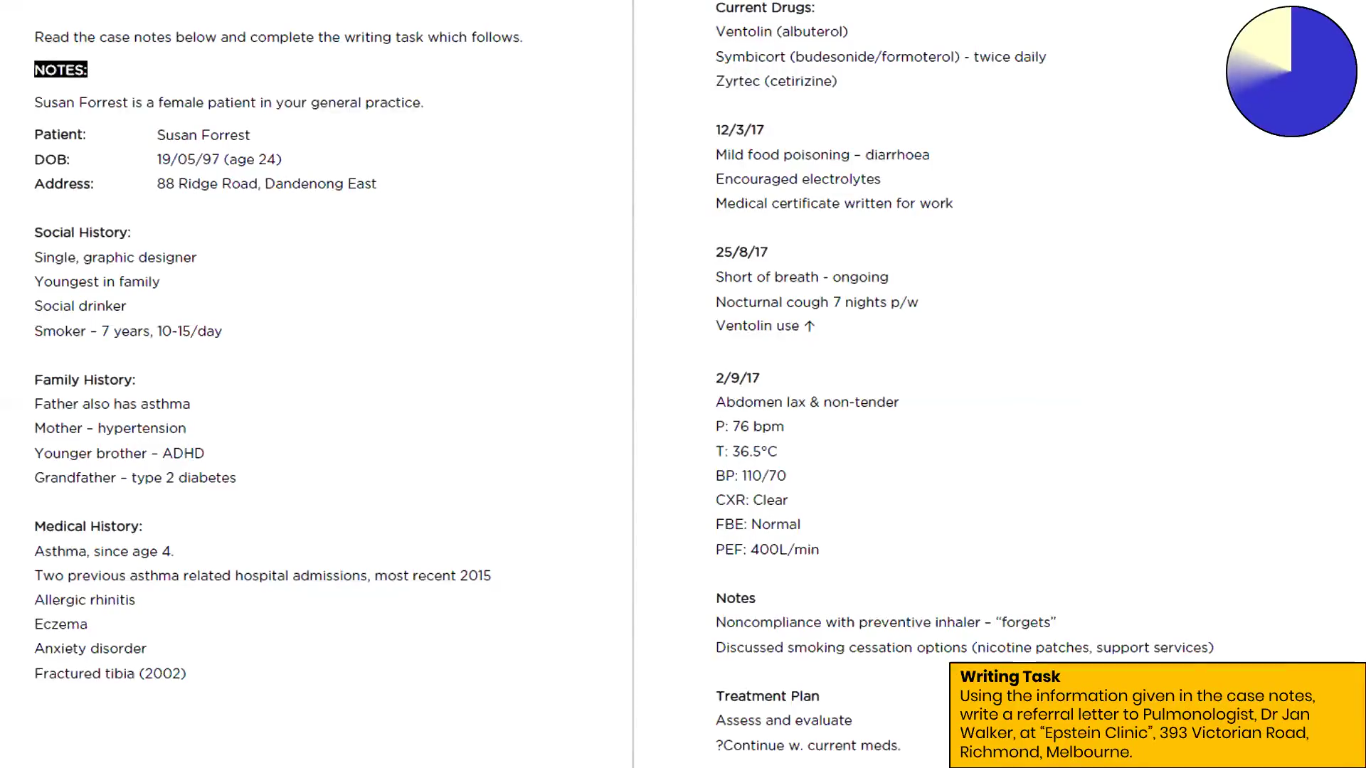
Left column
NOTES:
Susan Forrest is a female patient in your general practice.
Patient:
Susan Forrest
DOB:
19/05/97 (age 24)
Address:
88 Ridge Road, Dandenong East
Social History:
Single, graphic designer
Youngest in family
Social drinker
Smoker - 7 years, 10-15/day
Family History:
Father also has asthma
Mother - hypertension
Younger brother - ADHD
Grandfather - type 2 diabetes
Medical History:
Asthma, since age 4.
Two previous asthma related hospital admissions, most recent 2015
Allergic rhinitis
Eczema
Anxiety disorder
Fractured tibia (2002)
Right column
Zyrtec (cetirizine)
12/3/17
Mild food poisoning - diarrhoea
Encouraged electrolytes
Medical certificate written for work
25/8/17
Short of breath - ongoing
Nocturnal cough 7 nights p/w
Ventolin use 1
2/9/17
Abdomen lax & non-tender
P: 76 bpm
T: 36.5°C
BP: 110/70
CXR: Clear
FBE: Normal
PEF: 400L/min
Notes
Noncompliance with preventive inhaler - “forgets”
Discussed smoking cessation options (nicotine patches, support services)
Writing Task
Treatment Plan
Using the information given in the case notes,
Assess and evaluate
write 1 referral letter to Pulmonologist, Dr Jan
Walker, atEpstein Clinic”, 393 Victorian Road,
Model letter sample 1
Screenshot image12.png — OCR
Good Model
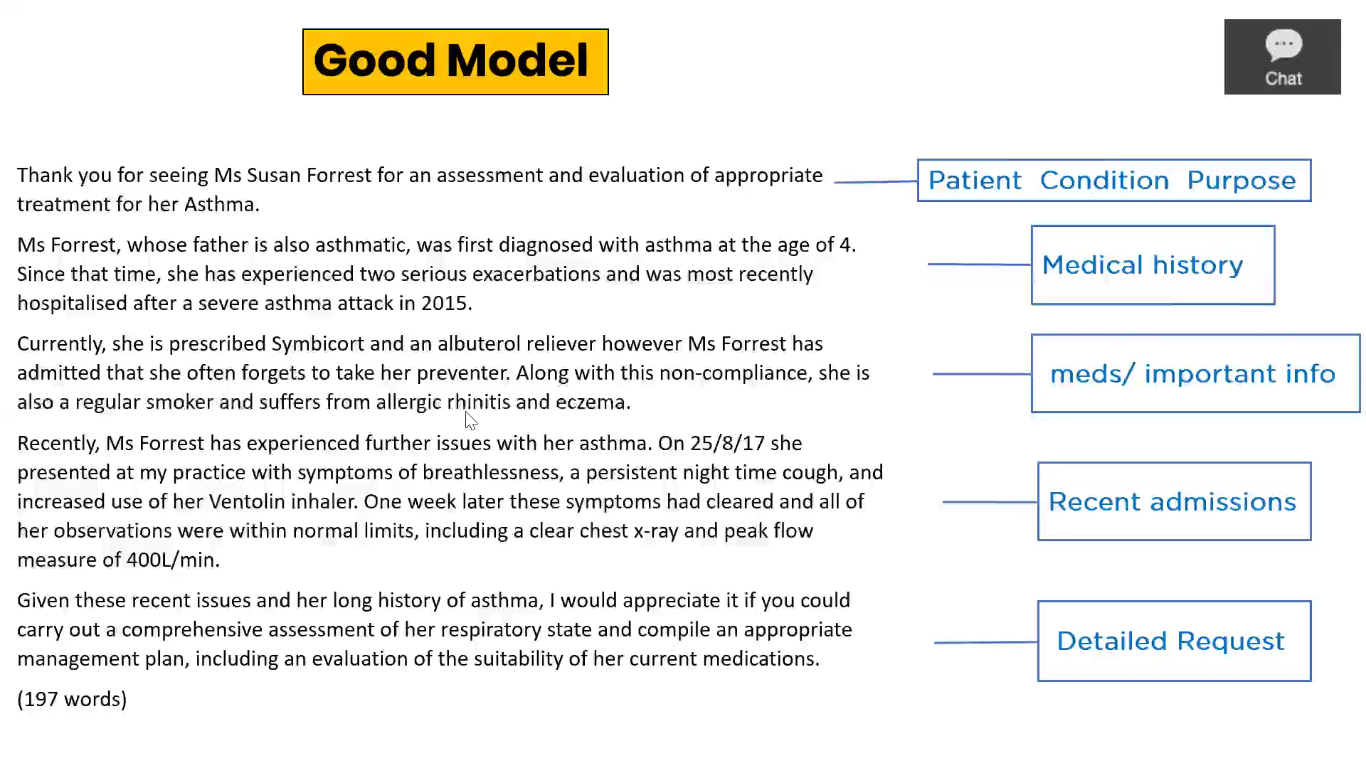
Thank you for seeing Ms Susan Forrest for an assessment and evaluation of appropriate Patient Condition Purpose treatment for her Asthma.
Forrest, whose father is also asthmatic, was first diagnosed with asthma at the age of 4. Since that time, she has experienced two serious exacerbations and was most recently hospitalised after a severe asthma attack in 2015.
Currently, she is prescribed Symbicort and an albuterol reliever however Ms Forrest has admitted that she often forgets to take her preventer. Along with this non-compliance, she is also a regular smoker and suffers from allergic rhinitis and eczema.
Recently, Ms Forrest has experienced further issues with her asthma. On 25/8/17 she presented at my practice with symptoms of breathlessness, a persistent night time cough, and ncreased use of her Ventolin inhaler. One week later these symptoms had cleared and all of her observations were within normal limits, including a clear chest x-ray and peak flow measure of 400L/min. Given these recent issues and her long history of asthma, I would appreciate it if you could carry out a comprehensive assessment of her respiratory state and compile an appropriate management plan, including an evaluation of the suitability of her current medications. (197 words)
Model letter sample 2
Screenshot image13.png — OCR
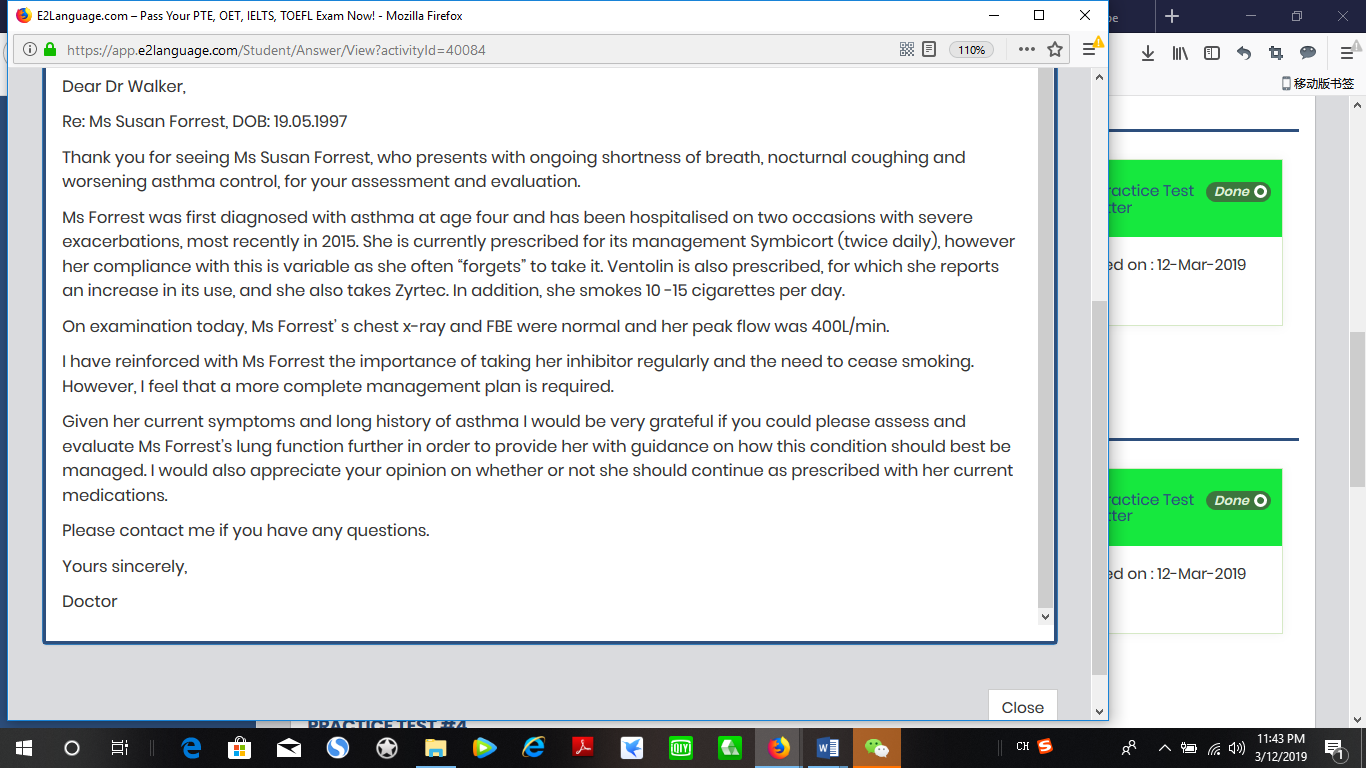
Dear Dr Walker, Re: Ms Susan Forrest, DOB: 19.05.1997
Thank you for seeing Ms Susan Forrest, who presents with ongoing shortness of breath, nocturnal coughing and worsening asthma control, for your assessment and evaluation.
Ms Forrest was first diagnosed with asthma at age four and has been hospitalised on two occasions with severe exacerbations, most recently in 2015. She is currently prescribed for its management Symbicort (twice daily), however her compliance with this is variable as she often “forgets” to take it. Ventolin is also prescribed, for which she reports an increase in its use, and she also takes Zyrtec. In addition, she smokes 10-15 cigarettes per day. On examination today, Ms Forrest’s chest x-ray and FBE were normal and her peak flow was 400L/min. I have reinforced with Ms Forrest the importance of taking her inhibitor regularly and the need to cease smoking. However, I feel that a more complete management plan is required. Given her current symptoms and long history of asthma I would be very grateful if you could please assess and evaluate Ms Forrest’s lung function further in order to provide her with guidance on how this condition should best be managed. I would also appreciate your opinion on whether or not she should continue as prescribed with her current medications.
Please contact me if you have any questions.
Yours sincerely,
Doctor
Dr Jan Walker
Pulmonologist
Epstein Clinic
393 Victorian Road
Richmond, Melbourne
2 September 2017
Dear Dr Walker
Re: Susan Forrest (DOB: 19/05/1997) - (Re: patient and age / DOB. If age and DOB are both given, write DOB instead)
Paragraph one: Patient / Condition / Purpose – formats are more or less fixed for all referral letters
I am referring Susan Forrest (*Patient), who has been suffering from asthma (*Condition**), to you for assessment and treatment evaluation (*Purpose)**
Paragraph 2
Details:
Smoker – 7 years, 10-15/day
Father also has asthma
Asthma since age 4
Two previous asthma related hospital admissions, most recent 2015
Allergic rhinitis, eczema
Smoking cessation options discussed
Susan Forrest has a family history of asthma and has been suffering from asthma since 4 years old. In addition, she experienced two asthma exacerbations (most recent in 2015) which caused her to become hospitalized. She also presents with allergic rhinitis and eczema. On top of that, she has been smoking around 10-15 cigarettes every day for the past 7 years.
Paragraph 3
Details: Current drugs: Ventolin (albuterol), symbicort (budesonide/formoterol) – twice daily, Zyrtec (cetirizine). Non-compliance with preventive inhaler – “forgets”
Currently, she is administered with Ventolin (albuterol), symbicort (budesonide/formoterol) and Zyrtec (cetirizine). She also mentions that she tends to forget to bring her preventive inhaler with her.
*Actually, we don’t have to include that much details on drugs. Simply: Currently, she is administered with Ventolin (albuterol), symbicort and Zyrtec……
Paragraph 4
Details:
25/8/17, short of breath – ongoing, nocturnal cough 7 nights, Ventolin use increase
2/9/17 – pulse, temperature, BP within normal limits; CXR clear; FBE clear; PEF 400 L/min
She presented (came to) at my clinic on 25/8/17 complaining about an ongoing shortness of breath, persistent night coughs, and the need to increase Ventolin usage. During her next visit on 2/9/17 (*This is too long winded, use “one week later” instead since 25/8/17 to 2/9/17 is around one week). Her pulse, temperature and blood pressure are all within normal limits, her chest X-ray is clear and her PEF is 400 L/min.
Paragraph 5
Details: assess and evaluate, ? continue with current meds
*Notice that the assessment and evaluation here are pretty brief. It didn’t specify assessment of what? Evaluation of what? Here we can add more details based on our understanding of the case notes.
In the view of above, kindly conduct a thorough (comprehensive) assessment on Susan Forrest’s respiratory condition and a detailed evaluation on the suitability of her current medications (detailed evaluation if it is advisable for her to continue with her current medications). Should you have any questions, please do not hesitate to contact me.
Referral letter – bowel cancer
Read the cases notes below and complete the writing task that follows
Time allowed: 40 minutes
Today’s Date
03.07.09
Patient History
Margaret Leon 01 .08. 49
Gender: Female
Regular patient in your General Practice .
14.01.09
*Subjective*
Wants general check up, single, lives with and takes care of elderly mother.
Father died bowel cancer aged 50.
Had colonoscopy 3 years ago. Clear
Does not smoke or drink
Objective
BP 160/90 PR 70 regular
Ht 152cm
Wt 69 kg
On no medication.
No known allergies.
Assessment
Overweight. Advised on exercise & weight reduction.
Borderline hypertension.
Review in 3 months
25.04.09
Subjective
Feeling better in part due to weight loss
Objective
BP 140/85
PR 70 regular
Ht 152cm
Wt 61 kg
Assessment
Making good progress with weight. Blood pressure within normal range
*03.07.09*
Subjective
Saw blood in the toilet bowl on two occasions after bowel motions. Depressed and very anxious. Believes she has bowel cancer. Trouble sleeping.
Objective
BP 180/95 P 88 regular
Ht 152cm Wt 50 kg
Cardiovascular and respiratory examination normal.
Rectal examination shows no obvious abnormalities.
Assessment
Need to investigate for bowel cancer
Refer to gastroenterologist for assessment /colonoscopy.
Prescribe 15 gram Alepam 1 tablet before bed.
Advise patient this is temporary measure to ease current anxiety/sleeplessness.
Review after BP appointment with gastroenterologist
Writing Task
Write a letter addressed to Dr. William Carlson, 1st Floor, Ballow Chambers, 56 Wickham Terrace, Brisbane, 4001 requesting his opinion.
In your answer:
-
Expand the relevant case notes into complete sentences
-
Do not use note form
-
The body of the letter should not be more than 200 words
-
Use correct letter format
Last modified: Tuesday, 12 January 2010, 09:08 AM
03/07/2009
Dr. William Carlson
First Floor,
Ballow Chamber
56 Wickham Tce,
Brisbane 4001
Dear Doctor Carlson,
Re: Margaret Leon
DOB 01/08/1949
Thank you for seeing my patient, Margaret Leon, who has been very concerned about blood in her stools. She has seen blood in the toilet bowl on two occasions after bowel motion. She is very anxious and as well as that depressed because her father died of bowel cancer and she feels she may have the same condition.
Margaret has otherwise been quite healthy. She does not drink or smoke and is not taking any medication. She was slightly overweight six months ago with borderline high blood pressure. At that time I advised her to lose weight which she did successfully. Three months later, her weight had dropped from 69kg to 61kg and blood pressure was back within normal range.
On presentation today she was distressed because she believes she has bowel cancer. She has had trouble sleeping and her weight has reduced a further 11 kg. The rectal examination did not show any abnormalities. Her blood pressure was slightly elevated at 180/95 but her cardiovascular and respiratory examination was unremarkable. Alepam, one before bed, was prescribed to control the anxiety and sleeplessness.
I would appreciate it if you could perform a gastroenterology assessment.
Yours sincerely,
Dr X (GP)
Referral letter – fibroids
Case notes
Screenshot image14.png — OCR
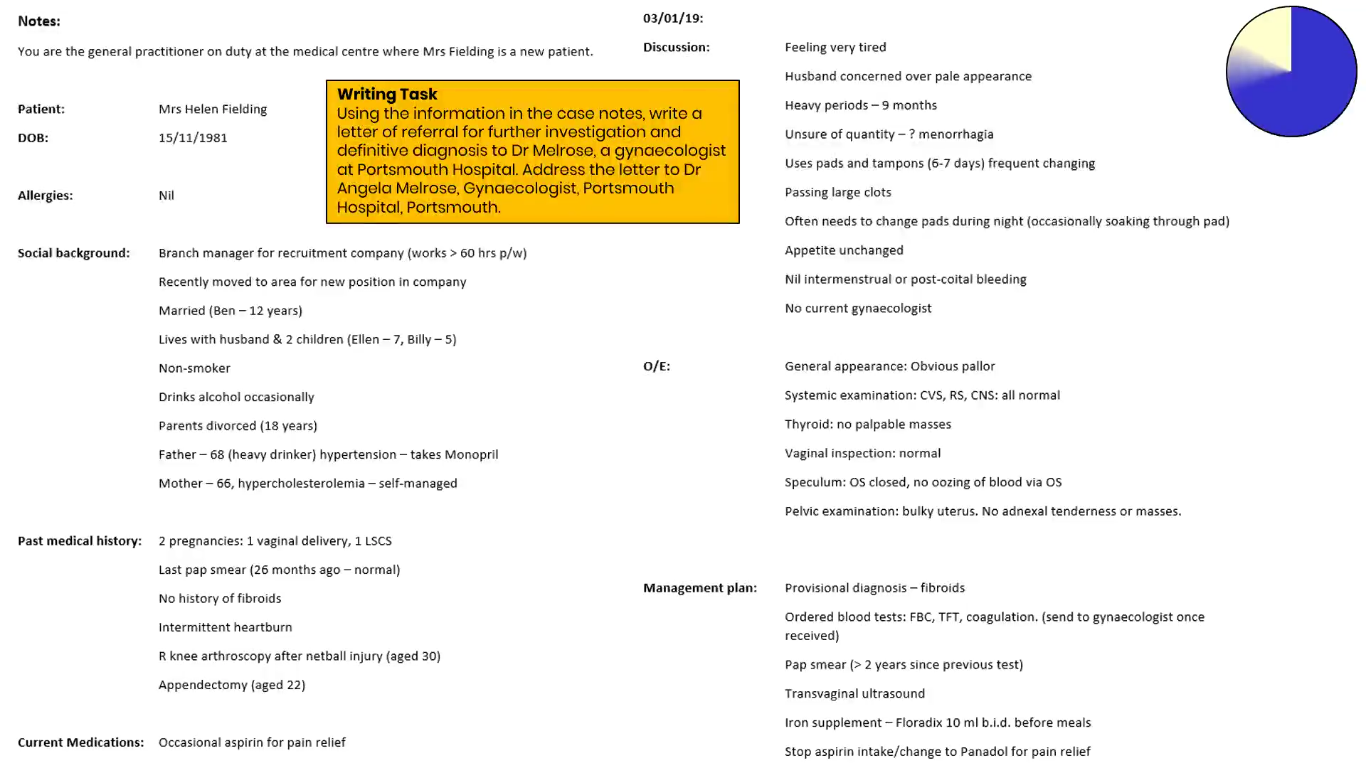
Left column
Writing T1sk
Patient:
Mrs Helen Fielding
Using the information in the case notes, write a
DOB:
15/11/1981
letter of referral for further investigation and
definitive diagnosis to Dr Melrose, a gynaecologist
at Portsmouth Hospital. Address the letter to Dr
Allergies:
Nil
Angela Melrose, Gynaecologist, Portsmouth
Hospital, Portsmouth.
Social background:
Branch manager for recruitment company (works > 60 hrs p/w)
Recently moved to area for new position in company
Married (Ben - 12 years)
Lives with husband & 2 children (Ellen - 7, Billy - 5)
Non-smoker
Drinks alcohol occasionally
Parents divorced (18 years)
Father - 68 (heavy drinker) hypertension - takes Monopril
Mother - 66, hypercholesterolemia - self-managed
Past medical history:
2 pregnancies: 1 vaginal delivery, 1 LSCS
Last pap smear (26 months ago - normal)
No history of fibroids
Intermittent heartburn
R knee arthroscopy after netball injury (aged 30)
Appendectomy (aged 22)
Current Medications:
Right column
Husband concerned over pale appearance
Heavy periods - 9 months
Unsure of quantity - ? menorrhagia
Uses pads and tampons (6-7 days) frequent changing
Passing large clots
Often needs to change pads during night (occasionally soaking through pad)
Appetite unchanged
Nil intermenstrual or post-coital bleeding
No current gynaecologist
O/E:
General appearance: Obvious pallor
Systemic examination: CVS, RS, CNS: all normal
Thyroid: no palpable masses
Vaginal inspection: normal
Speculum: OS closed, no oozing of blood via OS
Pelvic examination: bulky uterus. No adnexal tenderness or masses.
Management plan:
Provisional diagnosis - fibroids
Ordered blood tests: FBC, TFT, coagulation. (send to gynaecologist once
received)
Pap smear (> 2 years since previous test)
Transvaginal ultrasound
Iron supplement - Floradix 10 ml b.i.d. before meals
Model letter
Screenshot image15.png — OCR
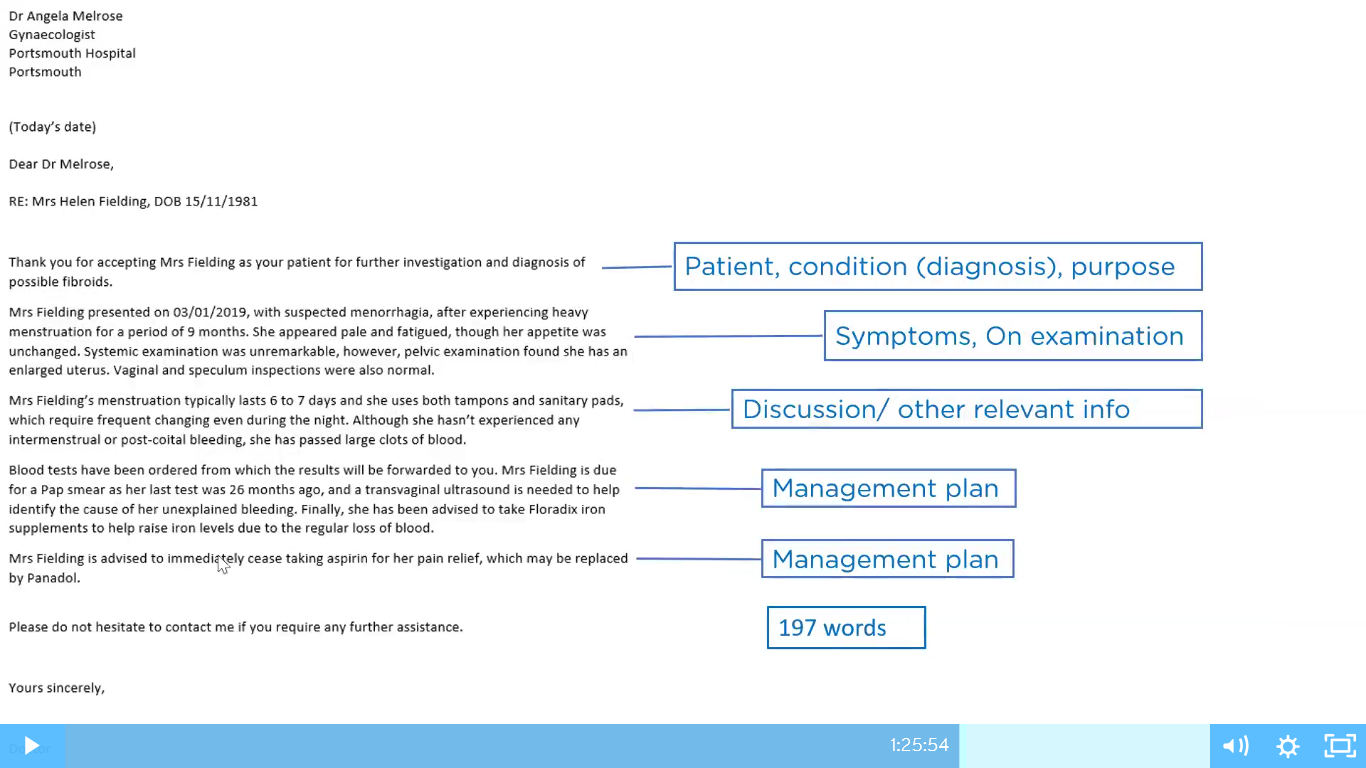
Portsmouth
(Today’s date)
Dear Dr Melrose,
RE: Mrs Helen Fielding, DOB 15/11/1981
Thank you for accepting Mrs Fielding as your patient for further investigation and diagnosis of possible fibroids. Patient, condition (diagnosis), purpose Mrs Fielding presented on 03/01/2019, with suspected menorrhagia, after experiencing heavy menstruation for a period of 9 months. She appeared pale and fatigued, though her appetite was unchanged. Systemic examination was unremarkable, however, pelvic examination found she has an Symptoms, On examination enlarged uterus. Vaginal and speculum inspections were also normal.
Mrs Fielding’s menstruation typically lasts 6 to 7 days and she uses both tampons and sanitary pads, which require frequent changing even during the night. Although she hasn’t experienced any Discussion/ other relevant info intermenstrual or post-coital bleeding, she has passed large clots of blood. Blood tests have been ordered from which the results will be forwarded to you. Mrs Fielding is due for a Pap smear as her last test was 26 months ago, and a transvaginal ultrasound is needed to help Management plan identify the cause of her unexplained bleeding. Finally, she has been advised to take Floradix iron supplements to help raise iron levels due to the regular loss of blood.
Mrs Fielding is advised to immediately cease taking aspirin for her pain relief, which may be replaced Management plan by Panadol.
Please do not hesitate to contact me if you require any further assistance. 197 words
Yours sincerely,
Paragraph one: patient / condition / request
Patient – Mrs Fielding. Condition – fibroids, request – further investigation and diagnosis
I am writing to refer Mrs Fielding, who is presenting with symptoms suggestive of fibroids, to you for further investigation and diagnosis.
Paragraph two
Details
3/1/19 – very tired, pale, heavy periods for 9 months, passing large clots, change pads and tampons frequently, appetite unchanged
Mrs Fielding first presented to my clinic with her husband on 3/1/19. She appeared pale and fatigue. She complained about heavy periods (menorrhagia suspected) for 9 months, which required her to change pads and tampons very frequently, even during the night. In addition, she observed large blood clots during her periods.
Paragraph three
Details: systemic examination, thyroid, vaginal inspection were unremarkable, speculum: cervix orifice closed, no oozing of blood via orifice, pelvic examination: bulky uterus, no adnexal tenderness or masses
Systemic examination was unremarkable and thyroid tests and vaginal inspection were normal. However, a Pelvic examination found that she has an enlarged uterus.
Paragraph four
Details: provisional diagnosis – fibroids, ordered blood tests: FBC, TFT, coagulation (send to gynecologist once received), pap smear (> 2 years since previous test), transvaginal examination, iron supplement – floradix before meals, stop aspirin intake / change to panadol for pain relief
My provisional diagnosis of Mrs Fielding is fibroids. I have ordered the following blood tests: FBC, TFT and coagulation, for which I instructed Mrs Fielding to forward them to you upon receiving. Mrs Fielding is deal for a pap smear as her last test was more than 2 years ago. I also ordered a transvaginal examination to help identify the cause of her unexplained bleeding.
I prescribed Mrs Fielding with floradix and advised her to stop taking aspirin and consume Panadol instead should she experiences pain.
In the view of above, kindly conduct the necessary investigations to confirm my provisional diagnosis. Should you have any questions, please do not hesitate to contact me,
Referral letter – Gastro-esophageal reflux
Case notes
Screenshot image16.png — OCR
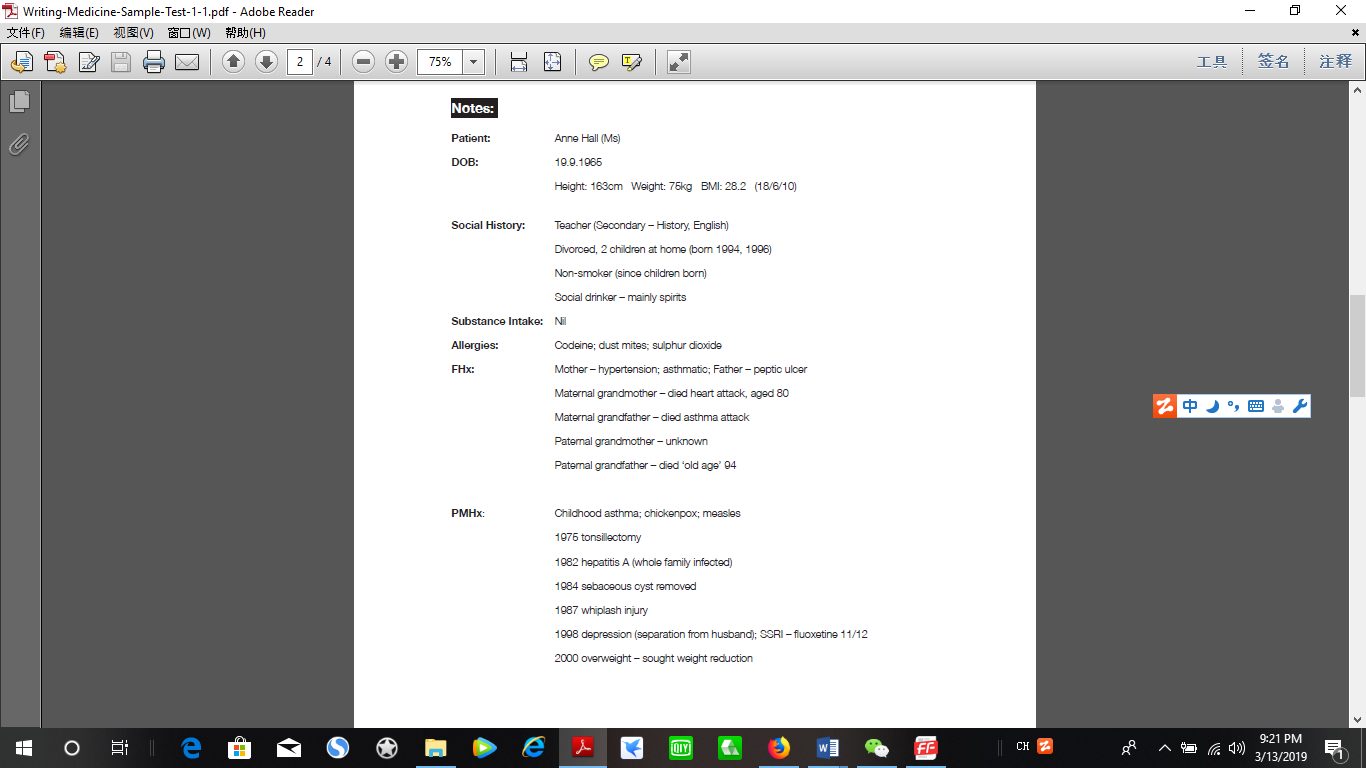
Notes:
Patient:
Anne Hall (Ms)
DOB:
19.9.1965
Height: 163cm Weight: 75kg BMI: 28.2 (18/6/10)
Social History:
Teacher (Secondary - History, English)
Divorced, 2 children at home (born 1994, 1906)
Non-smoker (since children born)
Social drinker - mainly spirits
Substance Intake:
Nil
Allergies:
Codeine; dust mites; sulphur dioxide
FHx:
Mother - hypertension; asthmatic; Father - peptic uloer
Maternal grandmother - died heart attack, aged 80
Maternal grandfather - died asthma attack
Paternal grandmother - unknown
Paternal grandfather - died ‘old age’ 94
PMHx:
Childhood asthma; chickenpox; measles
1975 tonsillectomy
1982 hepatitis A (whole family infected)
1984 sebaceous cyst removed
1987 whiplash injury
1998 depression (separation from husband); SSRI - fluoxetine 11/12
2000 overweight - sought weight reduction
Screenshot image17.png — OCR
75%
2002 URTI
2004 dyspepsia
2006 dermatitis; Rx oral & topical corticosteroids
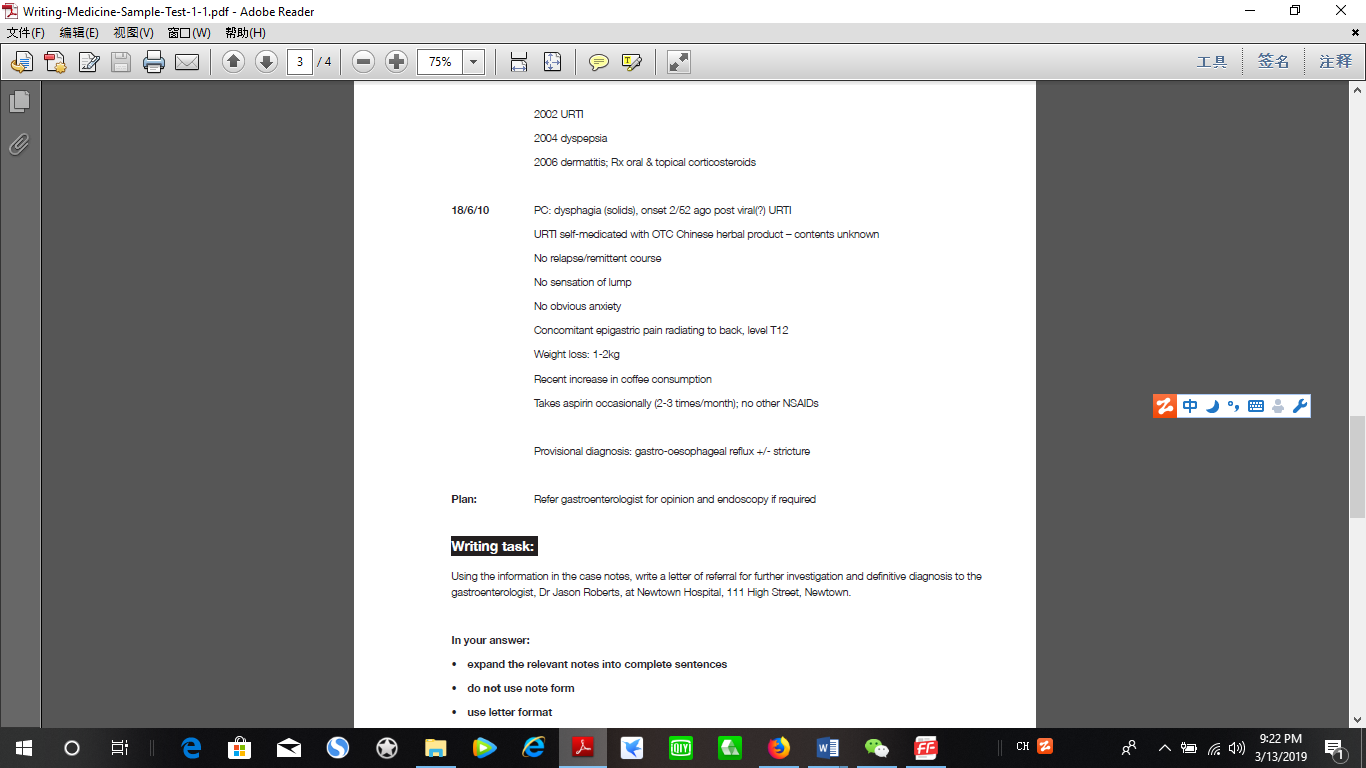
18/6/10
PC: dysphagia (solids), onset 2/52 ago post viral(?) URTI
URT self-medicated with OTC Chinese herbal product - contents unknown
No relapse/remittent course
No sensation of lump
No obvious anxiety
Concomitant epigastric pain radiating to back, level T12
Weight loss: 1-2kg
Recent increase in coffee consumption
Takes aspirin occasionally (2-3 times/month); no other NSAIDs
Provisional diagnosis: gastro-cesophageal reflux +/- stricture
Plan:
Refer gastroenterologist for opinion and endoscopy if required
Writing task:
Using the information in the case notes, write a letter of referral for further investigation and definitive diagnosis to the
gastroenterologist, Dr Jason Roberts, at Newtown Hospital, 111 High Street, Newtown.
In your answer:
• expand the relevant notes into complete sentences
• do not use note form
• use letter format
Model letter
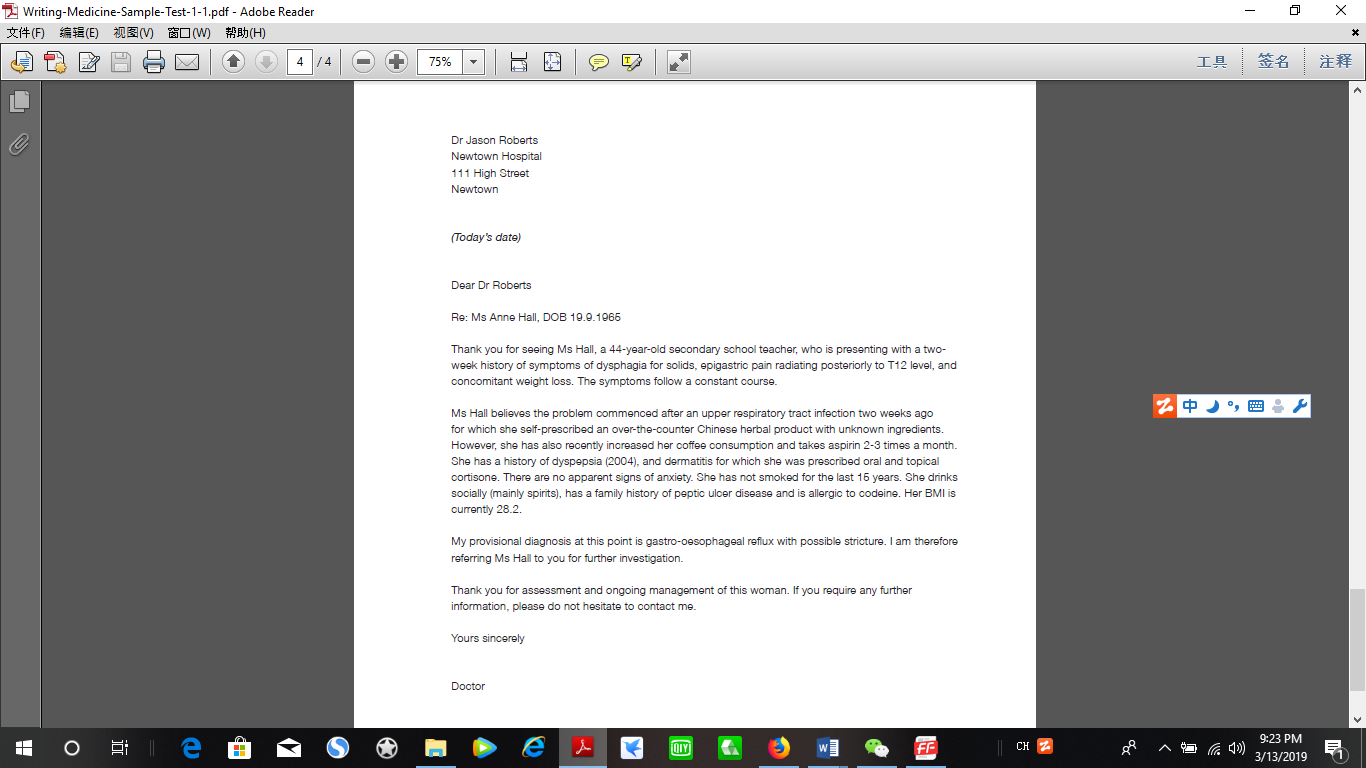
Screenshot image18.png — OCR
Dr Jason Roberts Newtown Hospital 111 High Street Newtown
(Today’s date)
Dear Dr Roberts
Re: Ms Anne Hall, DOB 19.9.1965
Thank you for seeing Ms Hall, a 44-year-old secondary school teacher, who is presenting with a two- week history of symptoms of dysphagia for solids, epigastric pain radiating posteriorly to T12 level, and concomitant weight loss. The symptoms follow a constant course.
Ms Hall believes the problem commenced after an upper respiratory tract infection two weeks ago for which she self-prescribed an over-the-counter Chinese herbal product with unknown ingredients. However, she has also recently increased her coffee consumption and takes aspirin 2-3 times a month. She has a history of dyspepsia (2004), and dermatitis for which she was presoribed oral and topical cortisone. There are no apparent signs of anxiety. She has not smoked for the last 15 years. She drinks socially (mainly spirits), has a family history of peptic ulcer disease and is allergic to codeine. Her BMI is currently 28.2.
My provisional diagnosis at this point is gastro-oesophageal reflux with possible stricture. I am therefore referring Ms Hall to you for further investigation.
Thank you for assessment and ongoing management of this woman. If you require any further information, please do not hesitate to contact me.
Yours sincerely
Doctor
For case notes like this – with one provisional diagnosis at the very end, we can write the letter this way
Paragraph one
I am writing to refer Ms Hall, who is presenting with symptoms suggestive of Gastro-esophageal reflux, to you for further investigation and diagnosis.
Paragraph two:
Details: father – peptic ulcer, 2004 dyspepsia, 2006 dermatitis; Rx oral and topical corticosteroids
Ms Hall has a history of peptic ulcer. She was diagnosed with dyspepsia in 2004 and dermatitis in 2006, for which she was prescribed oral and topical corticosteroids.
Paragraph three
Details: 18/6/10 – dysphagia (solids), no relapse / remittent course, no sensation of lump, concomitant epigastric pain radiating to back level T12, weight loss: 1-2 kg
Ms Hall presented to my clinic on 18/6/10 with dysphagia of solids which followed a remittent course but didn’t feel any lump in her throat or stomach during swallowing. In addition, she complained about a concomitant epigastric pain which radiated to her back, specifically, at T12. She also experienced weight loss of around 1-2 kg.
Paragraph four
Details: URTI self -mediated with OTC Chinese herbal product – contents unknown, recent increase in coffee consumption, takes aspirin occasionally (2-3 times / month)
Ms Hall self- prescribed an over-the-counter Chinese herbal product with unknown ingredients for her upper respiratory tract infection. She also reported to increase coffee consumption recently. (Recently, she has increased her coffee consumption) Furthermore, she takes aspirin 2-3 times per month.
Paragraph five
Details: non-smoker (since children born), social drinker (mainly sprints), BMI 28.2
Please also note that Ms Hall has stopped smoking for many years, is a social drinker (mainly sprints), and has a BMI of around 28.2.
Paragraph six
Details: further investigation and definitive diagnosis
In the view of above, I am concerned that Ms Hall’s condition will worsen, and it would be highly appreciated if you can conduct further investigations and necessary managements, to confirm my provisional diagnosis (indicate definitive diagnosis)
Or simply
In the view of above, kindly evaluate Ms hall’s condition and conduct the necessary investigations to confirm my provisional diagnosis.
Referral letter – memory loss
Case notes
Your long-term patient, Mrs Walshman, has attended your GP surgery with her daughter. Both are concerned about Mrs Walshman’s memory.
Patient: Mrs Patricia Walshman (D.O,B: 10/07/1933)
Address: 24 Kenneth St, Newtown
Marital status: widowed, 5 adult children
Next of kin: Christine – daughter
Diagnosis: osteoporosis. Dementia (? Early stage Alzheimers)
Social background: widowed 40 yrs, lives alone, children within 10 km radius
Medications: osteo vit-D 1000 IU, atorvastatin (lipitor) 20 mg mane, ibuprofen (Bruten) 200 mg prn, metoprolol 100 mg b.d, paracetamol (panadol 500 mg) prn
Past medical history
2010 – 2016 Regular GP visits to this clinic, pathology, BP – stable
1 October 2017 Fall – bruised nose only, X-ray – NAD, will begin to take it easy, slow down
8 November 2017
-
Occupational therapist (OT) home assessment. Evaluated shower rails, ramp, bed ok. R/V 4-6 months
-
Discussed shower with OT. All ok
-
Shower every other day to lessen likelihood of falls
-
Community support: home care provided by local council. 1 / fortnight
26 March 2018
-
BP 145 / 85
-
FBE: U&E, LFTs – all NAD
-
Total cholesterol 4.8 mmol/l (<5.5)
-
HDL cholesterol 1.4 mmol/l (0.9-2.2)
-
*LDL cholesterol 2.9 mmol/l (<2.0)
-
Triglycerides 1.1 mmol/l (0.5-2.0)
-
LDL/HDL 2:1
-
Chol/HDL 3:4
-
*Vitamin D < 54 (60-160 mmol/l)
Discussions:
-
spare scripts – not filling them or not taking medication regularly
-
Assures me she is taking medication regularly
-
Suggested Webster pack (a sealed weekly calender pack designed to help people take their medication correctly), was reluctant, promised to adhere to medication regime
-
Review 2 months, post-pathology
1 August 2018
-
BP 130/70, vit and lipids within normal range
-
Medication issue resolved
-
Daughter with pt, both want to discuss memory issues
-
Poor memory noted ++ e.g. forgetting hairdresser appointments, dinner engagements, missing social events. Behavioral changes, decision making issues
Mini memory assessment:
-
Poor short-term memory, day & date – several attempts, no results. Month – 3 attempts. Confirmed the year correctly. Quite worried
-
Requested further assessment
-
Family history of Alzheier’s
-
Asked about dementia – explained difference between Alzheimer’s disease and dementia
-
More assessments before diagnosis. Referred 🡪 Memory clinic
-
R/V post-assessment
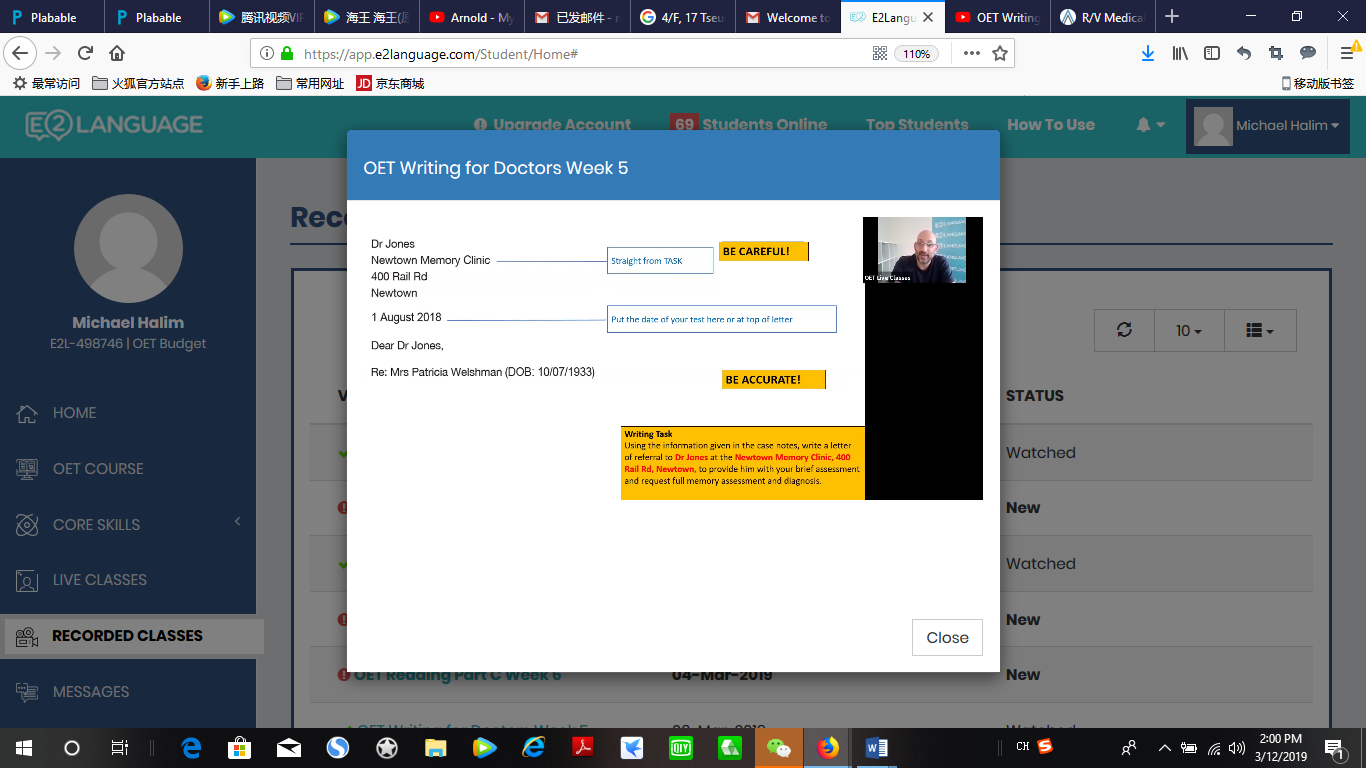
Writing task – using the information given in the case notes, write a letter of referral to Dr Jones at the Newtown memory clinic, 400 Rail rd, Newtown, to provide him with your brief assessment and request full memory assessment and diagnosis.
Screenshot image19.png — OCR
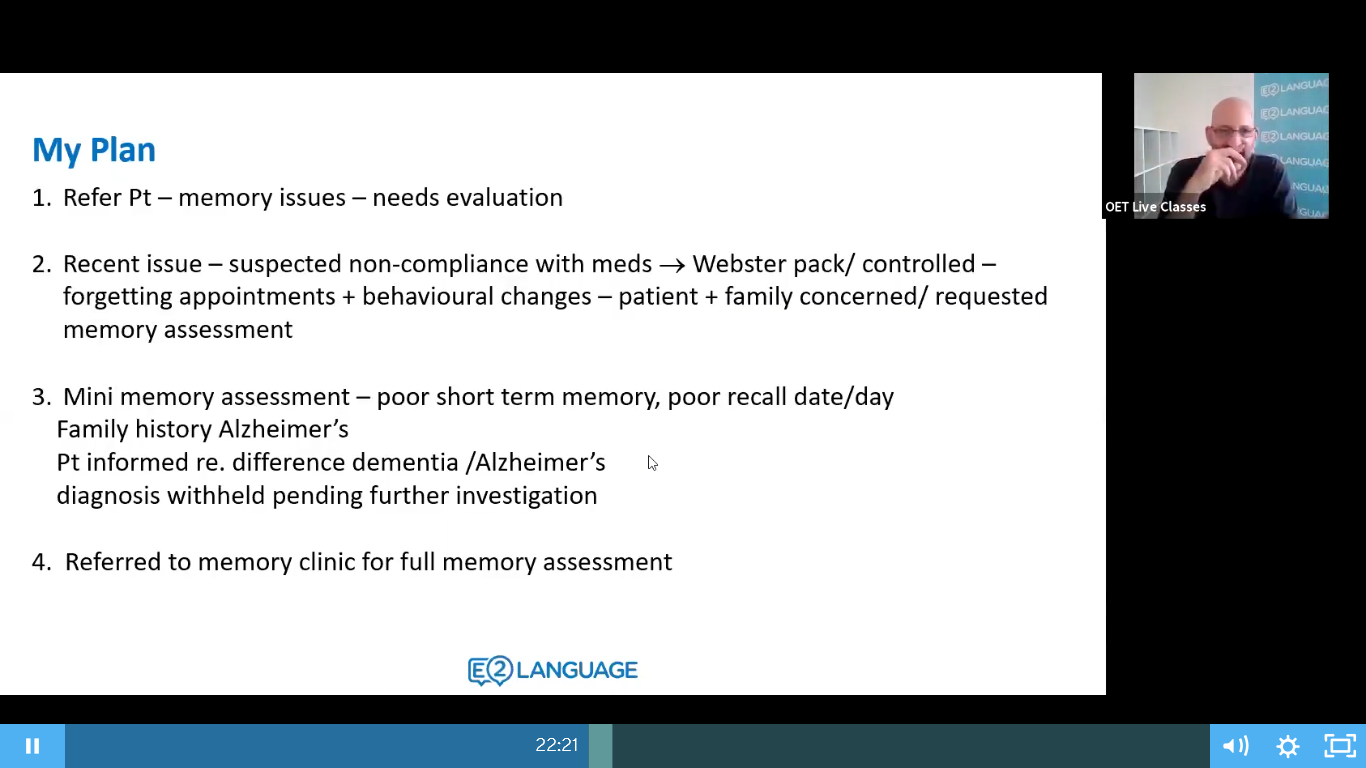
My Plan
-
Refer Pt - memory issues - needs evaluation
-
Recent issue - suspected non-compliance with meds → Webster pack/ controlled -
forgetting appointments + behavioural changes - patient + family concerned/ requested
memory assessment -
Mini memory assessment - poor short term memory, poor recall date/day
Family history Alzheimer’s
Pt informed re. difference dementia /Alzheimer’s D
diagnosis withheld pending further investigation -
Referred to memory clinic for full memory assessment
E2 LANGUAGE
Model letter
Screenshot image20.png — OCR
• Uparade Account 69
OET Writing for Doctors Week 5
Dr Jones BE CAREFUL! Newtown Memory Clinic Straight from TASK 400 Rail Rd Newtown 1 August 2018 Put the date of your test here or at top of letter Dear Dr Jones, Re: Mrs Patricia Welshman (DOB: 10/07/1933) BE ACCURATE!
Screenshot image21.png — OCR
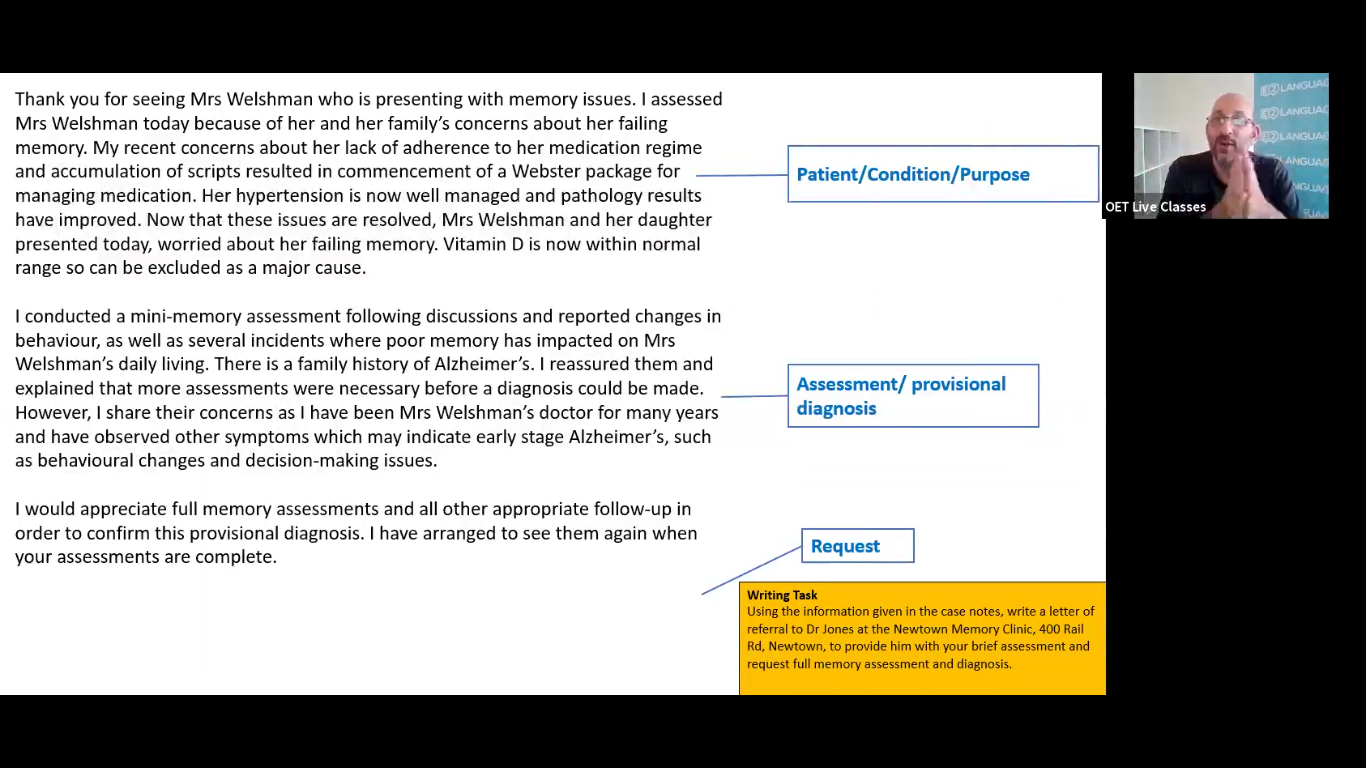
Thank you for seeing Mrs Welshman who is presenting with memory issues. I assessed Mrs Welshman today because of her and her family’s concerns about her failing memory. My recent concerns about her lack of adherence to her medication regime and accumulation of scripts resulted in commencement of a Webster package for managing medication. Her hypertension is now well managed and pathology results have improved. Now that these issues are resolved, Mrs Welshman and her daughter presented today, worried about her failing memory. Vitamin D is now within normal range so can be excluded as a major cause.
I conducted a mini-memory assessment following discussions and reported changes in behaviour, as well as several incidents where poor memory has impacted on Mrs Welshman’s daily living. There is a family history of Alzheimer’s. I reassured them and explained that more assessments were necessary before a diagnosis could be made. However, I share their concerns as I have been Mrs Welshman’s doctor for many years and have observed other symptoms which may indicate early stage Alzheimer’s, such as behavioural changes and decision-making issues.
I would appreciate full memory assessments and all other appropriate follow-up in order to confirm this provisional diagnosis. I have arranged to see them again when your assessments are complete.
Dr Jones (name of doctor you are referring the patient to)
Newtown Memory clinic (address)
400 Rail Rd
Newtown
1 August 2018 (Date – format doesn’t matter)
Dear Dr Jones (Dear name of doctor.)
Re: Mrs Patricia Welshman (DOB: 10/07/1933) – (Re: patient and age / DOB. If age and DOB are both given, write DOB instead)
Paragraph 1: patient, condition, purpose. Format is more or less the same
Patient – Mrs Welshman. Condition – memory issues. Purpose – full memory assessment and final diagnosis
I am referring Mrs Welshman, a long-term patient of mine, who is presenting with memory issues, to you for full memory assessment and final diagnosis.
Paragraph 2:
Details:
1 August 2018
-
Daughter with pt, both want to discuss memory issues
-
Poor memory noted ++ e.g. forgetting hairdresser appointments, dinner engagements, missing social events. Behavioral changes, decision making issues
Mini memory assessment:
-
Poor short-term memory, day & date – several attempts, no results. Month – 3 attempts. Confirmed the year correctly. Quite worried
-
Requested further assessment
-
Family history of Alzheimer’s
-
Asked about dementia – explained difference between Alzheimer’s disease and dementia
-
More assessments before diagnosis. Referred 🡪 Memory clinic
-
R/V post-assessment
Mrs Welshman and her daughter came to my clinic on 1 August 2018 to discuss about Mrs Welshman’s failing memory issues, which were evident in examples such as: forgetting appointments and engagements. In addition, Mrs Welshman demonstrated behavioral changes and experienced decision- making difficulties. I conducted a mini memory assessment and found out that Mrs Welshman was suffering from poor short-term memory as she was unable to remember the day and date of recent events. Mrs Welshman has a family history of Alzheimer. However, more assessments need to be conducted prior to confirming the diagnosis.
Model paragraph
Mrs Welshman and her daughter presented at my clinic to discuss the deteriorating state of her memory. They cited several examples of forgetfulness including missing appointments and perceived changes in her behavior and decision making. Upon conducting a mini memory assessment, the patient’s short term memory was found to be poor and she was unable to recall the day and date. Given that there is a family history of Alzheimer’s disease, Mrs Welshman and her family are clearly anxious and have asked for a more extensive evaluation.
Paragraph 3
Details
-
Hyperlipidemia and Vit D deficiency
-
spare scripts – not filling them or not taking medication regularly
-
Assures me she is taking medication regularly
-
Suggested Webster pack (a sealed weekly calender pack designed to help people take their medication correctly), was reluctant, promised to adhere to medication regime
-
Review 2 months, post-pathology
In terms of past medical history, Mrs Welshman failed to take her medications for hyperlipidemia and Vitamin D deficiency regularly. Moreover, she had not been filling up spare scripts. Therefore, a Webster pack had to be implemented to help her better manage her medications.
Paragraph 4
Details - request full memory assessment and diagnosis.
*Notice that full memory assessment is detailed enough because it specifies what kind of assessment that should be conducted. However, diagnosis is pretty brief here. Here, we can add other details based on our own understanding of the case notes.
In the view of above, kindly conduct a full memory assessment and other appropriate follow up on Mrs Welshman to confirm the provisional diagnosis. I have arranged Mrs Welshman for another appointment after your assessment. Should you have any questions, please do not hesitate to contact me.
In the view of above, kindly conduct a full memory assessment and other appropriate follow up on Mrs Welshman prior to reaching a final diagnosis (so that a final diagnosis can be made /so as to come up with a final diagnosis). I have arranged Mrs Welshman for another appointment after your assessment. Should you have any questions, please do not hesitate to contact me.
Referral letter - meningitis
Time allowed: 40 minutes
Read the case notes below and complete the writing task that follows:
Today’s Date
14.10.10
Patient History
Amina Ahmed aged 8 years – new patient at your clinic Parents – Mother Ayama, house-wife. Father Talan, cab driver Brothers Dalma aged 4 and Roble aged 2 Family refugees from Somali 2005. Have Australian Citizenship Amina and father good understanding of English, mother has basic understanding of slowly spoken English. Amina had appendicectomy 2 years ago
No known allergies
09/10/10
Subjective
Fever, runny nose, mild cough, loss of appetite
Unable to attend school
Objective
Pulse 85/min
Temperature 39.4
No rash
No neck stiffness
CVS, RS & abdo – normal
Assessment
Viral infection
Management
Keep home from school
Rest and paracetamol three times daily
Review in 3 days if no improvement
12/10/10
Subjective
Amina not well
Cough +, continuous headache, lethargic, loss of appetite
Difficult to control temperature with Paracetamol
Mother worried
Objective
Fever 39.8 C
No rash or neck stiffness
Management
Prescribe Brufen 200mg as required
FBC & UFR were ordered
Review in two days with results of reports
14/10/10
Subjective
Both parents very concerned
Reported Amina lethargic and listless
Vomited twice last night and headaches worse
Objective
FBC- WBC(18000) and left shift
Urinary Function Report Normal
Temperature 40.2C
Pulse 110/min
Macula-papular rash over legs
Neck Stiffness+
Assessment
Meningococcal Meningitis Penicillin IV given (stat dose)
Plan
Arrange urgent admission to the Emergency Paediatric Unit,
Brisbane General Hospital, for further investigation and treatment.
Writing Task
You are GP, Dr Lucy Irving, Kelvin Grove Medical Centre, 53 Goma Rd, Kelvin Grove, Brisbane. Write a referral letter to the Duty Registrar, Emergency Paediatric Unit, Brisbane General Hospital, 140 Grange Road, Kelvin Grove, QLD, 4222.
In your letter:
-
Expand the relevant case notes into complete sentences.
-
Do not use note form.
-
The body of your letter should be approximately 200 words.
-
Use correct letter format.
Kevin Grove Medical Centre
53 Goma Road
Kelvin Grove, Brisbane
14.10.09
The Duty Registrar
Emergency Paediatric Unit
Brisbane General Hospital
140 Grange Road
Kelvin Grove, QLD, 4222
Dear Doctor:
Re. Amina Ahmed (8years)
I am writing to refer Amina who is presenting with signs and symptoms of meningococcal meningitis for urgent assessment and management. She is the first child of a family of 5, which includes her parents and two younger siblings. They are immigrants from Somalia, though she and her father understand English.
Initially, accompanied by her parents, she presented to me on 9.10.10 with complaints of fever, runny nose, cough and loss of appetite. She was febrile with a temperature of 39.4 and a pulse rate of 85 beats per minute, but there was no rash or neck stiffness. However, her condition continued to deteriorate over the next two days as the fever could not be controlled by antipyretics. Therefore, blood and urine tests were ordered.
Regrettably, today Amina became lethargic and listless. She vomited twice last night and had been having severe headaches. On examination, she was severely febrile with a temperature of 40.2 and a pulse rate of 110 beats per minute. There was macula-papular rash over the legs and neck stiffness was present. Blood test showed leucocytosis with a shift to the left.
Based on the above, I believe she needs urgent admission and management. Please note, Penicillin IV has been given as a stat dose.
Yours sincerely.
Dr. Lucy Irving
Referral letter – pre-eclampsia
Time allowed: 40 minutes
Read the cases notes below and complete the writing task that follows:
Today’s Date
24/08/10
Patient History
Mrs. Jane MacIntyre (DOB 01.03.71)
Two children age 5 and 3
Two miscarriages
First pregnancy
-
developed severe pre-eclampsia
-
delivered by emergency Caesarean Section at 32 week
-
in intensive care for 3 days, required magnesium sulphate
-
baby (Sam) weighed 2.1 kg – in Neonatal Intensive Care Unit 2 weeks
-
did not require ventilation only CPAP (Continuous Positive Airway Pressure)
Second Pregnancy
-
BP remained normal
-
baby (Katie) delivered at full term, weighed 3.4kg
Family history of thrombosis
Known to be heterozygous for Factor V Leiden
Treated with prophylactic low molecular weight heparin in two previous pregnancies
No other medical problems
Not on any regular medication
Negative smear 2007
24/08/10
Subjective
Positive home pregnancy test – fifth pregnancy
Thinks she is 8 weeks pregnant
Last menstrual period 16.1.08
Painful urination last three days
Request referral to the Spirit Mother’s Hospital for antenatal care and birth.
Objective
BP:120/80.
Weight: 60kg
Height: 165cm
Some dysuria for the past 3 days
Urine dipstick: 3+ protein, 2+ nitrites, and 1+ blood
Abdomen soft and non-tender
Fundus not palpable suprapubically.
Assessment
Needs antenatal referral to an obstetrician in view of her history of severe pre-eclampsia, Caesarean Section, and her age
Needs to start folic acid.
Needs to start tinzaparine 3,500 units daily, subcutaneously, in view of thrombosis risk.
Suspected urinary tract infection based on her symptoms and the urine dipstick result
Plan
Refer Jane to Dr Anne Childers at the Spirit Mother’s Hospital
Commence her on folic acid 400 micrograms daily, advise to continue until 12 weeks pregnant
Arrange routine antenatal blood tests – results to be sent to the Spirit Mother’s Hospital when received
Counsel Jane re antenatal screening for Down’s Syndrome in view of her age
Jane elects to have a scan for nuchal translucency, which is done between 11 and 13 weeks.
Provide information on Greenslopes Screening Centre.
Prescribe tinzaparine 3,500 units daily subcutaneously.
Send a midstream urine specimen to laboratory
Prescribe cefalexin 250 milligrams 6-hourly for five days.
Writing Task
You are GP, Dr Liz Kinder, at a Family Medical Centre.Write referral letter to Dr Anne Childers MBBS FRANZCOG, Consultant Obstetrician, Spirit Mother’s Hospital, Stanley Street, South Brisbane.
-
Expand the relevant case notes into complete sentences
-
Do not use note form
-
The body of your letter should be approximately 200 words
-
Use correct letter format
Referral letter – prostate cancer
Read the cases notes below and complete the writing task which follows
Time allowed: 40 minutes
Today’s Date
15.08.09
Patient History
Darren Walker
DOB 05.07.69
Regular patient in your General Practice
09.07. 09
Subjective
Regular check up, Family man, wife, two sons aged 5 and 3
Parents alive - father age 71 diagnosed with prostate cancer 2002.
Mother age 68 hypertension diagnosed 1999.
Smokes 20 cigarettes per day –trying to give up
Works long hours – no regular exercise
Light drinker 2 –3 beers a week
Objective
BP 165/90 P 80 regular
Cardiovascular and respiratory examination normal
Height 173 cm Weight 85kg
Urinalysis normal
Plan
Advise re weight loss, smoking cessation
Review BP in 1 month
Request PSA test before next visit
14.08.09
Subjective
Reduced smoking to 10 per day
Attends gym twice a week, Weight 77 kg
Complains of discomfort urinating
Objective
BP 145/80 P76
DRE hardening and enlargement of prostate
PSA reading 10
Plan
Review BP, smoking reduction in 2 months
Refer to urologist – possible biopsy prostate
Writing Task
Write a referral letter addressed to Dr. David Booker (Urologist), 259 Wickham Tce, Brisbane 4001. Asl to be informed of the outcome.
In your answer:
* Expand the relevant case notes into complete sentences
* Do not use note form
* The body of the letter should not be more than 200 words
* Use correct letter format
Sample letter
Sample Model Letter 1
15/08/2008
Dr. David Brooker (Urologist)
The Urology Department
259 Wickham Tce,
Brisbane, 4001
Dear Doctor,
Re: Mr. Darren Walker
I am writing to refer this patient, a 40 year old married man with two sons aged 3 and 5, who requires screening for prostate cancer.
Initial examination on 09/07/09 revealed a strong family history of related illness as elderly father was diagnosed with prostate cancer and mother was diagnosed as hypertensive. Mr Walker is a smoker and light drinker. He works long hours and does not do any regular exercise. His blood pressure was initially 165/90 mmhg and pulse was 80 and regular. He is 173cm tall and his weight, at that time, was 85 kg. He was advised to reduce weight and stop smoking and a prostate specific antigen test was requested. There were no other remarkable findings.
When he came for the next visit on 14/08/2009, Mr Walker had reduced smoking from 20 to 10 cigarettes per day and was attending gym twice a week. He had lost 8kg of weight. His blood pressure was improved at 165/90mmhg. However digital rectal examination revealed an enlarged prostate and the PSA reading was 10.
In view of the above signs and symptoms, I believe he needs further investigations including a prostate biopsy and surgical management. I would appreciate your urgent attention for his condition.
Yours sincerely,
Dr.X
Discharge letter – chest pain and GERD
Case notes
Screenshot image22.png — OCR
Left column
Patient:
Mrs Judith Henning
Age:
54
Allergies:
Penicillin (hives/itchy skin)
Social background:
Runs her own clothing business
Married 30 years
Husband - Gregory, 56 yrs, police officer
2 children - Sally, married, 3 children, lives close by, John, single, lives
abroad.
Runs 5 km every other day
Drinks alcohol socially 1-2 drinks maximum
Heavy smoker for 26 years (ceased at age 45)
Medical history:
Chronic obstructive pulmonary disease (COPD) - since 2018
Acute bronchitis resulting from viral respiratory tract infection - 2017
Bankart repair R shoulder after frequent dislocations - 2015
Minor rotator cuff tear - 2013
Medications:
Aspirin 81mg daily
Calcium carbonate/Vitamin D 600 mg twice p/d
Combivent inhaler 2 puffs four times p/d
Albuterol inhaler PRN
06/01/2019:
Subjective:
New onset of chest pain 2 - 3 episodes
”Compression” pain only at night (woke from sleep)
Improved with repositioning (use of 2 pillows)
Recently consuming larger meals late at night
Nil pain on exertion
Experienced less shortness of breath (SOB) since last visit
Right column
Weight - 57 kg (with shoes)
Height - 157 cm
BMI - 23.1
Pulse - 70 reg
BP (sitting) - 116/64
Lungs - distinct breath sounds without wheezes
CV - RRR, normal S1 and S2, Nil S3 or S4 (gallops). Nil murmurs
Abdomen - normal bowel sounds, Nil tenderness to palpitation
Management plan:
Provisional diagnosis - chest pain resulting from gastroesophageal reflux
disease (GERD) as only when lying down/not present with exertion/larger
meals at night.
Update patient’s GP of recent onset
COPD:
Continue medications. Follow-up with GP in 3-4 weeks
Chest pain:
Discontinue eating 2-3 hours prior to sleep
Follow- up with GP in 3-4 weeks
If chest pain continues despite meal adjustment - call GP or
visit Emergency Department
If chest pain begins on exertion - call GP or visit Emergency
Department immediately
Writing Task
Using the information in the case notes, write a discharge letter to Mrs
5 minutes
Henning’s general practitioner advising her of the patient’s recent
condition and for her follow-up care. Address the letter to Dr Fiona Watson,
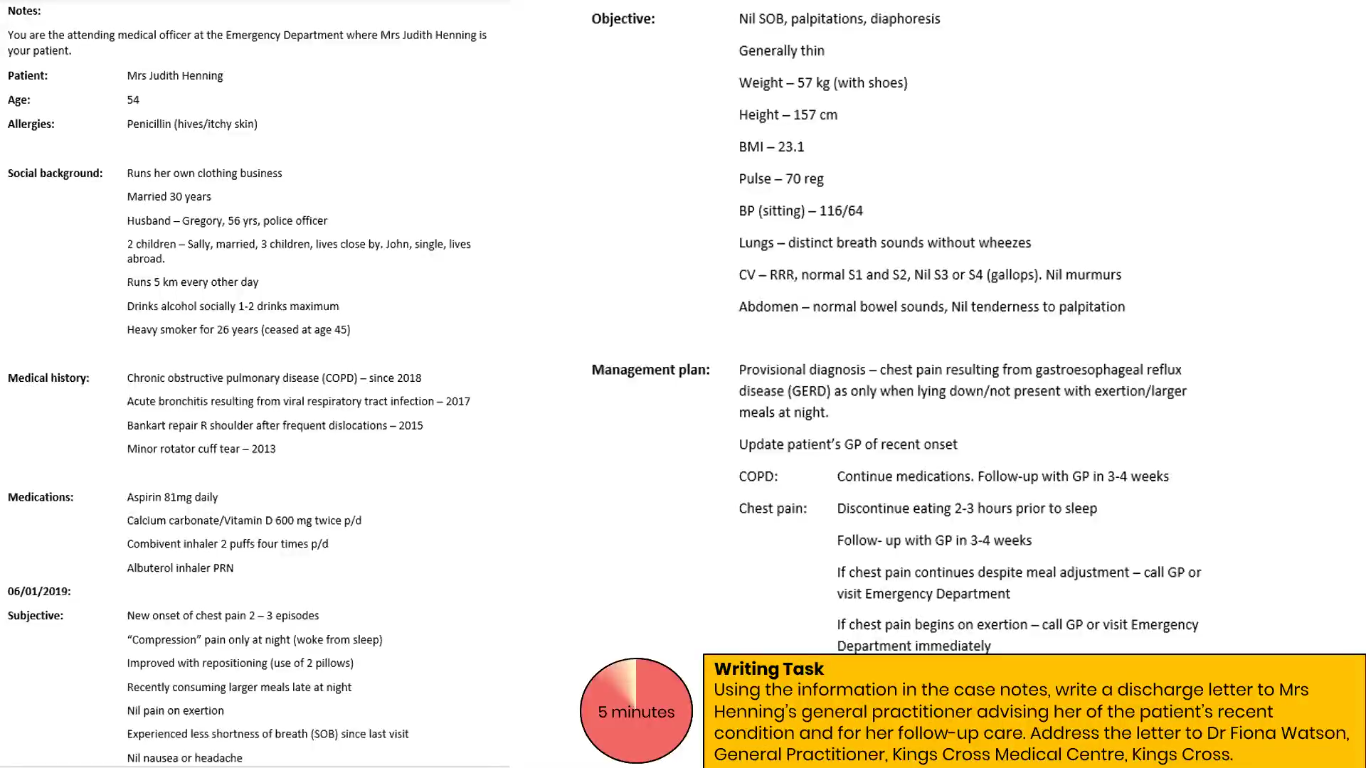
*Case note is blurry, but most information are irrelevant, so just refer to the details written down
Paragraph one – patient, condition, request
Mrs Henning was presented to the Emergency Department today after experiencing chest pain that might be attributable to gastro-esophageal reflux. Your follow up care is highly appreciated.
Paragraph two
Details: 6/01/2016 – new onset of chest pain 2-3 episodes, “compression” pain only at night, improved with repositioning (use 2 pillows), recently consuming larger meals at night
Mrs Henning presented with 2-3 bouts of chest pain. She also complained that she felt “compression” pain on her chest at night, which was relieved by repositioning herself using two pillows. In addition, she mentioned that she has been eating larger meals at night recently.
Mrs Henning presented with 2-3 bouts of chest pain. She complained of compression-like chest pain at night, which can only be alleviated by elevating herself with the help of two pillows. She also reported that she has been consuming larger meals at night recently.
Paragraph three
**Details: **generally thin, vitals such as BP, heart sounds, abdomen sounds are normal
An assessment noted that Mrs Henning is thin. However, her Vitals such as BP, heart sounds, abdomen sounds are normal
Or we can simply put this information in paragraph 2 saying that: Mrs Henning’s physical examination was unremarkable
Paragraph four
Details: provisional diagnosis – chest pain resulting from GERD as only when lying down / not presented with exertion / larger meals at night
Update patient’s GP of recent onset
COPD – continue medications. Follow up with GP in 3-4 weeks.
Chest pain – discontinue eating 2-3 hours prior to sleep, follow up with GP in 3-4 weeks – if chest pain continues despite meal adjustment – call GP or visit emergency department. If chest pain begins on trigger – call GP or visit emergency department
My provisional diagnosis of Mrs Henning is chest pain attributable to GERD because her pain is only present when she is lying down or after she has consumed larger meals at night. As you are aware that Mrs Henning has COPD, it is recommended for her to continue with her current medications – albuterol inhalers. Regarding Mrs Henning’s chest pain, it is advisable for her to stop eating 2-3 hours before sleeping. However, if this chest pain persists or is triggered by exertion, she should consult you or visit the emergency department immediately.
Mrs Henning’s condition is an indicative of chest pain attributable to GERD because her pain is only present either when she is lying down or after eating larger meals at night. The fact that pain doesn’t occur during exertion supports the finding. Since Mrs Henning has COPD, it is recommended for her to adhere to her current medications. Regarding Mrs Henning’s chest pain, it is advisable for her to avoid eating 2-3 hours before sleeping. However, if this chest pain persists or if it is triggered by exertion, she should report it to either yourself or to the emergency department at once.
Model letter image23.png — OCR
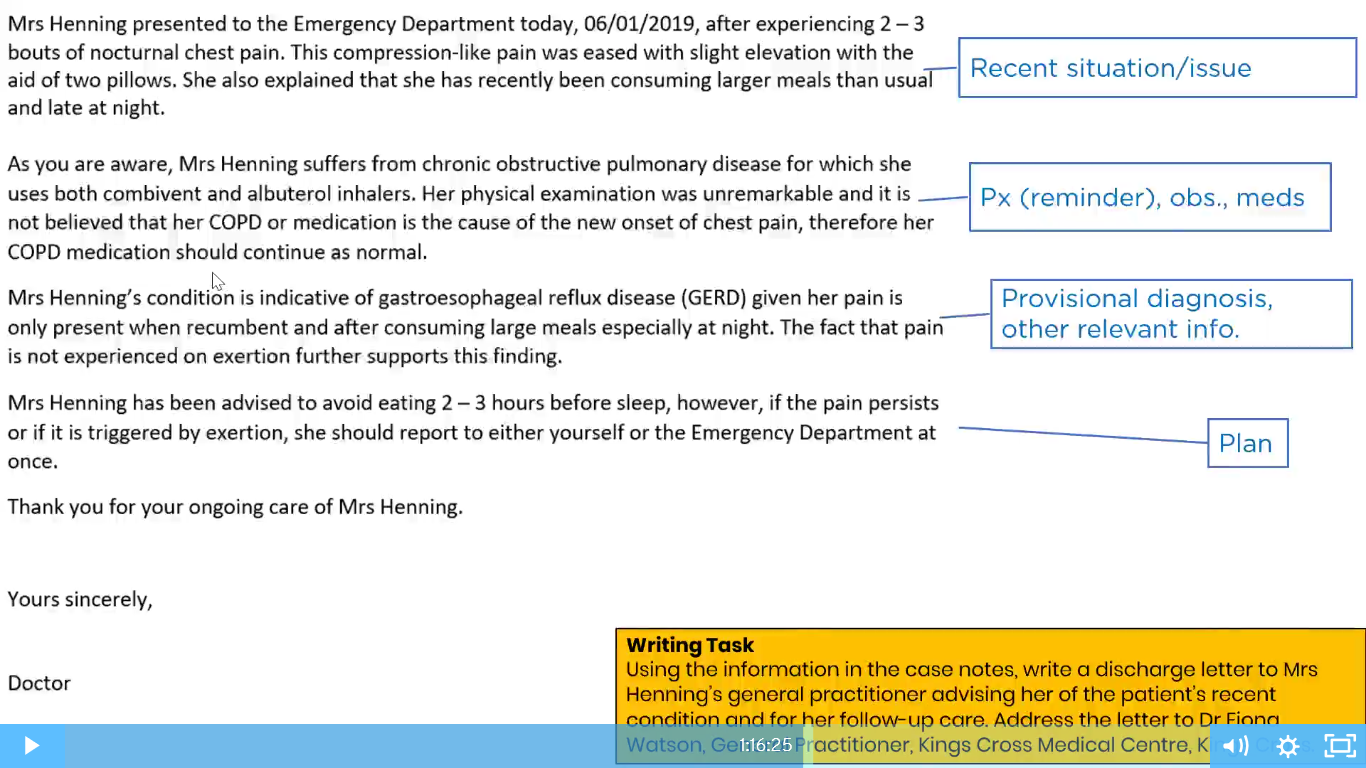
Mrs Henning presented to the Emergency Department today, 06/01/2019, after experiencing 2 - 3 bouts of nocturnal chest pain. This compression-like pain was eased with slight elevation with the aid of two pillows. She also explained that she has recently been consuming larger meals than usual and late at night.
As you are aware, Mrs Henning suffers from chronic obstructive pulmonary disease for which she uses both combivent and albuterol inhalers. Her physical examination was unremarkable and it is - not believed that her COPD or medication is the cause of the new onset of chest pain, therefore her COPD medication should continue as normal. Mrs Henning’s condition is indicative of gastroesophageal reflux disease (GERD) given her pain is only present when recumbent and after consuming large meals especially at night. The fact that pain is not experienced on exertion further supports this finding.
Mrs Henning has been advised to avoid eating 2 - 3 hours before sleep, however, if the pain persists or if it is triggered by exertion, she should report to either yourself or the Emergency Department at once.
Thank you for your ongoing care of Mrs Henning.
Yours sincerely,
Doctor
Discharge letter - Falls
Case notes
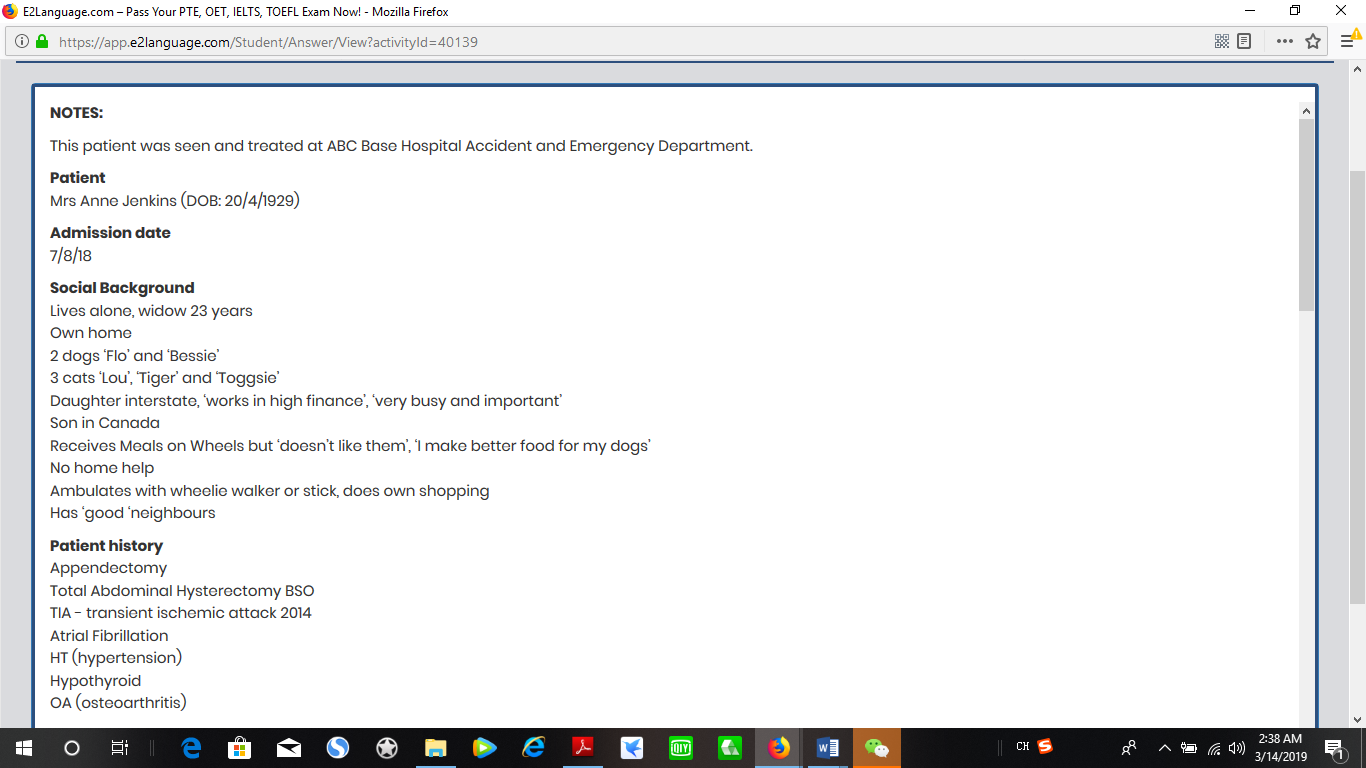
Screenshot image24.png — OCR
NOTES:
This patient was seen and treated at ABC Base Hospital Accident and Emergency Department.
Patient
Mrs Anne Jenkins (DOB: 20/4/1929)
Admission date
7/8/18
Social Background
Lives lone, widow 23 years
Own home
2 dogs ‘Flo’ and ‘Bessie’
3 cats ‘Lou’, Tiger’ and ‘Toggsie’
Daughter interstate, ‘works in high finance’, ‘very busy and important’
Son in Canada
Receives Meals on Wheels but ‘doesn’t like them’, ‘I moke better food for my dogs’
No home help
Ambultes with wheelie walker or stick, does own shopping
Has ‘good ‘neighbours
Patient history
Appendectomy
Total Abdominal Hysterectomy BSO
TIA - transient ischemic attack 2014
Atrial Fibrillation
HT (hypertension)
Hypothyroid
OA (osteoarthritis)
Screenshot image25.png — OCR
Medications
Oroxine 100mcg/50 mcg alt days
Atenolol 25mg daily
Digoxin 62.5mg 2 daily
Astrix 100mg daily
Panadol osteo 2 tds
Allergies
Elastoplast
Admission di1gnosis
90 yo woman BIBA
Presented after fall at home this am
NOF (no injury found)
Neighbour heard crying for help
Ambulance obs WNL
Unable to get up from ground by self
Slightly dishevelled, dried food scraps on dressing gown
Orientated to place / person but not date / day it’s all the same to me, dear”
Warm, well-pertused
Rang neighbour who says a few recent falls needing help up
Unable to contact Pt children - message left on daughter’s message bank
Although concerns of self-care and recent falls pt. competent to make decisions
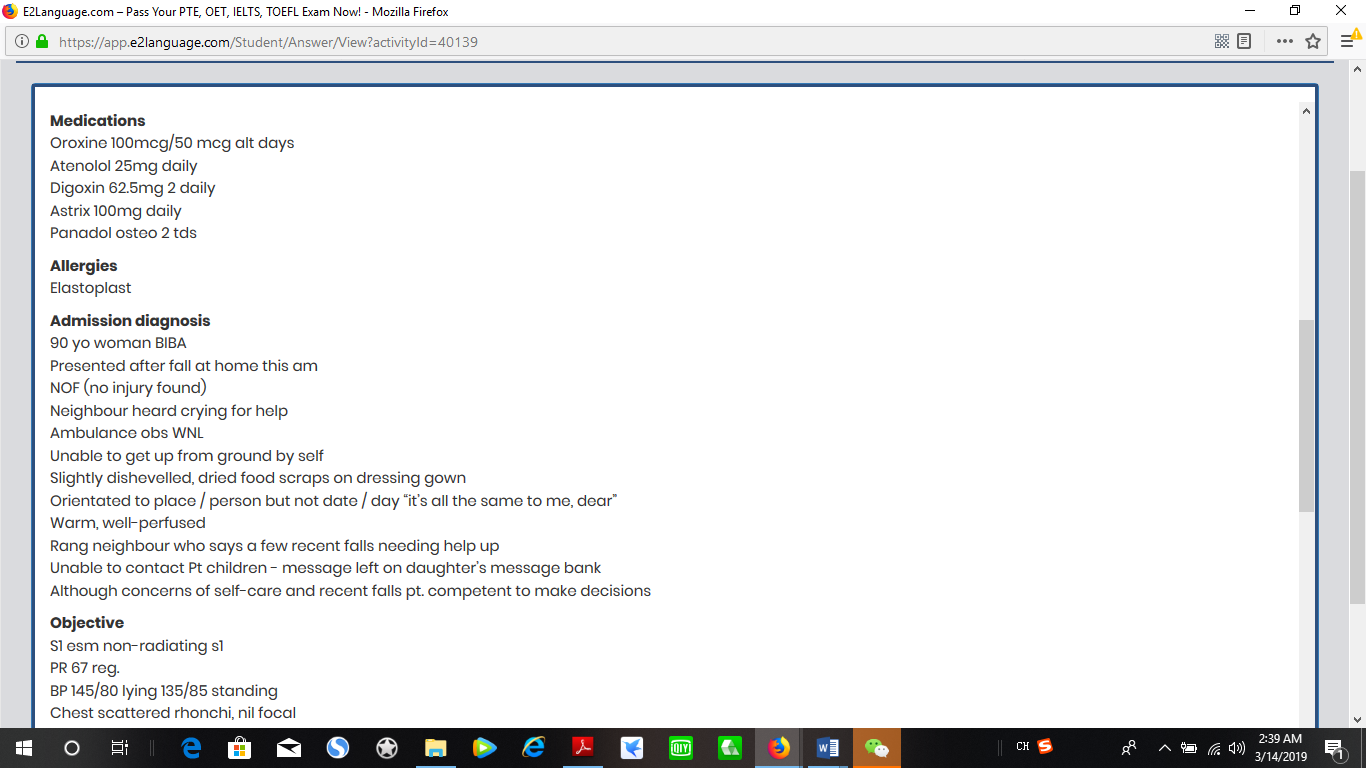
Objective
Sl esm non-raditing sl
PR 67 reg.
BP 145/80 lying 135/85 standing
Chest scattered rhonchi, nil focal
Screenshot image26.png — OCR
Objective
S1 esm non-radiating sl
PR 67 reg.
BP 145/80 lying 135/85 standing
Chest scattered rhonchi, nil focal
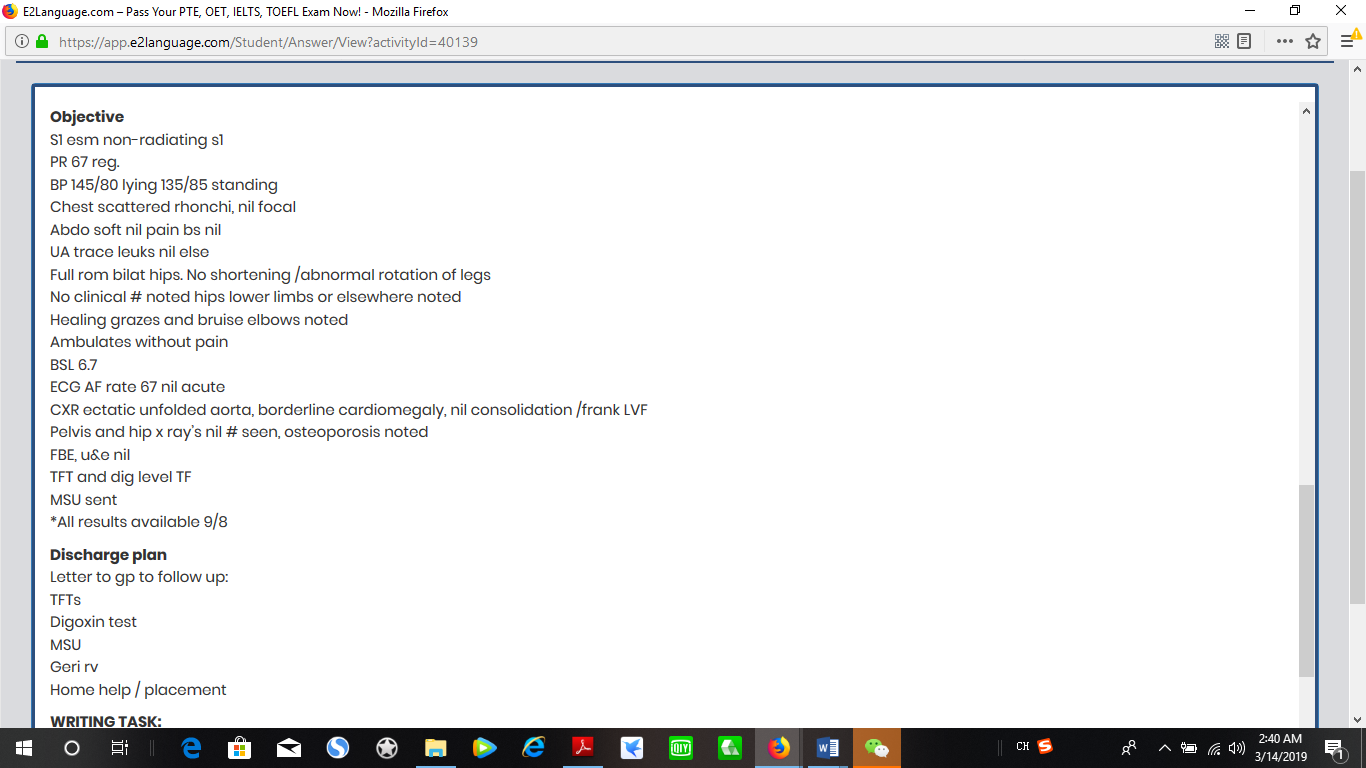
Abdo soft nil pain bs nil
UA trace leuks nil else
Full rom bilat hips. No shortening / obnormal rotation of legs
No clinical # noted hips lower limbs or elsewhere noted
Healing grazes and bruise elbows noted
Ambulates without pain
BSL 6.7
ECG AF rate 67 nil acute
CXR ectatic unfolded aorta, borderline cardiomegaly, nil consolidation /frank LVF
Pelvis and hip x ray’s nil # seen, osteoporosis noted
FBE, u&e nil
TFT and dig level TF
MSU sent
*All results available 9/8
Discharge plan
Letter to gp to follow up:
TFTS
Digoxin test
MSU
Geri rv
Home help / placement
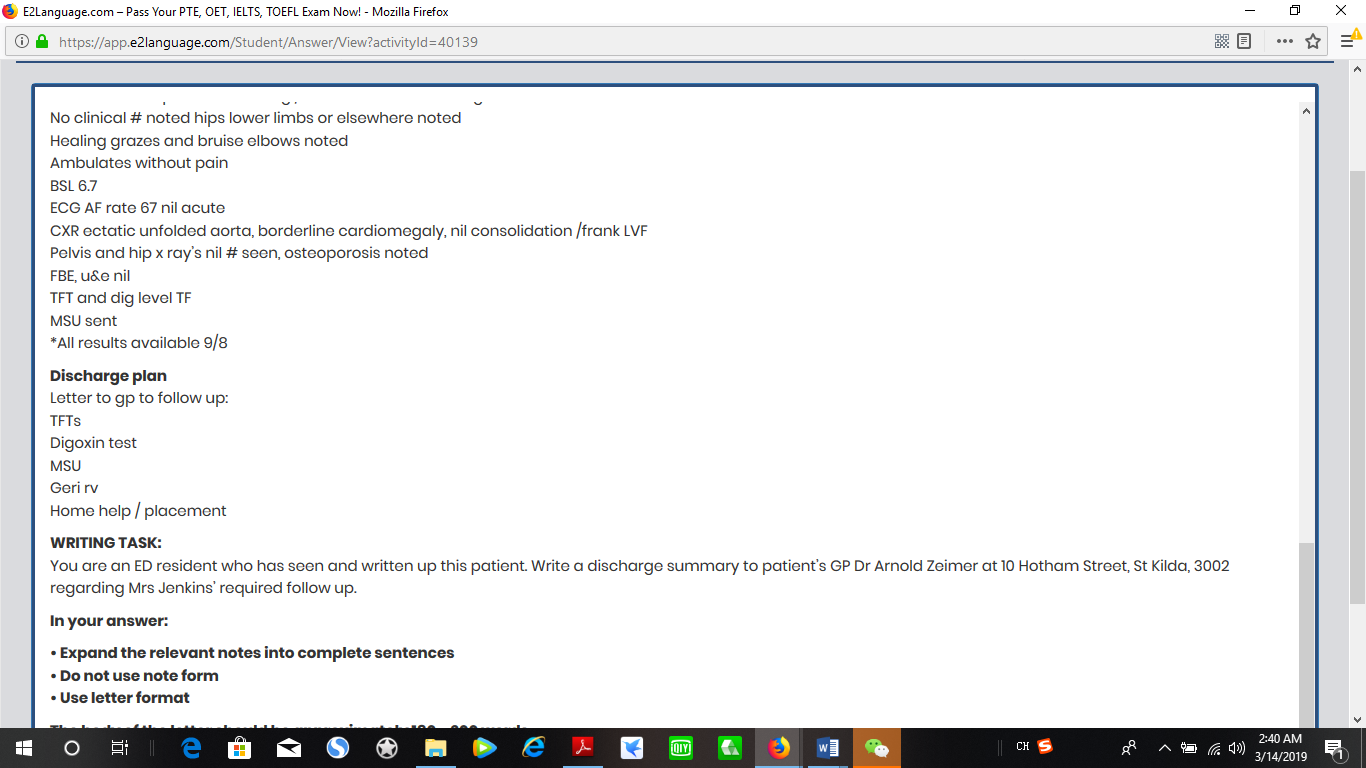
WRITING TASK:
Screenshot image27.png — OCR
No clinical # noted hips lower limbs or elsewhere noter ~
Heling grazes and bruise elbows noted
Ambulates without pain
BSL 6.7
ECG AF rate 67 nil acute
CXR ectatic unfolded aorta, borderline cardiomegaly, nil consolidation /frank LVF
Pelvis nd hip x ray’s nil # seen, osteoporosis noted
FBE, u&e nil
TFT and dig level TF
MSU sent
*All results available 9/8
Discharge pln
Letter to gp to follow up:
TFTS
Digoxin test
MSU
Geri rv
Home help / placement
WRITING TASK:
You are an ED resident who has seen and written up this patient. Write a discharge summary to patient’s GP Dr Arnold Zeimer at 10 Hotham Street, St Kilda, 3002
regarding Mrs Jenkins’ required follow up.
In your answer:
• Expand the relevont notes into complete sentences
• Do not use note form
• Use letter format
Model letter image28.png — OCR
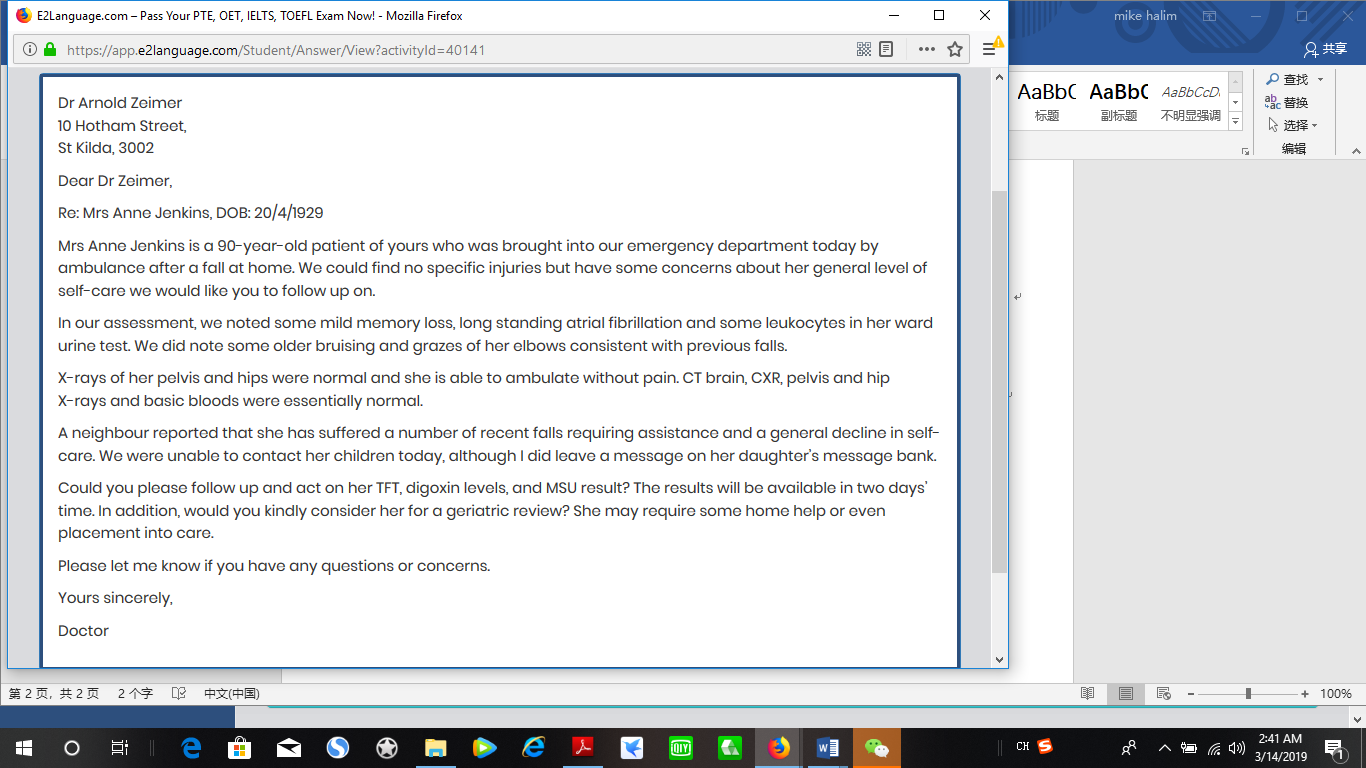
Dr Arnold Zeimer 10 Hotham Street, St Kilda, 3002
Dear Dr Zeimer, Re: Mrs Anne Jenkins, DOB: 20/4/1929 Mrs Anne Jenkins is a 90-year-old patient of yours who was brought into our emergency department today by ambulance after a fall at home. We could find no specific injuries but have some concerns about her general level of self-care we would like you to follow up on.
In our assessment, we noted some mild memory loss, long standing atrial fibrillation and some leukocytes in her ward urine test. We did note some older bruising ond grazes of her elbows consistent with previous falls.
X-rays of her pelvis and hips were normal and she is able to ambulate without pain. CT brain, CXR, pelvis and hip X-rays and basic bloods were essentially normal. A neighbour reported that she has suffered a number of recent falls requiring assistance and a general decline in self- care. We were unable to contact her children today, although I did leave a message on her daughter’s message bank.
Could you please follow up and act on her TFT, digoxin levels, and MSU result? The results will be available in two days’ time. In addition, would you kindly consider her for a geriatric review? She may require some home help or even placement into care.
Please let me know if you have any questions or concerns.
Yours sincerely, Doctor
Paragraph: patient / condition / request
Mrs Anne Jenkis (*patient) was brought into our emergency department today by an ambulance due to a fall (*condition) at home this morning. We have some concerns about her general level of self-care and would like you to follow up. (*request)
Paragraph one
Details: fell at home this morning, no injury found, neighbor came to her assistance and called the ambulance, disheveled, unable to get up from the ground by herself, seemed confused, unable to contact her children so left message on daughter’s message bank, neighbor claimed that she had a few recent falls which needed assistance,
Mrs Jenkis fell at home this morning but we couldn’t find any specific injuries. Her neighbor came to her assistance and called the ambulance. When her neighbor found her, she was disheveled and was unable to get up from the ground by herself. Her neighbor also reported that she had a few recent falls requiring assistance. Although she was aware about her surroundings and people, she seemed to be confused about the date and time. (*She also seemed to be suffering from some memory loss) We were unable to contact Mrs Jenkis’s children, so I sent a message to her daughter’s message bank.
Paragraph three
Details:
-
hypertensive, atrial fibrillation, rhonchi heard in lungs, chest x-ray: cardiomegaly
-
leukocytes in urine ward
-
no clinical fractures noted hips lower limbs, hips full range of motion, no shortening / abnormal rotation of legs, osteoporosis, ambulates without pain
-
healing grazes and bruise elbows,
According to our assessment, we noted that Mrs Jenkin’s had some healing grazes and bruises on her elbows due to her previous falls. X-rays of her hips and legs were normal and she was able to ambulate without any pain. However, she was hypertensive, had atrial fibrillation and cardiomegaly (borderline), and some leukocytes were found in her urine ward.
Paragraph four - request
Details: Discharge plan – letter to GP to follow up: TFTs, digoxin test, MSU, Geri rv, home help / placement
Could you please follow up and act on her TFTs, digoxin levels and MSU results? In addition, would you consider her for a geriatric review? Finally, she may require home help or placement into care. Should you have any questions, please do not hesitate to contact me.
Transfer letter – rehabilitation
Case notes
Screenshot image29.png — OCR
NOTES:
Julian McDonald (Mr) is a 68-year-old male recovering from total left knee joint replacement and needing transfer from your acute care hospital (The Alfred, 55
Commercial Rd, Melbourne VIC 3004) to the rehabilitation hospital (Cabrini Hopetoun Rehabilitation) who will take over his care. Mr B Mossley is the name of the
specialist who performed the surgery.
Patient details
Name: Julian McDonald (Mr)
DOB: 12/1/50
Other: Gold Card Veterans Affairs, DVA234965
Admission dte: 20/7/18 for elective L TKJR
Transfer date: 24/7/18
Reason for transfer: Rehabilitation care
Transfer type: One-way
Patient history
Osteoarthritis (past 10 years)
Gout (since 2010)
Smoker - 20cigs/day
Htn
Obesity- BMI 35
Hypocholesteraemia
PTSD
Alcohol > 6-10 SD /day
Discharge medications
Zyloric 300 mg daily
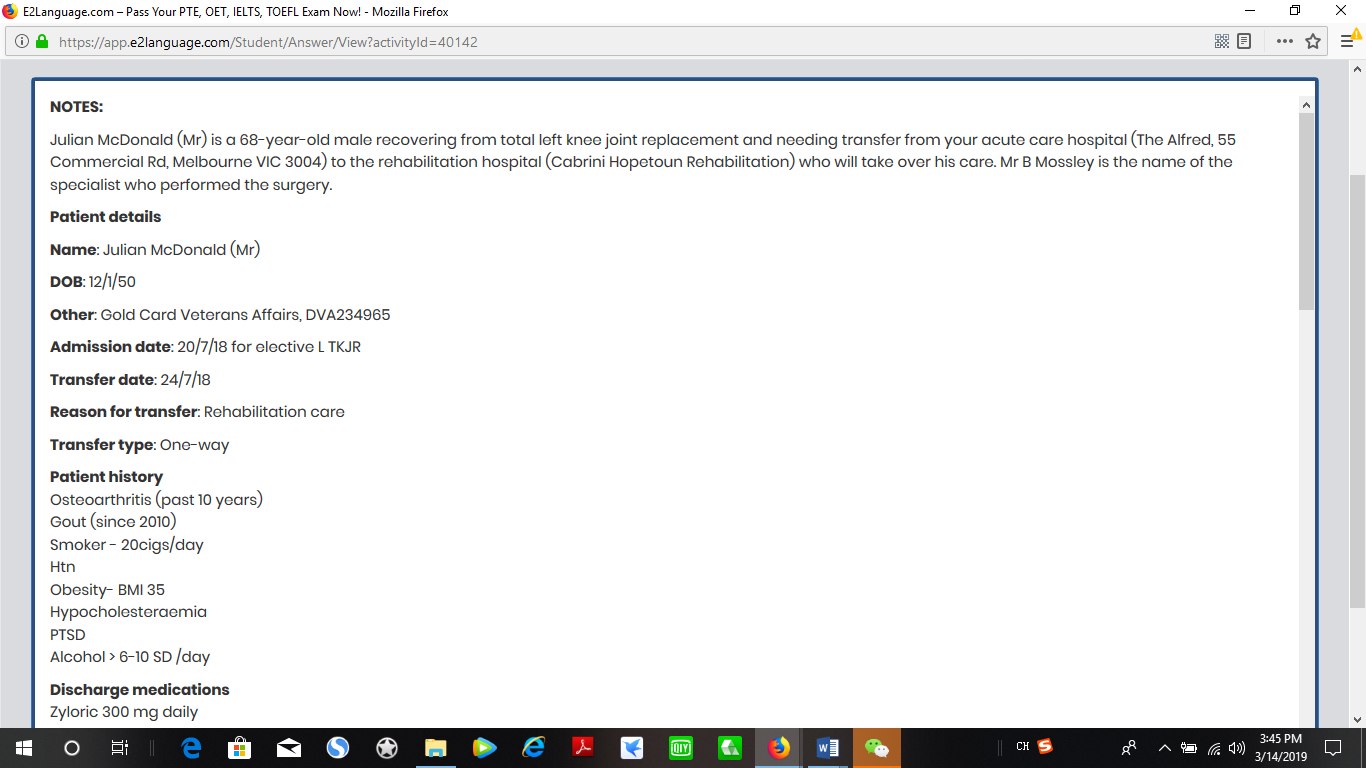
Screenshot image30.png — OCR
Discharge medications
Zyloric 300 mg daily
Lipitor 20mg nocte
Karvina 300mg daily
Mogadon 5mg nocte (ceased)
Paracetamol 1gm gid
Ibuprofen 400mg tas
Nicabate 21 mg patch
Targin 20/10 bd
Oxycodone 5-10mg q4hr prn
Allergies
Penicillin allergy rash as child
Social
Lives alone in caravan back of friend’s property w. 3 dogs, 6 chickens, cat
Outdoor shower
Uses BBQ to cook
Reg’d w. Dept. Vet. Affairs
Divorcee, 2 estranged children, few friends
Oper1tive report
Medial prepatellar approach
Stryker triathlon x3 Prosthesis
Reinfusion drains in situ
Spinal plus GA
Post op
Significant post op pain requiring a no. of medical reviews
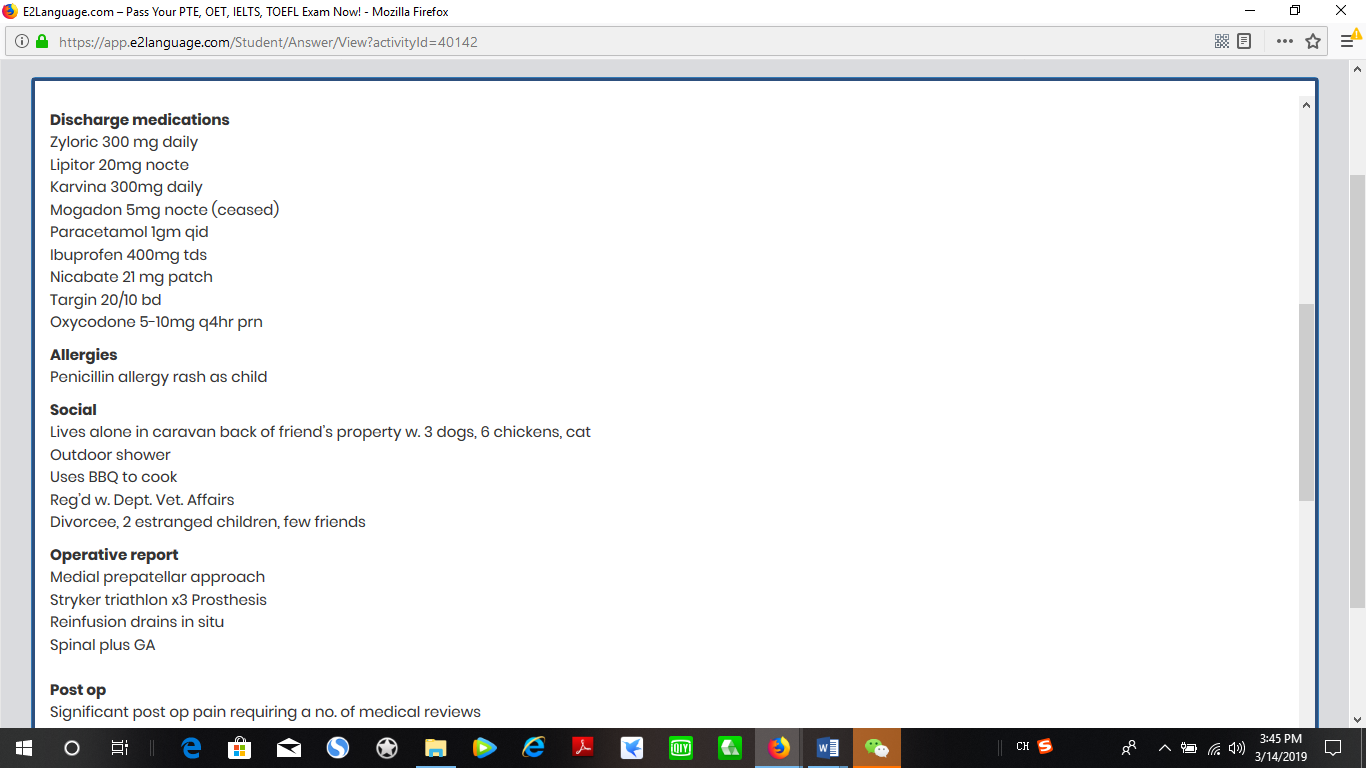
Screenshot image31.png — OCR
Post op
Significant post op pain requiring a no. of medical reviews
Morphine PCA inadequate
48 hr ketamine infusion used w effect
Ongoing pain following
Amitriptyline commenced - difficulty urinating so ceased w effect
Significant somnolence and snoring noted despite inadequate analgesia, needs formal sleep studies
CSU grew Staph saphrolyticus - prob. contaminant - specialist v concerned
5 d Keflex given in addition to normol 24 hr post op antibiotics
Some mild agitation and insomnia noted
Not significant alcohol withdrawal
Nicotine replacement instituted
Slow to mobilize partly from pain
Treatment plan
ROS at d10
Specialist at 6w (appointment made 7/9/18)
Significant rehab including physiotherapy and occupational therapy home visit to assess suitability and fitness of returning to caravan
Social work
Drug and Alcohol input appreciated
Sleep studies? OSA
Transfer plan
Immediate one-way transfer to the Cabrini Hopetoun Rehabilitation hospital for immediate treatment
WRITING TASK
Mr McDonald was admitted 4 days ago for knee surgery at the Alfred Hospital where you work. Using the information in the case notes, write a transfer letter to the
Admissions Officer at Cabrini Hopetoun Rehabilitation, 2-6 Hopetoun Street, Elsternwick, Vic 3185, for Mr McDonald’s immediate treatment.
In your 1nswer:
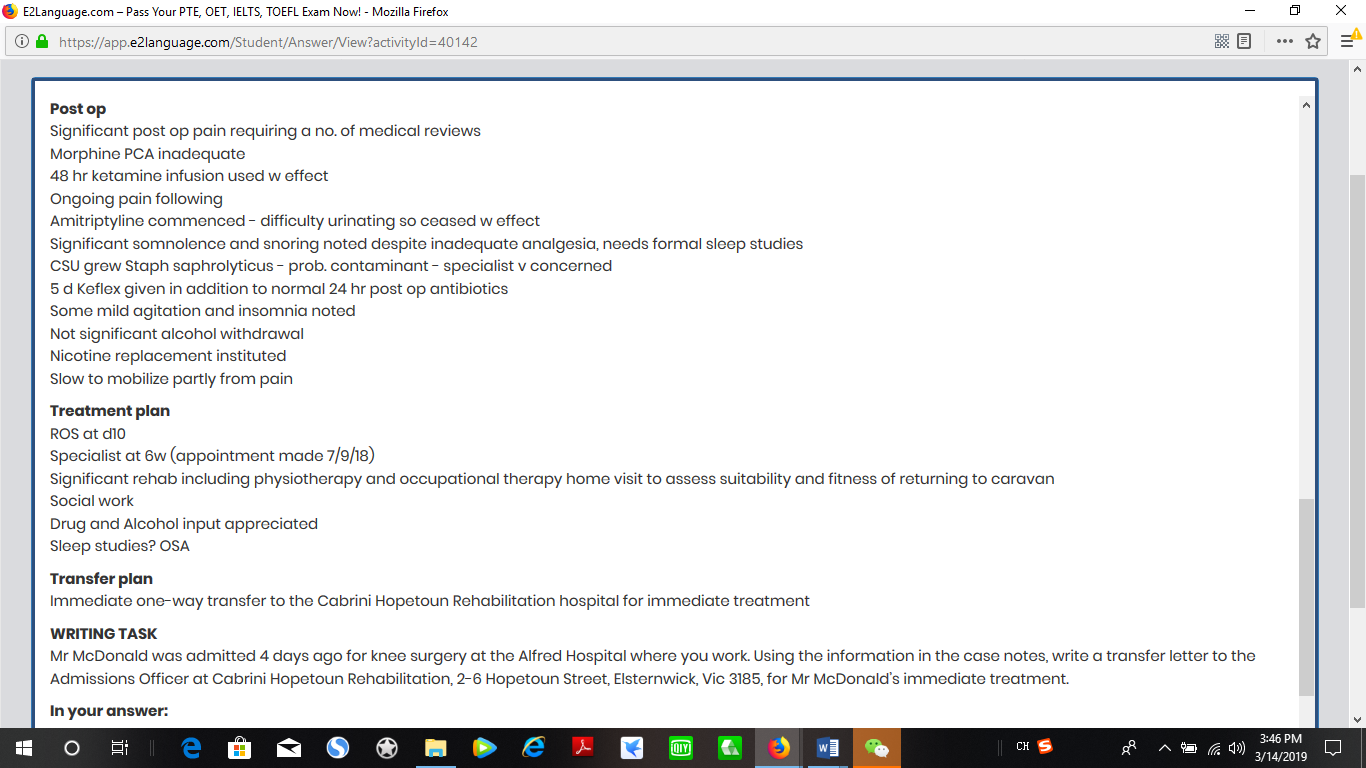
Model letter
Screenshot image32.png — OCR
24/7/2018 Admissions Officer Cabrini Hopetoun Rehabilitation 2-6 Hopetoun Street Elsternwick, Vic 3185
Dear Admissions Officer, Thank you for accepting this 68-year-old man who has recently undergone post left total knee joint replacement for rehabilitation and assessment for suitability to return to his home.
His background medical issues include obesity, hypertension, hypercholesterolemia, gout, cigarette smoking and excess alcohol intake. As a child he experienced a rash when given penicillin.
Mr McDonald underwent a routine joint replacement with specialist Mr B Mossley on 20/7/18. Postoperatively he experienced significant analgesic issues, and a possible catheter-related UTI which has been treated. In addition, we noted signs consistent with sleep apnoea.
His discharge medications are Zyloric, Karvina, Lipitor, paracetamol, ibuprofen, and a Nicabate patch. Included the opiates Targin and oxycodone. (Please see the attached list of dosages) Please provide Mr McDonald rehabilitation including physiotherapy as needed, as well as preparation for his return to living at home in a caravan. We anticipate his rehabilitation may be slow given the pain issues, and his isolated home situation will be problematic. Occupational therapy home visits and some social work input will be needed, as well as the possibility of drug and alcohol counselling and sleep studies arranged while an inpatient with your team.
Please note, Mr McDonald’s sutures need removal on 30/7/18 and an appointment has been made to see Mr Mossley 6 weeks postoperatively on 7/9/18. Please contact us with any enquiries.
Sincerely, Doctor
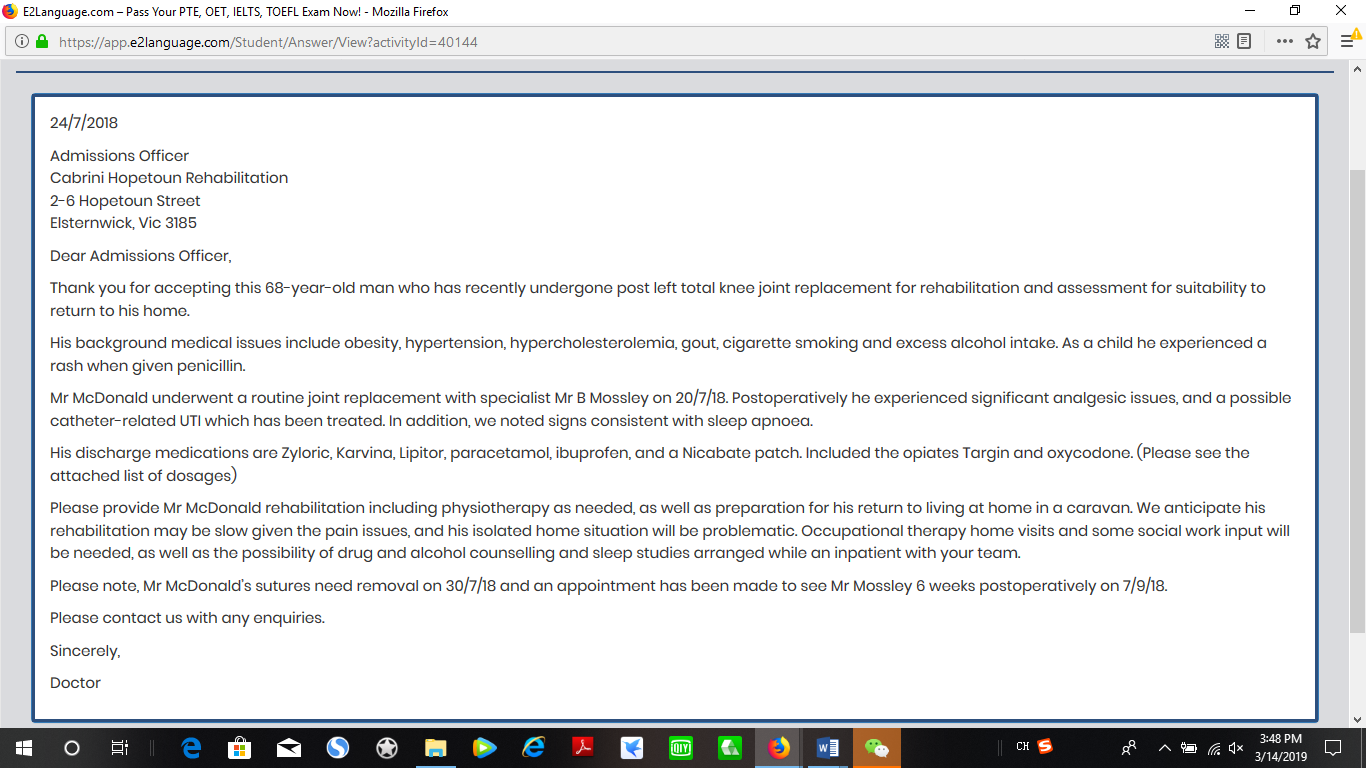
Paragraph one: patient / condition / request
Details: Patient – Mr Mc Donald. Condition – total left knee joint replacement operation. Request – rehabilitation
Thankyou for accepting Mr Mc Donald, who has recently undergone a total left knee joint replacement operation performed by specialist Mr B Mossley, for rehabilitation.
Paragraph two
Details: osteoarthritis (past 10 years), gout (since 2010), smoker – 20 cigarettes/day, hypertension, obesity – BMI 35, hypocholesteremia, alcohol > 6-10 SD/day, penicillin allergy as a child
Mr Mc Donald has been suffering from osteoarthritis for the past 10 years and was diagnosed with gout since 2010. He is obese (BMI 35), has hypertension and hypocholesteremia, and he smokes and drinks alcohol excessively. Furthermore, as a child, he experienced a rash after taking penicillin.
Paragraph three
Details: Discharge medications are Zyloric, Karvina, Lipitor, paracetamol, ibuprofen, and a nicabate patch (please see the attached list of dosages)
Paragraph four
Details: significant post operation pain, morphine inadequate, ketamine infused, ongoing pain following, amitriptyline commenced – ceased due to urinating difficulty, slow to mobilize partly from pain, catheter specimen of urine (CSU) – Staph. Saphrolyticus, keflex given in addition to antibiotics, insomnia noted
Mr Mc Donald complained about significant post-operation pain, which couldn’t be relieved by both morphine and ketamine, so amitriptyline was administered, but was eventually stopped because Mr Mc Donald experienced urinating difficulties. Mr Mc Donald also displayed limited mobility due to pain. The catheter specimen of urine revealed that Mr Mc Donald was infected by Staph. Saphrolyticus for which he was treated with Keflex and antibiotics. In addition, Insomnia was noted.
Paragraph five
Details: Treatment plan – review of system, specialist at 6 week (appointment made 7/9/18), significant rehab including physiotherapy and occupational therapy home visit to assess suitability and fitness of returning to caravan, social work, drug and alcohol input appreciated, sleep studies? OSA
I would appreciate if you could conduct a thorough review of system on Mr Mc Donald. Please provide a rehabilitation, including: physiotherapy and occupational therapy home visit, to ensure that Mr Mc Donald’s condition is fit enough prior to allowing him to return to his caravan. Both social work, drug and alcohol counselling, and sleep studies should be also incorporated if possible.
Please note that Mr Mc Donald has an appointment with Mr Mosley 6 weeks post-operatively on 7/9/18
Should you have any questions, please do not hesitate to contact me.