A format which will fit most scenarios is as follows:
- Introduction: Including purpose of writing and chief complaint in brief
- Body Paragraph 1: Patient past medical history in summary
- Body Paragraph 2: Trends in history & medication
- Body Paragraph 3: Chief complaint and current situation in detail
- Conclusion: Concluding request specific to the task
Structure
-
Address
- Doctor’s name
- Specialty
- Name of hospital and address
- Today’s date
- Dear (Doctor’s last name)
- Re: (patient’s full name), D.O.B./Age (if DOB not given)
-
Introduction
- Normally two sentences.
- Mainly maintain the purpose of referral.
-
Body Part 1
- Personal history/marital status/smoker/alcoholic/profession
- Medical history
- Medication history
- Family history
- Allergy history
-
Body Part 2/Initial Relevant Visit
- Complaints & symptoms
- Examination finding
- Treatment:
- Prescription
- Advice
- Investigation
- Review schedule
-
Body Part 3/Subsequent Visit
- Condition (improvement/deterioration)/new symptom
- Examination finding
- Investigation results
- Further changes to medication/additional advice/recommendation
-
Body Part 4 (Final/Today’s Visit)
- Final condition
- Final investigation findings
- Final assessment
- Final treatment and plan
-
Conclusion
- In view/light of the above, I believe X is/has been suffering from Y disease.
- Your further assessment—include any specific request.
- Should there be any queries, please do not hesitate to contact me.
-
Closing
- Yours sincerely,
- Doctor
Words and phrases
- Risperidone was commenced during admission. (≈ begin)
Discharge letter
Date: 18 March 2018
Dr Giovanni DiCoccio Proudhurst Family Practice 231 Brightfield Avenue Proudhurst
Dear Dr DiCoccio,
Re: Ms Bethany Tailor, aged 35
I am writing to discharge Ms Bethany Tailor, a 35-year-old patient of yours, who was admitted on 01 March 2018 with decompensated schizophrenia. She has made good progress and is being discharged today back into your care.
Ms Tailor self-admitted following medication non-compliance and recent cocaine use. On admission, she was agitated, aggressive, and exhibited thought blocking and latency. She also experienced auditory command hallucinations urging self-harm, visual hallucinations of grinning shadow figures, and delusions regarding connections to political leaders.
During hospitalisation, Ms Tailor was commenced on risperidone, alongside nursing care focused on behavioural control, delusion redirection, and medication adherence. She responded well; by 10 March, her hallucinations had resolved, thought blocking had ceased, and thinking was less disorganised. Currently, she can minimise delusions, engage in daily activities, and demonstrates good insight and fair judgment.
Ms Tailor is discharged home on oral risperidone 4mg nightly, with 1mg twice daily as needed for agitation or psychosis. Outpatient follow-up has been arranged at Proudhurst Mental Health Clinic. As she risks decompensation if non-compliant or abusing substances, your ongoing monitoring of her compliance and mental state would be appreciated.
Should you have any queries, please do not hesitate to contact me.
Yours sincerely,
Doctor
Referral letter
07 November 2010
Dr James Brown 1238 Gympie Road Chermside, 4352
Dear Dr Brown,
Re: Mr David Taylor, aged 38
I am referring Mr Taylor for orthopaedic assessment and management of an MRI-confirmed medial cartilage injury in his left knee. Given his persistent functional limitation, I would appreciate your opinion regarding removal of the damaged cartilage.
Mr Taylor, a 38-year-old landscape gardener, first presented on 12 August with left knee pain, swelling and difficulty strengthening the leg. These symptoms followed a twisting injury sustained while playing tennis six months earlier. Examination revealed a limp, mild swelling and medial tenderness, without effusion; his vital signs were normal. He was prescribed Voltarin 50 mg twice daily for one week, and an X-ray was requested.
At review on 25 August, he reported intermittent pain and swelling that restricted his work and reduced his income. Although flexion and extension were normal, power was reduced on active and passive testing. Medial tenderness and swelling persisted, without effusion. An MRI was ordered.
At review today, his pain had decreased, but his limp and swelling persisted. The MRI confirmed medial cartilage damage. Your receptionist has arranged an appointment for Mr Taylor with you at 8:00 am on 21 November 2010.
Yours sincerely,
Dr Peter Perfect
Speaking
- Briefly introduce yourself according to the scenario.
- Ask questions to make an initial diagnosis .
- Respond carefully to the patient’s responses.
- Provide an explanation of the condition & respond to further questions and concerns of the patient.
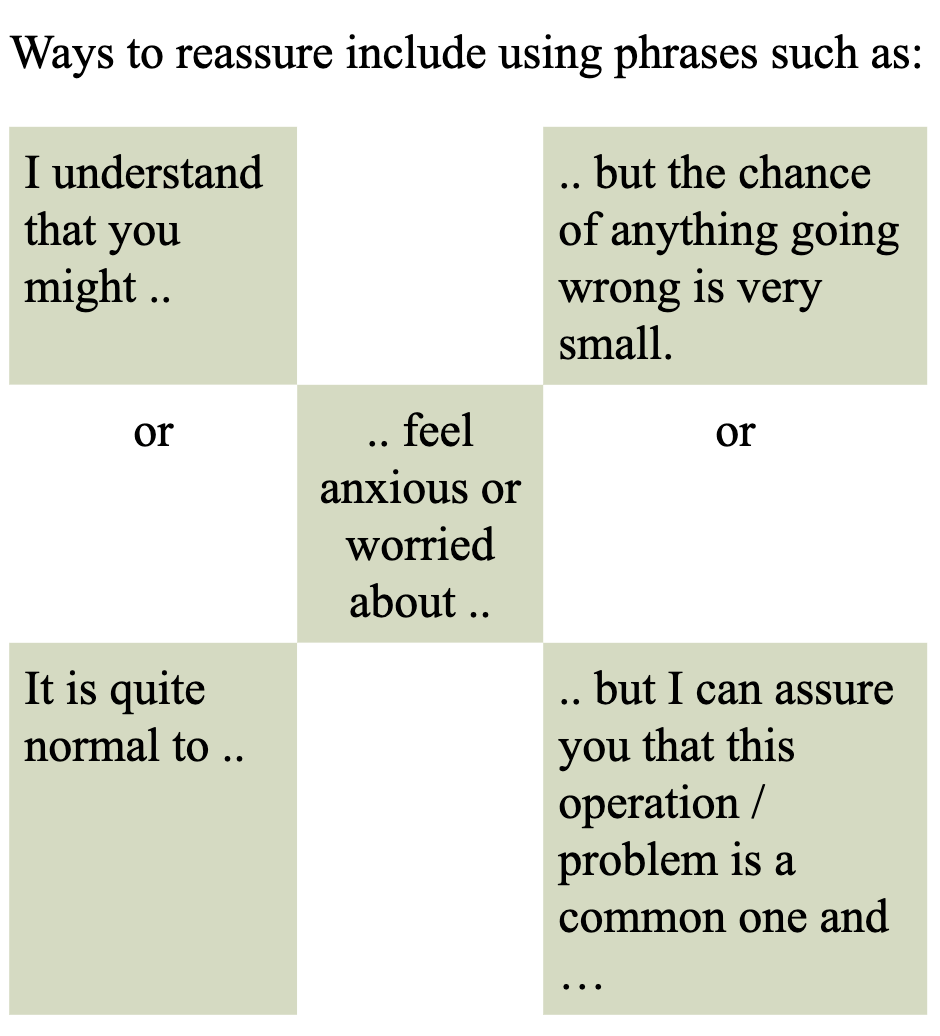
- Provide advice and reassurance as required.
- Short simple concluding sentence.
Before we start, may I ask what you’d like to be called?
Briefly introduce yourself according to the scenario.
- start the conversation
- Doctor: “Hi Mrs Smith, my name is DrJay. Thanks for coming to see me. Now, I understand that you are having some issues with your medications?”
- be attentive
- Doctor: “Do you mind if l ask you a few questions about your medical history?… Ok, thank you.”
- be non-judgmental
- Doctor: “I understand that you might not want to stop taking your medication. I can understand that.”
- show empathy
- Doctor: “Hmmm, yes… I can see how stopping taking the medication so suddenly might be a bit scary.”
- explore the patient’s concerns/ideas
- Doctor: “What do you think might becausing your dizziness?”
- pick up on patient cues
- Doctor: “You seem a little uncomfortable about reducing your medication. Is that right?”
- relate explanations to P’s concerns
- Doctor: “So, there’s certainlysomething we can do about yourdizziness; that shouldn’t be aproblem.”
- sequence the interview
- “l’d like to talk to you about three ways we can help you. First…”
- organise your explanations
- “So, just to recap what we’ve discussed. We talked about X. PAUSE …and it’s really important to remember that… PAUSE”
- open question → closed question
- Doctor: “Tell me about your medicationuse.”
- Patient: “Blah blah blah.”
- Doctor: “So you’re over-medicating?”
- Patient: “Yes.”
- summarise
- Doctor: “Okay, so as far as I understand, you X, Y and Z… Right?”
- establish what the patient knows
- Doctor: “So what do you already know about the side effects?”
- In an accident and emergency department of a hospital it would be appropriate to say: “Hello, I am Doctor Robertson and I will be looking after you today, now ~ ”
- On a hospital ward a candidate could start by introducing themselves “Good day, my name is Cathy, I’m the nurse on this ward and I’m gong to be looking after you today, are you feeling comfortable?”
Phrases to show empathy
It is really important for real life as well as OET to demonstrate empathy with our patients. Here are some useful phrases so you can sound professional and empathetic:
“It sounds like this has been a stressful time for you”
“It seems to me that this has been a big worry for you”
“I can see that you appear to be very upset by this, would you like to talk more about that?”
“I’m sorry to hear that”
Avoid the natural tendency to say “I understand how you feel”. Whatever the situation, you have not been in the exact same situation as the patient, so especially if they are upset, they can easily say “you don’t understand how I feel, you couldn’t possibly understand”.
Instead say something like:
“It is understandable to feel worried/upset/frustrated in this situation”
OR
“I appreciate that this has been worrying/upsetting for you”