- Preterm labor: regular uterine contractions with cervical effacement, dilation, or both before 37 weeks’ gestation
- Preterm birth
- Live birth between 20 0/7 weeks’ and 36 6/7 weeks’ gestation
- WHO subcategories
- Extremely preterm (< 28 weeks)
- Very preterm (28 to < 32 weeks)
- Moderate to late preterm (32 to < 37 weeks)
Epidemiology
Etiology
Risk factors
- Prior spontaneous PTB (single strongest risk factor).
- Short cervical length (CL <25 mm on TVUS prior to 24 wks). c
- Multiple gestations (uterine overdistension). c
- Cervical trauma/surgery (e.g., LEEP, cold knife conization).
- Infections: Intra-amniotic infection, STIs, asymptomatic bacteriuria, BV.
- Uterine anomalies or large leiomyomas.
- Low SES, maternal age <18 or >35, cigarette/substance use, short interpregnancy interval (<18 mos).
Pathophysiology
Clinical features
Diagnostics
Treatment
-
Secondary Prevention (Asymptomatic High-Risk Patients):
- Prior sPTB: Serial TVUS CL monitoring every 1–2 weeks from 16 to 24 weeks GA + vaginal progesterone (or IM 17-OHPC).
- If CL shortens to ≤ 25 mm before 24 weeks place cervical cerclage.
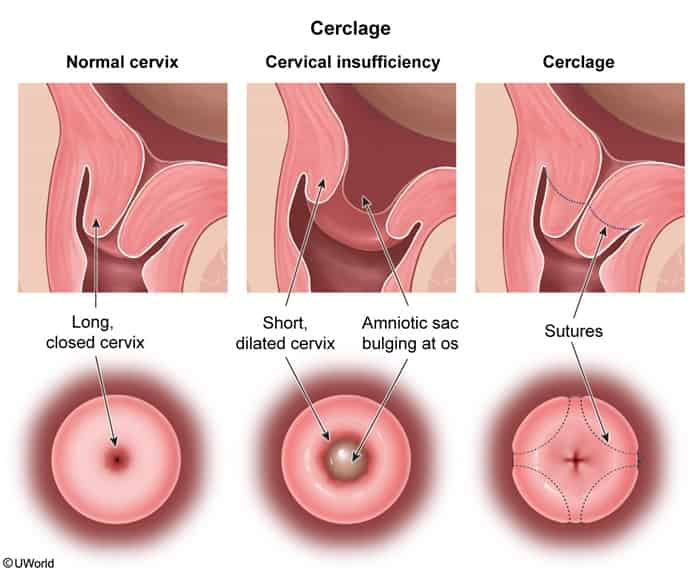
- If CL shortens to ≤ 25 mm before 24 weeks place cervical cerclage.
- Incidental Short Cervix (CL ≤ 25 mm at ≤ 24 weeks, no prior sPTB): Initiate daily vaginal progesterone (cerclage not routinely indicated).
- Prior sPTB: Serial TVUS CL monitoring every 1–2 weeks from 16 to 24 weeks GA + vaginal progesterone (or IM 17-OHPC).
-
Acute Active Preterm Labor Management (by Gestational Age):
-
< 32 Weeks GA:
- Antenatal Corticosteroids: Betamethasone (12 mg IM q24h 2 doses) or Dexamethasone (6 mg IM q12h 4 doses) to accelerate fetal lung maturity (reduces RDS, IVH, NEC, and neonatal mortality). c
- Tocolytic Therapy (48 hours): Indomethacin (first-line < 32 wks; COX inhibitor). Limit use to < 48 hours to prevent oligohydramnios and premature closure of fetal ductus arteriosus.
- Neuroprotection: Magnesium Sulfate () IV bolus + maintenance infusion to reduce risk and severity of cerebral palsy.
- GBS Prophylaxis: IV Ampicillin (or Penicillin G) administered until delivery or until GBS culture returns negative.
-
32 0/7 to 33 6/7 Weeks GA:
- Antenatal Corticosteroids: Betamethasone or Dexamethasone.
- Tocolytic Therapy (48 hours): Nifedipine (first-line 32 wks; CCB).
- GBS Prophylaxis: IV Ampicillin/Penicillin.
- is NOT indicated for neuroprotection at 32 weeks.
-
34 0/7 to 36 6/7 Weeks GA (Late Preterm):
- Antenatal Corticosteroids: Betamethasone (if not previously administered and delivery expected within 7 days).
- No Tocolytics: Allow labor to progress; risks of tocolysis outweigh benefits at 34 weeks.
- GBS Prophylaxis: IV Ampicillin/Penicillin if GBS status is positive or unknown.
-
-
Contraindications to Tocolysis:
- Absolute: Intrauterine fetal demise (IUFD), lethal fetal anomaly, non-reassuring fetal status, severe preeclampsia/eclampsia, maternal hemodynamic instability/abruption, intra-amniotic infection.
Complications
- Neonatal Complications:
- Respiratory Distress Syndrome (RDS) (surfactant deficiency).
- Intraventricular Hemorrhage (IVH) (fragile subependymal germinal matrix). c2
- Necrotizing Enterocolitis (NEC).
- Patent Ductus Arteriosus (PDA).
- Bronchopulmonary Dysplasia (BPD) & Retinopathy of Prematurity (ROP).
- Anemia of prematurity: impaired ability to produce adequate erythropoietin
- Neonatal sepsis, hypothermia, hypoglycemia, hyperbilirubinemia.
- Long-term: Cerebral palsy, developmental delay, chronic lung disease.
- Maternal Complications:
- Intra-amniotic infection (chorioamnionitis) and postpartum endometritis.
- Postpartum hemorrhage (PPH) due to uterine atony.
- Increased rate of operative interventions (Cesarean delivery, vacuum/forceps-assisted birth).
Intraventricular hemorrhage (IVH)
- Definition: Bleeding into the ventricles from the germinal matrix, a highly vascularized region within the subventricular zone of the brain from which cells migrate out during brain development.
- Etiology: associated with a number of risk factors
- Birth weight < 1500 g and delivery before 32 weeks’ gestation due to the fragility of the germinal matrix and/or impaired autoregulation of blood pressure
- Maternal chorioamnionitis
- Pathophysiology
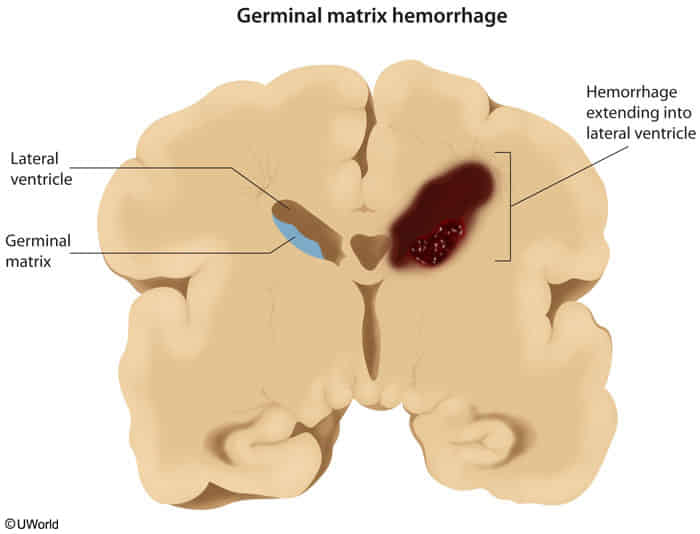
- Immaturity of the basal lamina and lack of astrocytic glial fibrillary acidic protein within the germinal matrix leads to abnormal cerebral autoregulation.
- Alterations in an infant’s blood pressure (e.g., during birth, intubation) → failure of cerebral autoregulation to compensate for the change in blood pressure → rupture of and bleeding from vessels in the germinal matrix → rupture of ependyma → blood flows into the ventricles
- Clinical features
- Usually occurs within the first days of life (up to day 5)
- Most infants are asymptomatic, but saltatory (for several days) or, more rarely, catastrophic (over minutes to hours) courses are also possible.
- Lethargy, hypotonia, irregular respirations, seizures, bulging anterior fontanelle c
- Cranial nerve abnormalities (e.g., pupils react sluggishly to light) and changes in eye movement (e.g., roving eye movements)