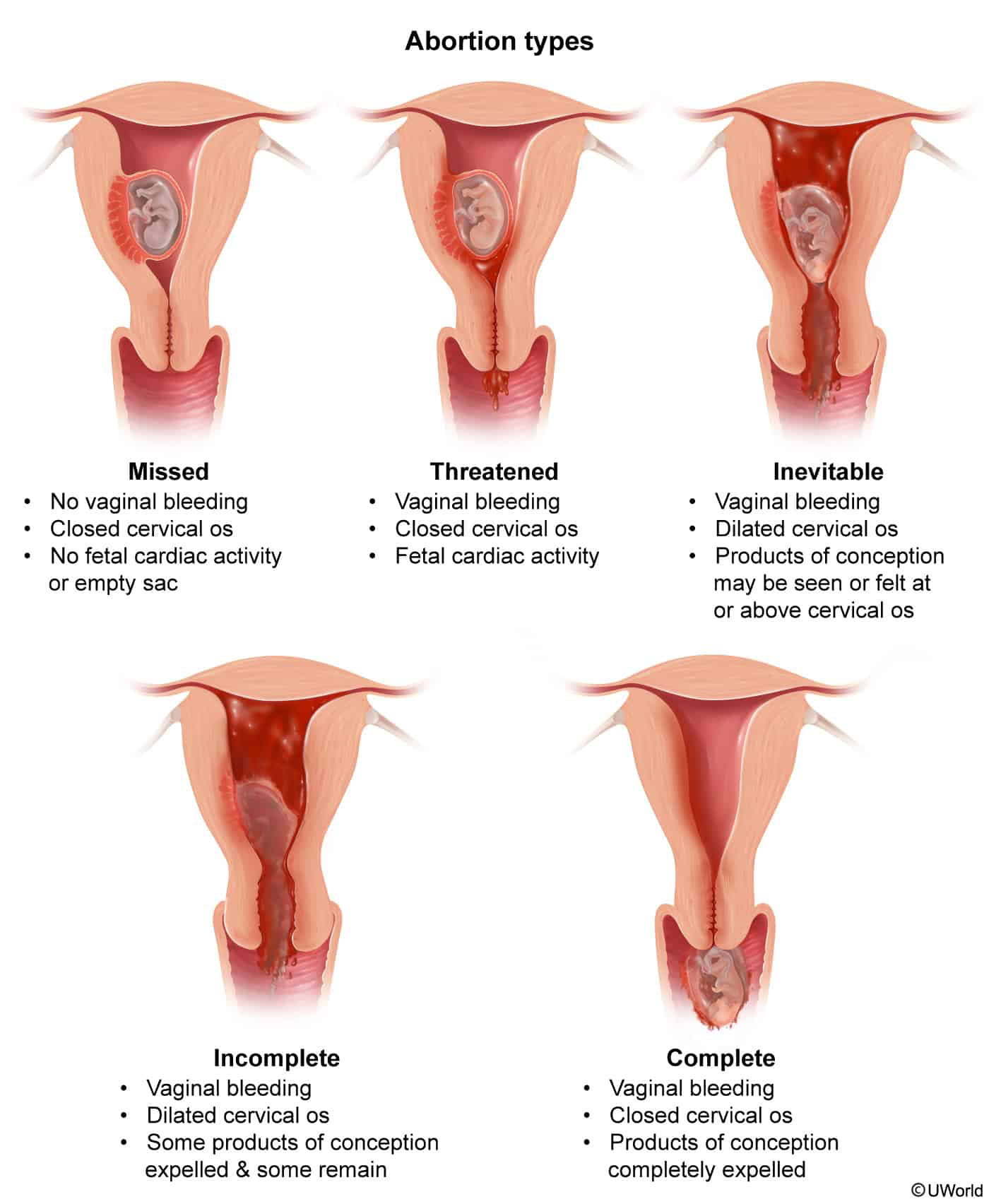
Recurrent Pregnancy Loss (RPL): ≥ 2 or ≥ 3 consecutive spontaneous losses.
Etiology & Risk Factors:
Fetal Chromosomal Abnormalities: Most common cause of 1st-trimester SAB (~50%); primarily autosomal trisomies (trisomy 16 most common, though non-viable; trisomies 21, 18, 13), followed by monosomy X (45,X) and polyploidy.
Maternal Factors:
Advanced maternal age (AMA > 35 yo; independent risk factor).
Prior history of SAB (strongest clinical predictor).
Environmental / Lifestyle: Maternal smoking, alcohol use, cocaine, high caffeine intake, trauma, NSAID use in early pregnancy.
Clinical Features
Type
Bleeding?
Cervical Os
TVUS / Fetal Cardiac Activity
Management
Threatened
(+)
Closed
Viable (FHR present)
Expectant, pelvic rest, serial TVUS
Inevitable
(+)
Open
Nonviable / Ruptured membranes
Expectant, medical, or surgical
Incomplete
(+)
Open
Retained POC
Medical or surgical evacuation
Complete
(+/-) (resolved)
Closed
Empty uterus
Follow β-hCG to negative
Missed
(-)
Closed
Nonviable / No progression
Expectant, medical, or surgical
Septic
(+), malodorous
Open + boggy
Retained POC + infection signs
IV Abx + Urgent D&C
General Presentation: Vaginal bleeding, lower midline abdominal/pelvic cramping, passage of products of conception (POC), regression of pregnancy symptoms (nausea, breast tenderness).
History: Asymptomatic or regression of pregnancy symptoms; no active bleeding (or light brownish spotting), no cramping.
Speculum/Bimanual: Closed cervical os.
Ultrasound: Retained nonviable embryo/fetus (no fetal heart activity) or empty gestational sac (anembryonic pregnancy / blighted ovum). c
Septic Abortion: The death of a fetus before 20 weeks’ gestation without expulsion of any products of conception.
History: Severe pelvic pain, fever/chills, malodorous vaginal discharge; often post-unsterile instrumentation.
Speculum/Bimanual: Foul-smelling/purulent discharge, cervical motion tenderness (CMT), marked uterine tenderness; open or closed os.
Systemic: Tachycardia, hypotension, leukocytosis (signs of sepsis/SIRS).
Diagnosis
Initial / Best Imaging: Transvaginal Ultrasound (TVUS)
Assesses location (rule out ectopic) and fetal viability.
Diagnostic criteria for nonviable IUP:
Crown-rump length (CRL) ≥7 mm with no fetal heart rate (FHR).
Mean sac diameter (MSD) ≥25 mm without an embryo.
Key Labs:
Maternal Blood Type & Rh(D) Screen: Mandatory in all patients with bleeding in pregnancy to assess need for Rho(D) immune globulin (RhoGAM).
Quantitative serum β-hCG: Serial levels every 48 hours if TVUS is indeterminate. Nonviable IUP demonstrates subnormal rise (<35% in 48h) or plateau/decline.
CBC, Type & Screen/Cross: If heavy vaginal bleeding or hemodynamic instability.
Coagulation studies (PT/INR, PTT, Fibrinogen): If septic abortion or prolonged retention of missed abortion (risk of DIC).
Confirmatory / Pathology:
Histopathological examination of expelled/curetted tissue demonstrating chorionic villi (confirms IUP, excludes complete molar pregnancy and ectopic pregnancy).
Recurrent Pregnancy Loss (RPL) Workup (≥2 consecutive clinical pregnancy losses):
Parental karyotyping.
Uterine cavity assessment: Hysterosalpingography (HSG), Sonohysterography, or Hysteroscopy.
Differentiating features: Empty uterus on TVUS with β-hCG above discriminatory zone (>1500–2000 mIU/mL), adnexal mass (“bagel/tubal ring sign”), adnexal tenderness, fluid in pouch of Douglas.
Differentiating features: Painless cervical dilation and effacement in the 2nd trimester without uterine contractions or significant bleeding; bulging amniotic membranes (“hourglassing”).
Intrauterine Fetal Demise (IUFD / Stillbirth):
Differentiating features: Fetal death occurring at ≥20 weeks gestation (vs. spontaneous abortion at <20 weeks); absent fetal movement and absence of cardiac activity on ultrasound.
Physiologic Implantation Bleeding:
Differentiating features: Light, self-limited spotting around the time of expected menses; normal doubling of serial β-hCG; no cramping; closed os.
Management
Emergency / Hemodynamically Unstable / Septic / Heavy Hemorrhage:
ABC & Resuscitation: 2 large-bore IVs, IV crystalloid bolus, Type & Crossmatched blood transfusion (activate MTP if severe).
Septic Abortion Additions: Broad-spectrum IV antibiotics (Ampicillin + Gentamicin + Metronidazole OR Clindamycin + Gentamicin) followed by prompt D&C to remove the infected nidus.
Indications: Patient preference, stable, minimal symptoms, GA <13 weeks.
Observation for up to 2–4 weeks; monitor with serial TVUS/β-hCG.
Medical Management:
Regimen: Mifepristone (progesterone antagonist) 200 mg PO followed 24 hours later by Misoprostol (PGE1 analog) 800 mcg vaginally/buccally (or Misoprostol alone).
Disseminated Intravascular Coagulation (DIC): Triggered by release of fetal/placental tissue factor into maternal circulation (high risk in prolonged retained dead fetus >4 weeks or septic abortion).
Asherman Syndrome: Intrauterine synechiae secondary to aggressive curettage during D&C → secondary amenorrhea and infertility.
Uterine perforation / Cervical laceration during surgical instrumentation.
Rh(D) Alloimmunization: If RhoGAM is omitted in Rh-negative patients → hydrops fetalis in subsequent pregnancies.
Psychological sequelae: Postpartum depression (PPD), Major Depressive Disorder (MDD), Post-Traumatic Stress Disorder (PTSD), and complicated grief.