Overview
- Primary screening tool for cervical intraepithelial neoplasia (CIN) and cervical cancer.
- Etiology: High-risk human papillomavirus (hrHPV types 16, 18, 31, 33).
- Goal: Identify pre-malignant dysplasia (CIN 2/3) prior to malignant transformation.
Screening Guidelines (USPSTF / ACOG)
- <21 years: No screening regardless of sexual activity initiation (high rate of transient infection & self-resolving dysplasia).
- 21–29 years: Pap smear (cytology) alone q3y.
- HPV co-testing is NOT recommended in this age group.
- 30–65 years: Options include:
- hrHPV co-testing + Cytology q5y (Preferred).
- Cytology alone q3y.
- hrHPV alone q5y.
- >65 years: Discontinue screening if adequate negative prior screening:
- 3 consecutive negative cytology alone OR 2 consecutive negative co-tests within past 10 yrs (most recent within 5 yrs).
- AND no hx of CIN 2, CIN 3, or adenocarcinoma in situ (AIS) in past 20 yrs.
- Post-Hysterectomy:
- Total Hysterectomy (cervix removed) for benign indications + no hx of CIN 2+: Discontinue screening.
- Subtotal Hysterectomy (cervix intact): Continue routine screening.
- Hysterectomy w/ hx of CIN 2+: Continue vaginal cuff screening for 20 years post-procedure.
Special Populations
- HIV / Immunocompromised:
- Initial screening at HIV diagnosis (or within 1 yr of sexual onset).
- Screening schedule: Pap smear annually (or q3y if 3 consecutive normal results). Continue screening lifelong (do NOT stop at 65).
- In Utero DES Exposure:
- Annual screening with cytology + thorough vaginal palpation (risk for Clear Cell Adenocarcinoma of vagina/cervix).
Management of Abnormal Pap Smear Results (ASCCP Guidelines)
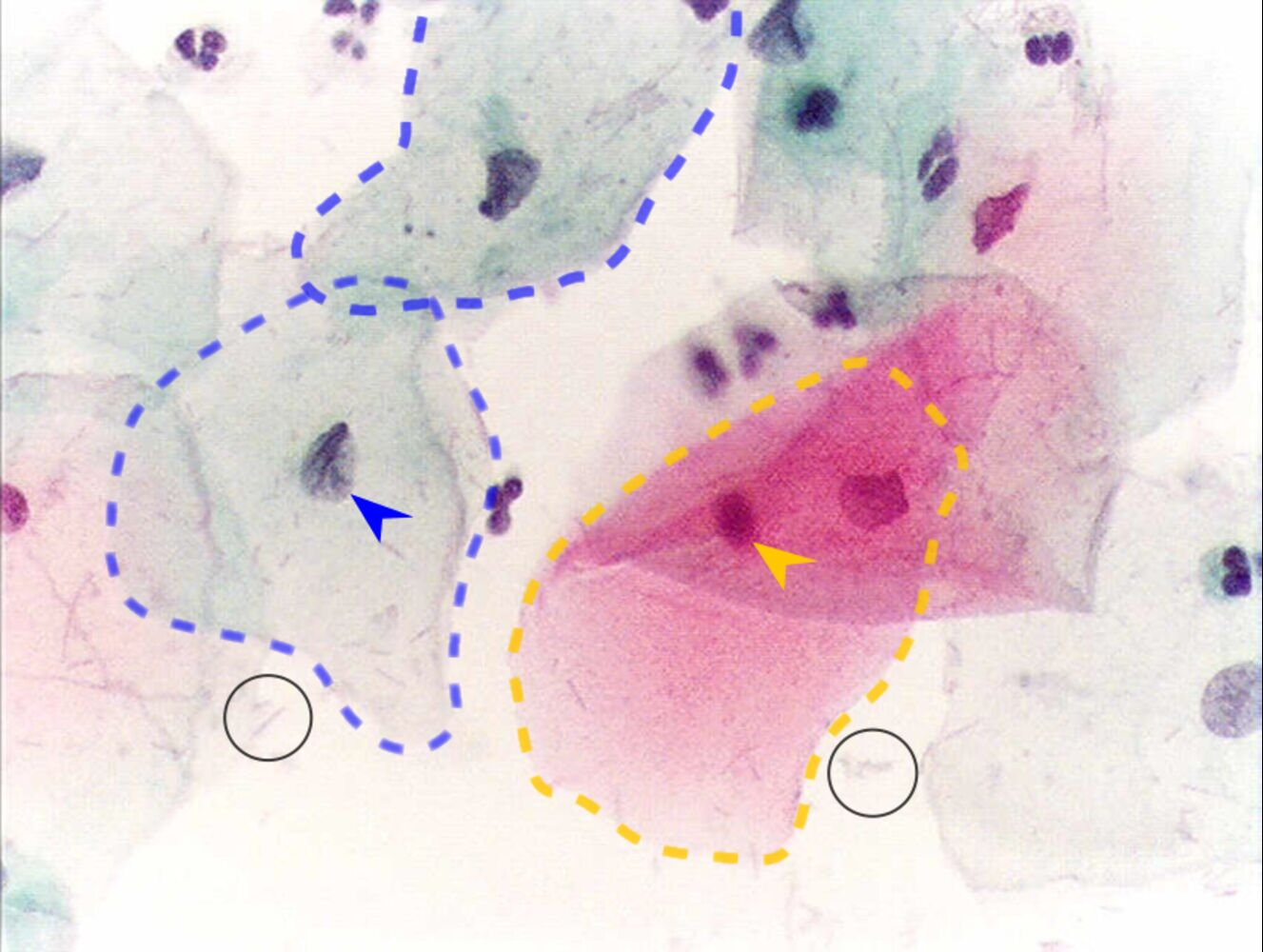 Normal squamous epithelial cells are present.
- The cells with blue (cyanophilic) cytoplasm on the left of the image are intermediate cells (marked by blue dotted line).
- The cell with the red (eosinophilic) cytoplasm on the right of the image is a superficial cell (marked by yellow dotted line).
- Neutrophils can also be seen (small cells with a segmented nucleus).
ASC-US (Atypical Squamous Cells of Undetermined Significance)
- Changes in squamous cells that do not qualify as squamous intraepithelial lesion (SIL) but are more significant than inflammatory or reactive changes.
- Age 21–24:
- Repeat Pap in 12 months (preferred). c
- If repeat Pap is ASC-US/LSIL -> Repeat Pap again at 24 mo.
- Colposcopy indicated ONLY if persistent ASC-US/LSIL at 24 mo or if ASC-H/HSIL detected.
- Age ≥25:
- Reflex HPV Testing (preferred).
- If hrHPV (+) -> Colposcopy.
- If hrHPV (-) -> Resume routine screening in 3 years.
LSIL (Low-Grade Squamous Intraepithelial Lesion)
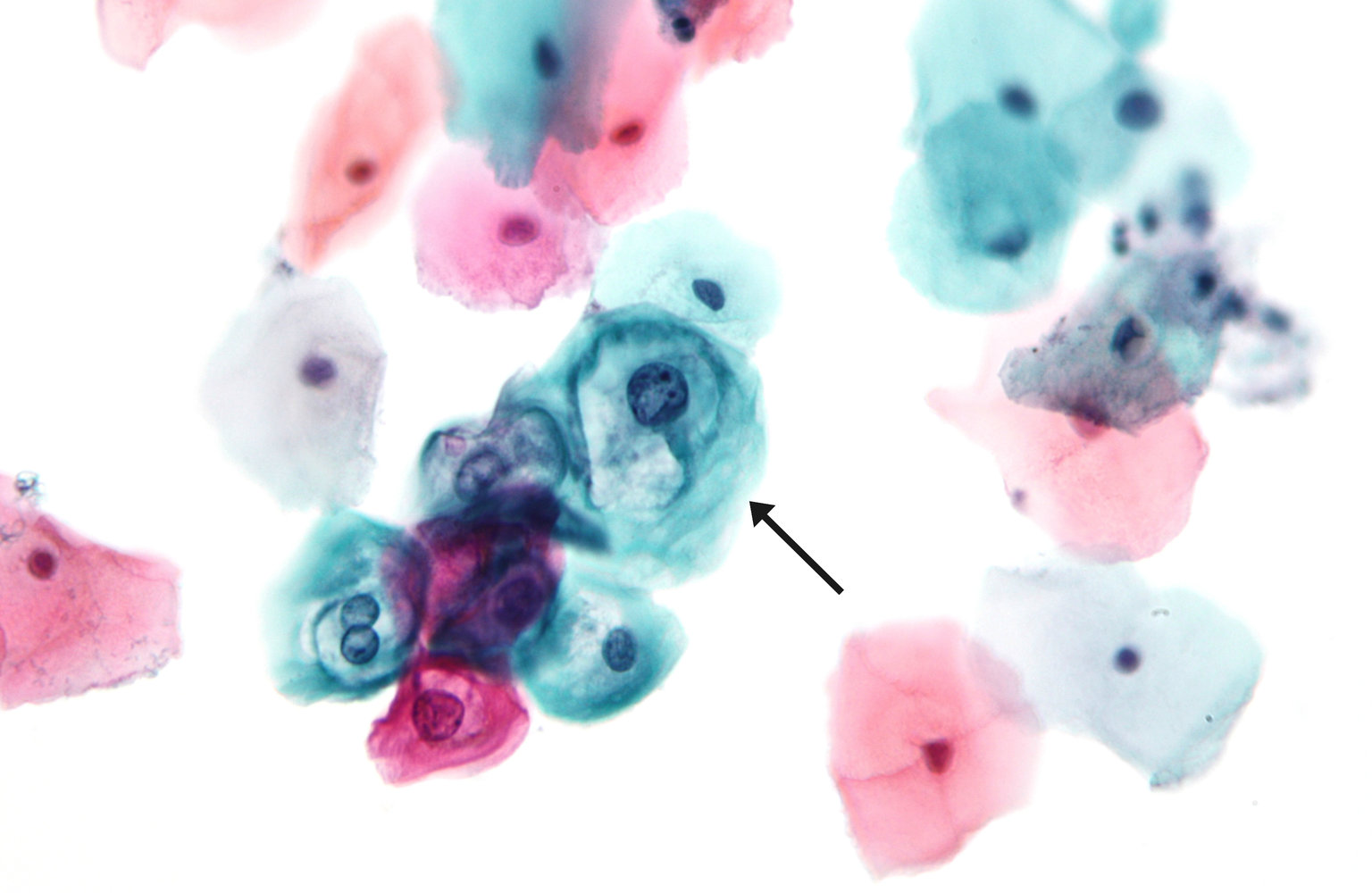
- Age 21–24: Repeat Pap in 12 months (Colposcopy contraindicated due to high spontaneous regression rates).
- Age 25–29: Colposcopy.
- Age ≥30:
- If hrHPV (-) -> Repeat Pap in 1 yr OR Colposcopy.
- If hrHPV (+) -> Colposcopy.
ASC-H (Atypical Squamous Cells, Cannot Exclude HSIL)
- All age groups: Colposcopy immediately (regardless of HPV status).
HSIL (High-Grade Squamous Intraepithelial Lesion)
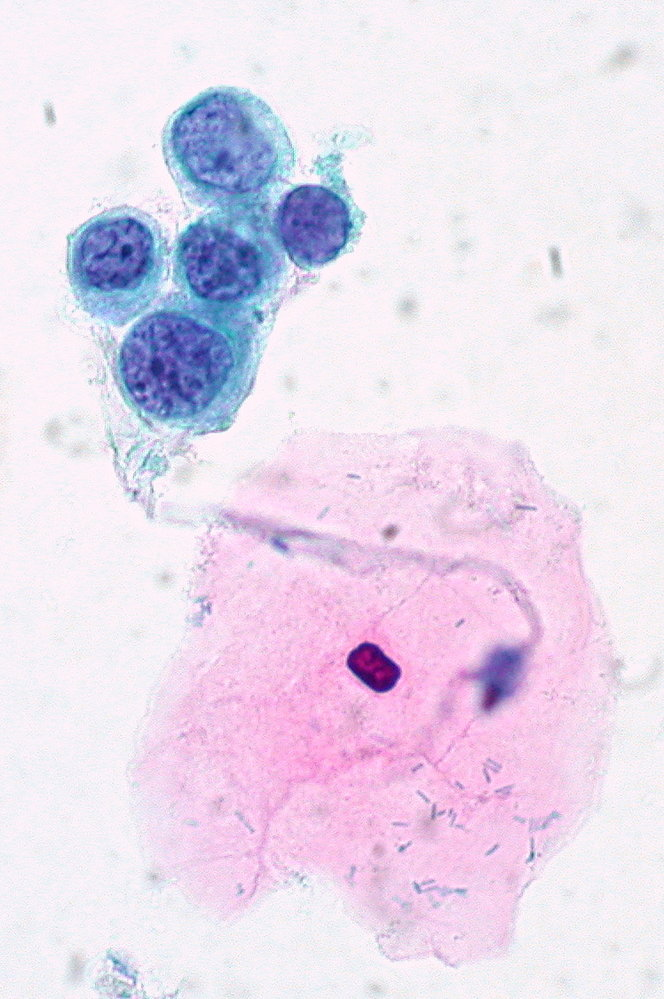
- Age 21–24: Colposcopy.
- Age ≥25:
- Colposcopy OR immediate LEEP (Loop Electrosurgical Excision Procedure) / excisional biopsy.
AGC (Atypical Glandular Cells)
- All ages: Colposcopy + Endocervical Curettage (ECC).
- If Age ≥35 OR Risk factors for Endometrial Cancer (e.g., abnormal uterine bleeding, obesity, anovulation):
- Add Endometrial Biopsy (EMB).
Diagnostic Procedures & Indications
| Procedure | Clinical Indications | Notes / Key Points |
|---|---|---|
| Colposcopy | Follow-up for high-risk abnormal Pap (ASC-H, HSIL, AGC, or HPV+ ASC-US). | Visual inspection w/ acetic acid (acetowhite lesions) & Lugol iodine. Biopsy abnormal zones. |
| ECC | Evaluation of endocervical canal during colposcopy. | Contraindicated in pregnancy. |
| LEEP / Cone Biopsy | Diagnostic/Therapeutic for CIN 2/3, discordant biopsy vs cytology, or positive ECC. | Risks: Cervical stenosis, cervical insufficiency (preterm labor in future pregnancies). |
| EMB | AGC on Pap in patient ≥35 yo, or postmenopausal bleeding. | Evaluates endometrial lining for hyperplasia/carcinoma. |
Pregnancy Management Considerations
- Safe in Pregnancy: Cytology, HPV testing, and Colposcopy (without endocervical sampling).
- CONTRAINDICATED in Pregnancy:
- Endocervical Curettage (ECC) (risk of pregnancy disruption).
- Endometrial Biopsy (EMB).
- Excisional procedures (LEEP/Cone biopsy): Defer until postpartum unless invasive cervical cancer is strongly suspected.
- If CIN 2/3 is confirmed during pregnancy -> Re-evaluate w/ Pap and colposcopy 6–12 weeks postpartum.