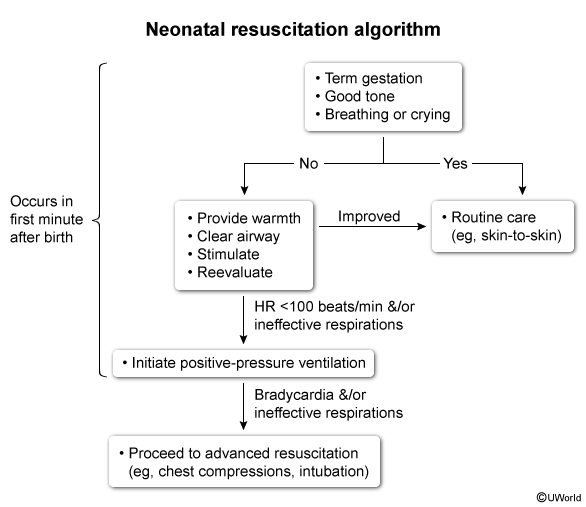
Overview & Initial Assessment

  • Rapid evaluation of 3 key questions immediately at birth:
    • Term gestation?
    • Good muscle tone?
    • Breathing or crying?
  • If YES to all 3: Infant stays with mother (skin-to-skin) c , routine care (warmth, position airway, clear secretions if needed, dry).
  • If NO to any: Move to radiant warmer for initial steps of resuscitation.


Initial Steps (First 30 Seconds)

  • Warm and maintain body temperature: Place under radiant warmer (36.5–37.5°C target).
  • Position head and neck: “Sniffing position” to open airway.
  • Clear secretions: Suction mouth then nose (“M” before “N”) only if airway obstructed or PPV required.
  • Dry and stimulate: Remove wet linens; rub back and extremities to stimulate breathing.
  • Reassess Heart Rate (HR) and Respirations at 30 seconds.

Indications & Protocol for Positive Pressure Ventilation (PPV)

  • Indications (at 30 seconds):
    • Apnea or gasping OR
    • HR < 100 bpm
  • Initiation:
    • Rate: 40–60 breaths/min (“Breathe, two, three, breathe…”).
    • Initial FiO2: 21% (Room air) for ≥35 weeks GA; 21–30% for <35 weeks GA.
    • Attach Pre-ductal SpO2 monitor to Right wrist/hand.
  • HR Assessment during PPV:
    • First check: After 15 seconds of PPV.
      • If HR increasing: Continue PPV, recheck HR at 30 seconds.
      • If HR not increasing: Assess chest movement. If no chest movement, perform MR SOPA.

Troubleshooting Ventilation: MR SOPA

  • Mask adjustment: Reapply mask for tight seal.
  • Reposition head: Neutral or “sniffing” position.
  • Re-evaluate PPV & chest movement.
  • Suction airway: Bulb syringe or suction catheter.
  • Open mouth: Lift jaw, open mouth slightly.
  • Re-evaluate PPV & chest movement.
  • Pressure increase: Increase PIP in 5 cm H2O increments (max 40 cm H2O).
  • Re-evaluate PPV & chest movement.
  • Alternative airway: Insert ETT or Laryngeal Mask Airway (LMA).

Chest Compressions

  • Indication: HR < 60 bpm despite at least 30 seconds of effective PPV (moving chest/ETT in place).
  • Technique:
    • Two-thumb encircling hands method over lower 1/3 of sternum.
    • Depth: 1/3 anterior-posterior chest diameter.
    • Compression-to-ventilation ratio: 3:1 (90 compressions + 30 breaths = 120 events/min).
  • Oxygenation: Increase FiO2 immediately to 100%.
  • Airway: Secure via ETT if not already completed.
  • Reassess HR after 60 seconds of continuous compressions + PPV.

Vascular Access & Medications

  • Indication: HR < 60 bpm despite 60 seconds of coordinated chest compressions + 100% FiO2 PPV.
  • Access: Umbilical Venous Catheter (UVC) is route of choice.
  • Epinephrine:
    • Concentration: 0.1 mg/mL (1:10,000).
    • IV/UVC Dose: 0.02 mg/kg (0.2 mL/kg) IV push.
    • ET Dose: 0.1 mg/kg (1 mL/kg) — only while IV/UVC access is being established.
    • Repeat q3–5 minutes if HR remains < 60 bpm.
  • Volume Expansion:
    • Indication: Suspected hypovolemia/shock (e.g., pale skin, weak pulses, history of placental abruption or blood loss).
    • Agent: 0.9% NaCl (Normal Saline) or Uncrossmatched Type O, Rh-negative PRBCs.
    • Dose: 10 mL/kg IV over 5–10 minutes.

Targeted Pre-Ductal Oxygen Saturation (SpO2)

  • Placed exclusively on Right Hand/Wrist (pre-ductal).
  • Goal is gradually rising SpO2 (mimics normal transition):
    • 1 min: 60–65%
    • 2 min: 65–70%
    • 3 min: 70–75%
    • 4 min: 75–80%
    • 5 min: 80–85%
    • 10 min: 85–95%

High-Yield Clinical Scenarios & Board Pearls

Congenital Diaphragmatic Hernia (CDH)

  • Presentation: Scaphoid abdomen, respiratory distress, bowel sounds in chest, shifted heart sounds.
  • High-Yield Management: CONTRAINDICATION to bag-valve-mask (BVM) ventilation/PPV via mask (dilates stomach/bowels in chest, worsening pulmonary hypoplasia/collapse).
  • Next Step: Immediate ET Intubation + Placement of Orogastric (OG) tube for decompression.

Meconium-Stained Amniotic Fluid

  • Management: Routine endotracheal suctioning at delivery is NO LONGER RECOMMENDED, regardless of infant vigor.
  • Follow standard algorithm: If depressed (apneic/hypotonic) → Initial steps under warmer → PPV if HR < 100 or non-breathing.

Maternal Opioid Exposure

  • Infant presents with respiratory depression secondary to maternal intrapartum opioid administration.
  • High-Yield Management: DO NOT give Naloxone (can precipitate acute withdrawal seizures in opioid-exposed infants).
  • Next Step: Provide ventilatory support via PPV until respiratory drive recovers.

Prematurity (<32 Weeks GA)

  • Management:
    • Place infant up to neck in polyethylene plastic wrap without drying skin (prevents evaporative heat loss).
    • Use thermal mattress.
    • Use CPAP instead of PPV if infant is breathing spontaneously with HR > 100 but has dyspnea/grunting.

Post-Resuscitation Care

  • Monitor for therapeutic hypothermia eligibility if moderate/severe Hypoxic-Ischemic Encephalopathy (HIE) present (gestation ≥35 weeks, initiate within 6 hours of birth).
  • Monitor blood glucose (risk of severe hypoglycemia).
  • Monitor arterial blood gas (ABG), electrolytes, and CXR (verify ETT placement 1–2 cm above carina).