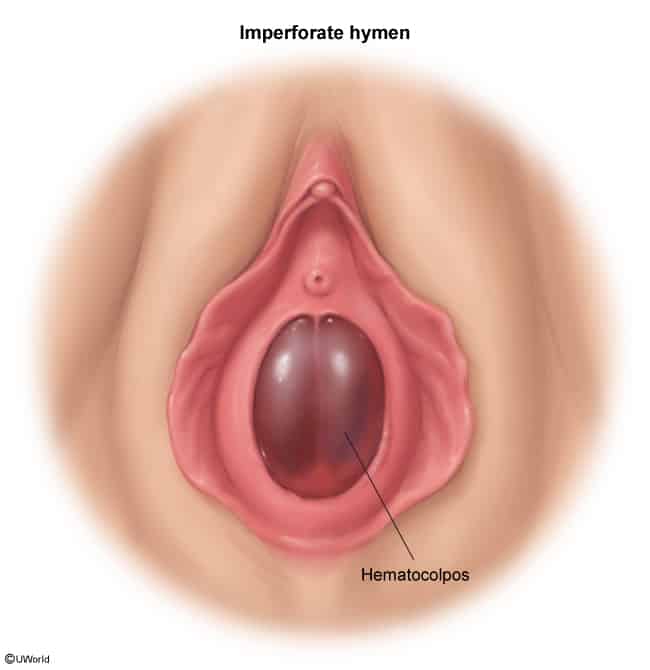
Epidemiology & Risk Factors
Most common obstructive genital tract anomaly in females (1 in 1,000–2,000).
Pathophysiology: Failure of central hymeneal membrane canalization/resorption in fetal dev.
Etiology: Typically sporadic; isolated congenital defect.
Clinical Features
Adolescents (Classic Presentation) :
Cyclic, recurrent lower abdominal/pelvic pain w/ primary amenorrhea . c Normal secondary sexual characteristics (Tanner stage 4/5 breasts & pubic hair; intact HPO axis).Bulging, purplish/bluish vaginal membrane visible at introitus (due to hematocolpos).Urinary retention, dysuria, constipation , or back pain (secondary to mass effect on urethra/rectum). c
Neonate Presentation :
Mucocolpos (accumulation of cervical secretions secondary to maternal estrogen stimulus).
Interlabial mass or lower abdominal mass; rarely causes urinary obstruction.
Diagnosis
Initial Step : Physical Exam (inspection of vulva showing bulging bluish membrane ).Imaging :
Pelvic US : Confirms hematocolpos (blood-filled vagina) and hematometra (blood-filled uterus); rules out concurrent renal anomalies.Pelvic MRI : Indicated if diagnosis is unclear or to differentiate from transverse vaginal septum.
Labs :
Serum β-hCG : Negative (rules out pregnancy in primary/secondary amenorrhea workup).Hormonal workup (FSH, LH, Estradiol): Normal (not routinely required if clinical presentation is clear).
Differential Diagnostics
Transverse Vaginal Septum :
Differentiated by normal external hymeneal ring, absence of bluish/purplish bulging membrane, and fibrous tissue band higher in vagina on pelvic US/MRI.
Mayer-Rokitansky-Küster-Hauser (MRKH) Syndrome (Vaginal Agenesis) :
Differentiated by absent uterus/upper vagina , absent hematocolpos on US, though secondary sexual characteristics remain normal (46,XX).
Androgen Insensitivity Syndrome (AIS) :
Differentiated by 46,XY karyotype, absent/sparse pubic and axillary hair, blind-ending vagina, absent uterus, and elevated serum testosterone levels.
Labial Adhesions :
Differentiated by fusion of labia minora (common in young girls with low estrogen states), lacking vaginal mass/hematocolpos.
Management
Definitive Treatment : Cruciate Hymenotomy or hymenectomy (surgical incision and evacuation of accumulated blood/mucus).Surgical Timing :
Asymptomatic neonates/children: Delay until pubertal development (estrogenized tissues heal better w/ less scarring/stenosis).
Symptomatic adolescents: Perform immediately.
Contraindicated : Needle aspiration of hematocolpos (high risk of introducing infection leading to pyocolpos/pelvic sepsis).
Complications
Acute Urinary Retention and hydronephrosis secondary to pelvic mass pressure.Pyocolpos / Pyometra : Ascending infection if left uncorrected or aspirated inappropriately.Retrograde Menstruation : Can lead to endometriosis , pelvic adhesions, and subfertility/infertility.