Definition
- Chronic Hypertension (CHTN)
- Baseline SBP ≥ 140 mmHg and/or DBP ≥ 90 mmHg present before pregnancy or diagnosed < 20 wks gestation.
- Persists > 12 wks postpartum.
- Gestational Hypertension (gHTN)
- New-onset SBP ≥ 140 mmHg and/or DBP ≥ 90 mmHg at ≥ 20 wks gestation in a previously normotensive pt.
- No proteinuria and no severe features.
- Resolves < 12 wks postpartum.
- Preeclampsia (PEC) without Severe Features
- New-onset SBP ≥ 140 mmHg or DBP ≥ 90 mmHg on 2 occasions ≥ 4 hrs apart at ≥ 20 wks gestation PLUS:
- Proteinuria: ≥ 300 mg/24-hr urine, Urine Protein/Creatinine (UPCR) ratio ≥ 0.3, or urine dipstick ≥ 2+.
- Preeclampsia with Severe Features (PEC w/ SF)
- Meets PEC criteria PLUS ≥ 1 of the following severe features:
- Severe HTN: SBP ≥ 160 mmHg or DBP ≥ 110 mmHg on 2 occasions ≥ 15 min apart.
- Thrombocytopenia: Plt < 100,000/µL.
- Renal Insufficiency: Serum Cr > 1.1 mg/dL or doubling of baseline Cr.
- Impaired Liver Function: Transaminases (AST/ALT) > 2x upper limit of normal or severe persistent RUQ/epigastric pain. c2
- Pulmonary Edema.
- Cerebral/Visual Symptoms: Severe persistent headache, scotomata, altered mental status.
- Note: Degree of proteinuria is NOT a severe feature in current ACOG guidelines.
- Can present up to 6 weeks after delivery c
- Meets PEC criteria PLUS ≥ 1 of the following severe features:
- Chronic HTN with Superimposed Preeclampsia
- Pt w/ pre-existing CHTN who develops new-onset proteinuria, sudden worsening of control, or severe features at ≥ 20 wks gestation.
- Eclampsia
- New-onset generalized tonic-clonic seizures in a pt with preeclampsia without other neurologic etiology.
- HELLP Syndrome
- Severe variant of PEC defined by:
- Hemolysis: Microangiopathic hemolytic anemia (MAHA) w/ schistocytes, ↑ indirect bili, ↑ LDH (> 600 U/L), low haptoglobin.
- Elevated Liver enzymes: AST/ALT > 2x normal.
- Low Platelets: Plt < 100,000/µL.
- Severe variant of PEC defined by:
Epidemiology
Etiology
Pathophysiology
- Two-Wave Trophoblast Invasion:
- First wave (weeks 0–12): Endovascular trophoblasts invade decidual segments of maternal spiral arteries.
- Second wave (weeks 16–20): Trophoblasts invade myometrial segments, converting high-resistance/low-flow vessels into low-resistance/high-flow channels.
- Abnormal Placentation: Defective second wave trophoblast invasion → failure of spiral artery remodeling → persistent narrow, high-resistance vessels → placental ischemia.
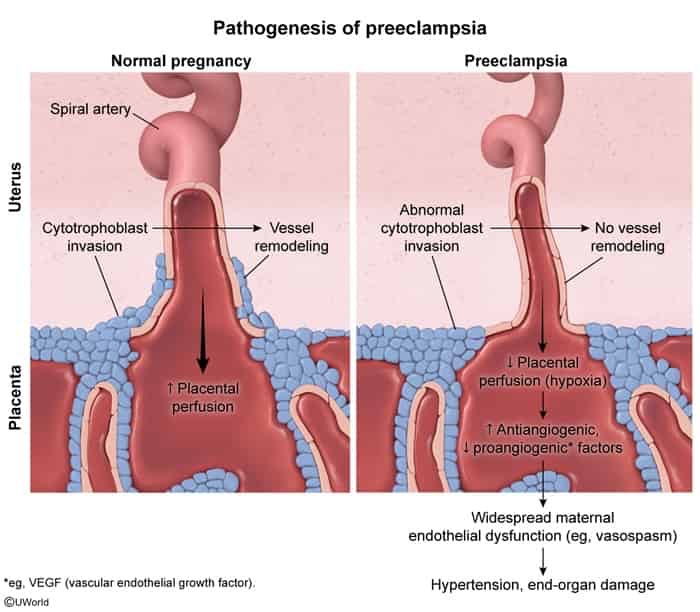
- Antiangiogenic Release: Hypoxic placenta releases sFlt-1 and Soluble Endoglin (sEng) → neutralizes VEGF and PlGF.
- Systemic Endothelial Dysfunction:
- Vasospasm & HTN: ↓ PGI2/NO, ↑ Thromboxane A2 & Angiotensin II sensitivity.
- Capillary Leak: Proteinuria, generalized edema, pulmonary edema.
- End-Organ Damage:
- Renal: Glomerular endotheliosis (capillary swelling, ↓ GFR, proteinuria).
- CNS: Loss of autoregulation → vasogenic cerebral edema (PRES-like pattern) → seizures.
- Hepatic: Sinusoidal fibrin deposition → periportal necrosis → Glisson capsule distension/rupture.
- Hematologic: Microvascular shear stress → schistocytes (MAHA) + platelet consumption (accelerated platelet adhesion and aggregation at sites of injured endothelium)
Clinical features
Diagnostics
- BP Measurement: ≥140/90 on 2 occasions ≥4 hrs apart (or ≥160/110 once confirmed).
- Proteinuria Assessment:
- Screen: Urine Dipstick (≥1+).
- Confirm: Urine Protein:Creatinine Ratio (UPCR) ≥0.3 OR 24-hr urine protein >300 mg (Gold Standard).
- Key Labs (End-Organ Check):
- CBC: Plt <100k (Thrombocytopenia).
- CMP: Cr >1.1 (or doubling), AST/ALT >2x upper limit normal. c
- Smear: Assess for hemolysis (schistocytes) if HELLP suspected.
- Fetal Assessment: NST, BPP, Umbilical Artery Doppler (risk of IUGR/oligohydramnios).
Differential diagnostics
- Systemic Lupus Erythematosus (SLE) Flare / Lupus Nephritis:
- Differentiating Features: Low complement levels (low C3, C4), elevated anti-dsDNA titers, active urinary sediment with RBC casts; preeclampsia lacks complement consumption and RBC casts. c
| Feature | Chronic HTN | Gestational HTN | Preeclampsia | Eclampsia |
|---|---|---|---|---|
| Onset | < 20 wks | ≥ 20 wks | ≥ 20 wks | ≥ 20 wks |
| Defining Feature | HTN that predates pregnancy or starts before 20 weeks. | New HTN w/o proteinuria or signs of end-organ damage. | New HTN w/ proteinuria OR signs of end-organ damage (↑Cr, ↑LFTs, low platelets, HA, visual sx). | Preeclampsia + new-onset tonic-clonic seizures. |
| Management | Monitor; Tx if severe (Labetalol, Nifedipine). | Monitor for progression to preeclampsia. | Delivery is the cure. MgSO4 for seizure prophylaxis in severe cases. | 1. MgSO4 (to control seizures) 2. Delivery (once stable). |
| Key Complication | Superimposed preeclampsia. | Progression to preeclampsia. | HELLP syndrome, eclampsia, placental abruption. | Stroke, status epilepticus, maternal death. |
| Postpartum | HTN persists. | HTN resolves. | HTN resolves. | HTN resolves. |
Treatment
- Antihypertensive Therapy (Severe Range BP ≥ 160/110 mmHg)
- Goal: SBP 140-150 / DBP 90-100 to prevent maternal stroke while maintaining uteroplacental perfusion.
- First-line Acute IV/Oral Agents:
- IV Labetalol: Non-selective β-blocker w/ α1-blocking activity. Avoid in bradycardia or asthma.
- IV Hydralazine: Direct vasodilator. Risk of reflex tachycardia and profound hypotension. c
- Oral Immediate-Release Nifedipine: CCB. Avoid if vomiting/unable to tolerate PO.
- Maintenance Antihypertensives (for CHTN/long-term control):
- Labatetalol, Long-acting Nifedipine, Methyldopa.
- Contraindicated: ACEi, ARBs, Direct Renin Inhibitors, Mineralocorticoid Receptor Antagonists (teratogenic / fetal renal agenesis). Atenolol is avoided because it is associated with lower birth weight c
- Seizure Prophylaxis & Treatment
- Magnesium Sulfate (MgSO4): Indicated for PEC w/ severe features, HELLP, and Eclampsia.
- Dosing: 4-6 g IV loading dose followed by 1-2 g/hr IV maintenance.
- MgSO4 Toxicity Monitoring: c
- Loss of Deep Tendon Reflexes (DTRs): 8-10 mEq/L (earliest sign).
- Respiratory Depression: 12-15 mEq/L.
- Cardiac Arrest: > 15 mEq/L.
- Antidote for Mg Toxicity: IV Calcium Gluconate (10 mL of 10% solution).
- Magnesium Sulfate (MgSO4): Indicated for PEC w/ severe features, HELLP, and Eclampsia.
- Timing & Mode of Delivery (Definitive Cure)
- Gestational HTN & PEC w/o severe features: Deliver at 37 0/7 wks gestation.
- PEC w/ Severe Features / HELLP:
- ≥ 34 0/7 wks gestation: Deliver upon stabilization.
- < 34 0/7 wks gestation: Hospitalize; administer antenatal corticosteroids (Betamethasone) for fetal lung maturity; deliver if maternal/fetal deterioration occurs.
- Eclampsia: Emergency stabilization (Airway, Oxygen, MgSO4, IV antihypertensives) -> Immediate delivery regardless of gestational age once mother is stable.
- Mode of Delivery: Vaginal delivery is preferred unless obstetric indications (e.g., nonreassuring fetal status, breech) mandate C-section.
Prevention
- Low-dose ASA 81 mg/day
- Start 12–28 weeks GA, ideally before 16 weeks; continue until delivery.
- Give for:
- ≥1 high-risk factor: Prior preeclampsia, multifetal gestation, chronic HTN, CKD, pregestational DM, SLE/APLS. c
- ≥2 moderate-risk factors: Nulliparity, obesity, age ≥35, FHx, IVF, prior adverse pregnancy outcome.
- Calcium 1.5–2 g/day if dietary calcium intake is low.
- Optimize comorbidities before pregnancy: Weight, DM, chronic HTN; avoid ACEi/ARBs during pregnancy.
- Not recommended solely for prevention: Salt restriction, bed rest, vitamins C/E, diuretics, fish oil, or routine LMWH.
Complications
- Maternal:
- Placental Abruption (Abruptio Placentae).
- DIC (Disseminated Intravascular Coagulation).
- Pulmonary Edema.
- Acute Kidney Injury (AKI) / Acute Tubular Necrosis.
- Cerebrovascular Accident (Stroke) / Intracranial Hemorrhage. c
- Hepatic Rupture / Subcapsular Hematoma.
- Fetal / Neonatal:
- Fetal Growth Restriction (FGR) secondary to chronic uteroplacental insufficiency.
- Oligohydramnios.
- Prematurity (iatrogenic or spontaneous).
- Preterm delivery
- Intrauterine Fetal Demise (IUFD).
- Neonatal Respiratory Distress Syndrome (RDS).