Epidemiology
- Most common type of sex cord-stromal malignancy (∼ 90%)
- Peak age: 50–55 years
Etiology
Pathophysiology
Clinical features
- Hyperestrogenic manifestations:
- Juvenile / Prepubertal: Peripheral precocious puberty (isosexual: breast buds, pubic/axillary hair, early vaginal bleeding, accelerated linear growth with premature epiphyseal closure).
- Reproductive age: Abnormal uterine bleeding (AUB), heavy menstrual bleeding, oligomenorrhea/amenorrhea.
- Postmenopausal: Postmenopausal bleeding (PMB), breast tenderness, vaginal discharge.
- Mass effect & local symptoms:
- Unilateral pelvic pain, fullness, pressure, or palpable adnexal mass on pelvic examination.
- Acute abdomen secondary to ovarian torsion or tumor rupture with hemoperitoneum.
Diagnostics
- Initial / Screening Imaging:
- Transvaginal Ultrasound (TVUS): Large, complex, solid-cystic adnexal mass with a multilocular or “Swiss cheese” appearance; thickened endometrial stripe (> 4 mm in postmenopausal women).
- Key Labs / Tumor Markers:
- ↑ Inhibin (Inhibin A and B): Sensitive and specific tumor marker; gold standard for monitoring treatment response and detecting recurrence.
- ↑ Serum Estradiol (E2).
- Serum CA-125: Non-specific, may be mildly elevated.
- Essential Adjunctive Procedure:
- Endometrial Biopsy (EMB): Mandatory in patients with AUB/PMB or thickened endometrium to rule out concurrent endometrial hyperplasia or cancer. c
- Confirmatory / Gold Standard:
- Surgical Staging & Histopathology:
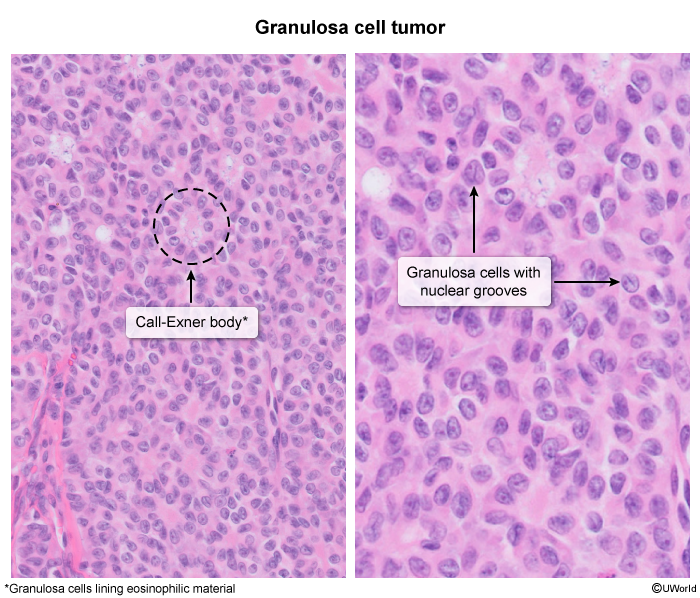
- Call-Exner bodies: Rosette-like arrangement of granulosa cells around central eosinophilic, fluid-filled spaces.
- “Coffee-bean” nuclei: Pale, round-to-oval nuclei with longitudinal grooving.
- Immunohistochemistry (IHC): (+) Calretinin, (+) Inhibin, (+) WT-1, (+) FOXL2.
- Surgical Staging & Histopathology:
Mnemonic
Give Granny a Call