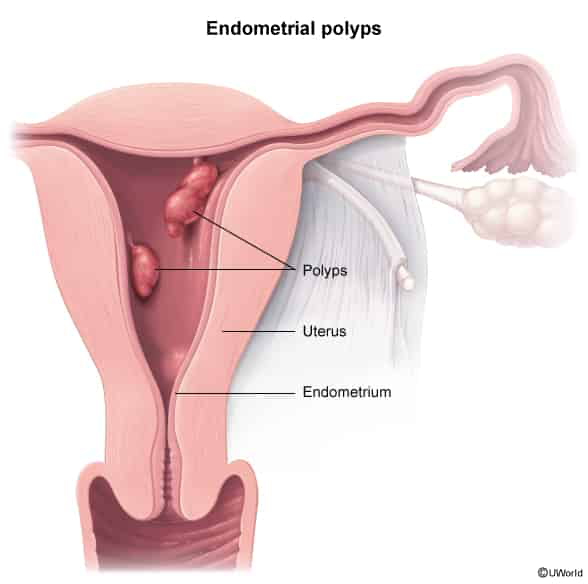
Abnormal Uterine Bleeding (AUB-P): Most common presenting symptom.
Premenopausal: Intermenstrual bleeding (spotting), heavy menstrual bleeding (menorrhagia). c
Postmenopausal: Postmenopausal bleeding (requires mandatory workup to rule out malignancy).
Infertility: Primary or secondary (mechanical interference with embryo implantation).
Asymptomatic: Incidental finding on routine pelvic imaging.
Diagnosis
Initial Test: Transvaginal Ultrasound (TVUS).
Findings: Focal hyperechoic endometrial lesion with smooth borders; vascular pedicle visible on Doppler ultrasound.
Best Test / Confirmatory: Saline Infusion Sonohysterography (SIS) or Hysteroscopy.
SIS: Highly sensitive; saline distends the uterine cavity to delineate focal intracavitary lesions from diffuse endometrial thickening.
Hysteroscopy: Gold standard for direct visualization + simultaneous diagnostic biopsy/resection.
Histopathology: Confirms diagnosis (benign polyp vs endometrial hyperplasia/carcinoma).
Differential Diagnostics
Submucosal Leiomyoma (Fibroid): Differs by hypoechoic origin from the myometrium on TVUS/SIS; presents more frequently with severe heavy menstrual bleeding rather than intermenstrual spotting.
Endometrial Hyperplasia / Endometrial Carcinoma: Differs by diffuse endometrial thickening (>4 mm in postmenopausal women) and histological cytological atypia or malignant invasion.
Endometrial Adhesions (Asherman Syndrome): Differs by history of aggressive uterine curettage or infection; shows hyperechoic intra-uterine synechiae on SIS, presents with amenorrhea/hypomenorrhea.
Management
Symptomatic (AUB / Infertility): Polypectomy via hysteroscopy (first-line; diagnostic & therapeutic). c
Asymptomatic + High Risk: Hysteroscopic polypectomy.
Indications: Postmenopausal state, Tamoxifen use, polyp size >1.5–2 cm, or multiple polyps.
Asymptomatic + Premenopausal + Low Risk: Conservative management with observation (high rate of spontaneous regression for small polyps <1.5 cm).
Complications
Malignant Transformation: Risk ~1–5% (significantly higher in postmenopausal patients and Tamoxifen users).