Epidemiology
Etiology
- Impaired development and/or fusion of embryonic structures (pleuroperitoneal membrane) → defect in the diaphragm persists during fetal development → displacement of abdominal contents into the pleural cavity → compression of lung tissue → pulmonary hypoplasia
- Failure of fusion of the septum transversum postero-laterally with the pleuroperitoneal membranes → Bochdalek hernia
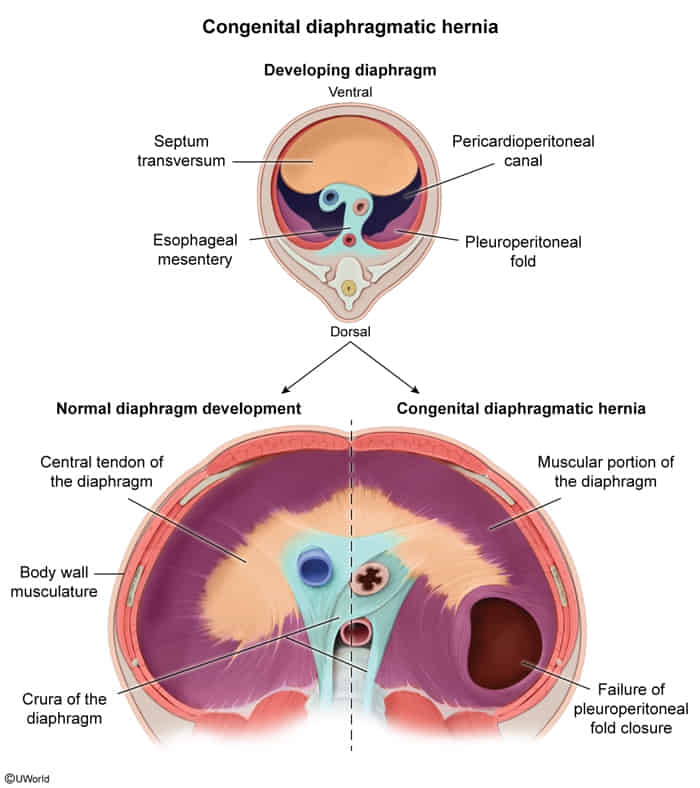
- Failure of fusion of the septum transversum postero-laterally with the pleuroperitoneal membranes → Bochdalek hernia
Pathophysiology
Clinical features
<% tp.file.cursor() %>
Diagnostics
<% tp.file.cursor() %>
Differential diagnostics
Bronchogenic cysts
- Etiology & Location:
- Congenital foregut duplication anomaly (abnormal budding).
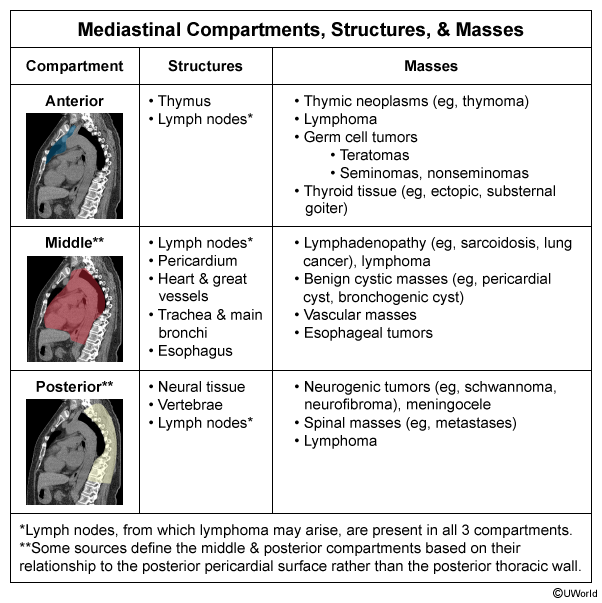
- Most commonly located in the middle mediastinum (subcarinal, paratracheal) or lung parenchyma. c
- Clinical Presentation:
- Asymptomatic: Most common (incidental finding on imaging).
- Compressive symptoms: Stridor, wheezing, chronic cough, dyspnea, dysphagia (esophageal compression).
- Infection: Recurrent post-obstructive pneumonia, fever, purulent sputum, hemoptysis. c
- Diagnosis:
- Initial: CXR showing a well-circumscribed, round/oval middle mediastinal mass.
- Best / Definitive Imaging: Chest CT with IV contrast showing a thin-walled, smooth, non-enhancing fluid-filled cystic lesion.
- Histology: Resected wall shows ciliated pseudostratified columnar epithelium with cartilage and mucous glands.
- Key Differentials:
- Pericardial cyst: Located at the cardiophrenic angle (typically right anterior/middle).
- Anterior mediastinal masses (Thymoma, Teratoma, Lymphoma, Thyroid): Located in anterior mediastinum.
- Neurogenic tumors (Schwannoma, Neurofibroma): Located in posterior mediastinum.
- Pulmonary sequestration: Fed by an anomalous systemic artery directly off the aorta.
- Congenital Pulmonary Airway Malformation (CPAM): Multicystic intrapulmonary mass presenting in neonates/infants.
- Management:
- Complete surgical resection (VATS or open thoracotomy): Treatment of choice for all symptomatic patients and asymptomatic operable patients (to prevent future infection, rupture, or rare malignant degeneration).
- IV broad-spectrum Abx: For superinfected cysts, followed by elective resection once inflammation resolves.
- Complications:
- Superinfection / abscess formation.
- Cyst rupture (causing pneumothorax, hemothorax, or empyema).
- Airway obstruction.
- Malignant transformation (rare: adenocarcinoma).
Treatment
<% tp.file.cursor() %>