Physical child abuse
- Risk Factors:
- Child: Age < 1 yo, prematurity, chronic disability/illness.
- Caregiver/Family: Unrelated male partner in home, young/single parent, substance abuse, domestic violence.
- High-Yield Clinical Findings:
- TEN-4 Rule: Bruising on Torso, Ears, or Neck in a child < 4 yo, or ANY bruise in an infant < 4 mo.
- Patterned skin marks: Belt loops, bite marks, uniform circular cigarette burns.
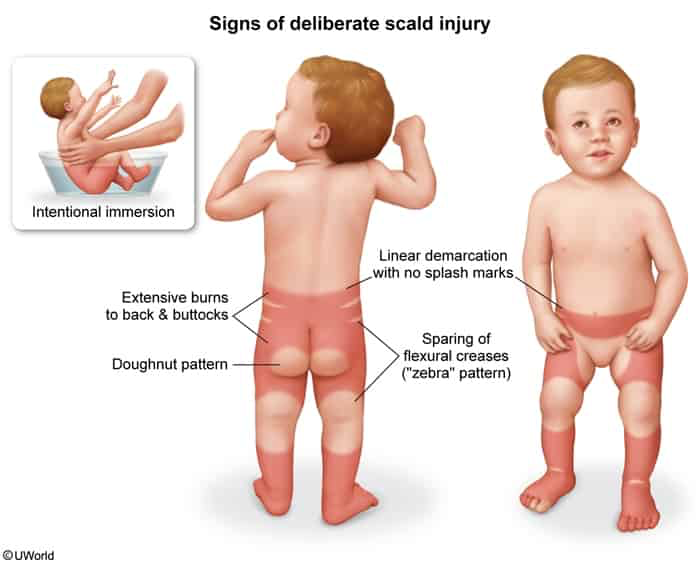
- Scald burns: “Stocking-glove” pattern, sharp margins, absent splash marks, “doughnut-shaped” sparing of central buttocks. c
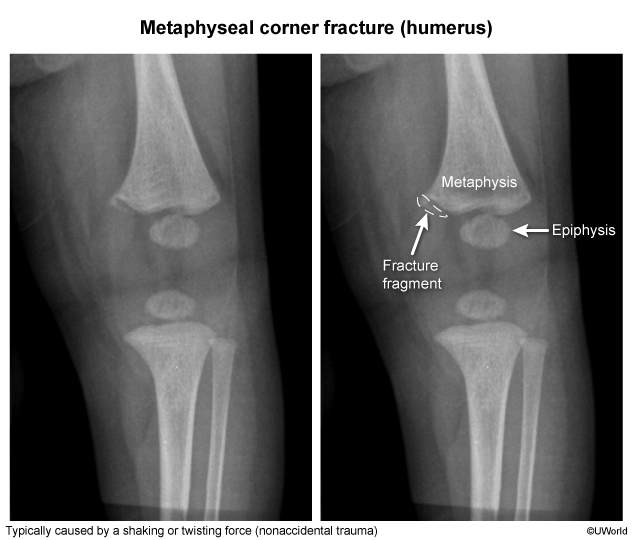
- Pathognomonic fractures: Metaphyseal corner / “bucket-handle” fractures (traction/twisting) and posterior rib fractures (chest compression).
- Fractures of varying healing stages or long bone fractures in non-ambulatory infants.
- Abusive Head Trauma (AHT): Triad of subdural hematoma (interhemispheric), diffuse/multi-layered retinal hemorrhages, and encephalopathy (AMS, seizures).
- Visceral trauma: Duodenal hematoma (blunt abdominal blow presenting with delayed vomiting/obstruction).
- Diagnostic Workup:
- Skeletal survey: Mandatory in all children < 2 yo; repeat in 2 weeks to detect healing occult fractures.
- Non-contrast Head CT: Indicated for AMS, neurologic deficits, bulging fontanelle, or high-risk fractures.
- Dilated fundoscopy: Must be performed by ophthalmology to document retinal hemorrhages.
- Occult trauma labs: LFTs (AST/ALT > 80 U/L indicates liver injury → follow with abdominal CT), lipase/amylase, UA (hematuria).
- Coagulation panel (PT/INR, PTT, platelets): Required to rule out underlying bleeding disorders.
- Key Differentials:
- Osteogenesis imperfecta: Bone fragility with blue sclerae, osteopenia, and COL1A1/2 mutations (posterior rib/metaphyseal fractures atypical).
- Congenital dermal melanocytosis: Benign, non-tender, stable slate-gray/blue sacral macules.
- Toddler’s fracture: Benign, accidental, non-displaced spiral fracture of the tibia in ambulatory toddlers.
- Management Priorities:
- 1. Stabilize ABCs and manage acute trauma/ICP.
- 2. Admit to hospital: Mandatory to ensure physical safety; do not discharge home even if medically stable.
- 3. Immediate CPS/law enforcement report: Mandatory upon suspicion (definitive proof or parental consent is not required).
- 4. Screen household contacts: Complete PE +/- skeletal survey for all siblings and household children < 2 yo.
- 5. Non-accusatory communication: Remain objective and avoid direct confrontation to prevent caregiver flight.