Gram stain & culture of purulent exudate (if drained/ruptured).
NAAT for N. gonorrhoeae & C. trachomatis.
Confirmatory / Biopsy: Indicated for patients >40 years old, postmenopausal patients, persistent/recurrent non-healing lesions, or mass with solid/nodular features to R/O adenocarcinoma/SCC.
Differential Diagnostics
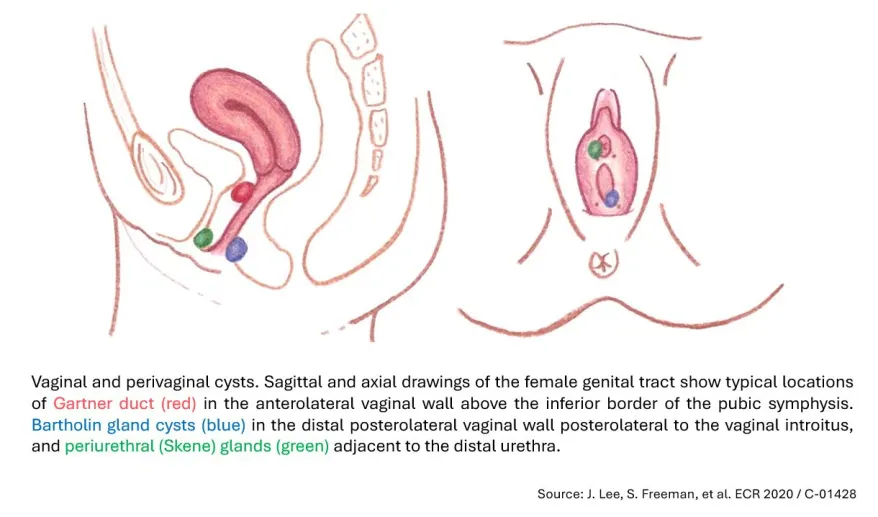
Gartner Duct Cyst: Diff by location along anterolateral vaginal wall (remnant of mesonephric/Wolffian duct).
Nabothian Cyst: Diff by benign location directly on the cervix (mucus retention cyst).
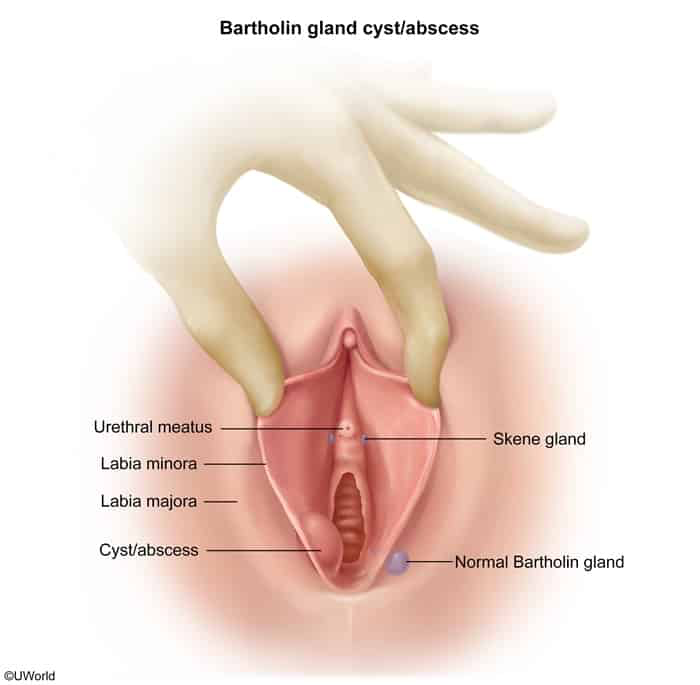
Skene Gland Abscess/Cyst: Diff by periurethral location at 1 and 11 o’clock adjacent to external urethral meatus.
Epidermoid Cyst: Diff by subcutaneous location anywhere on vulva, presence of a central punctum, slow-growing.
Bartholin Gland Carcinoma: Diff by hard, fixed, non-fluctuant mass in postmenopausal women; confirmed via biopsy.
Management
Asymptomatic Cyst (Premenopausal):
Expectant management / warm sitz baths. No intervention required. c
Symptomatic Cyst or Abscess:
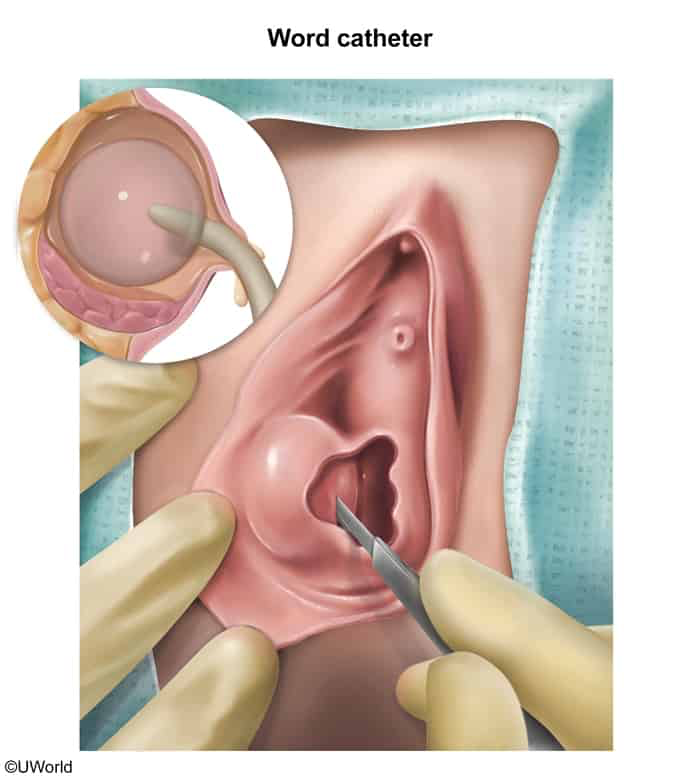
Incision & Drainage (I&D) with Word Catheter Placement: First-line. Catheter inflated w/ 2–3 mL saline and left in place for 4–6 weeks to permit re-epithelialization of drainage tract.
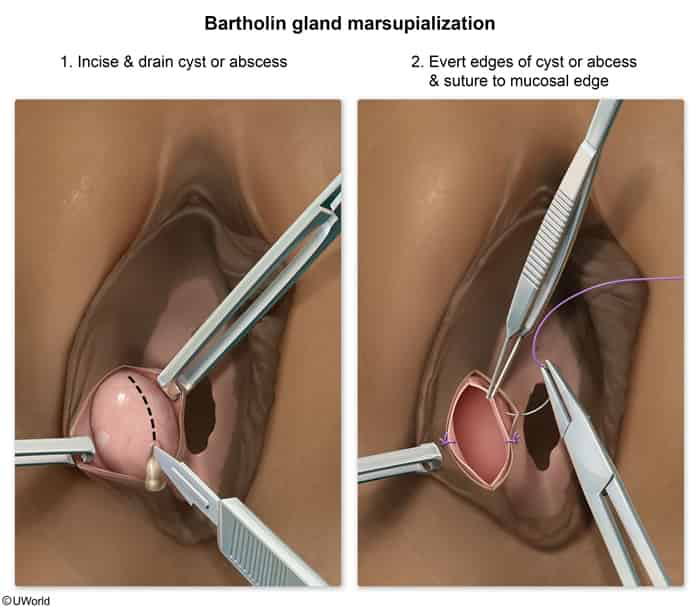
Marsupialization: Surgical creation of a permanent open pouch. Reserved for recurrent cysts/abscesses or after Word catheter failure.
Antibiotic Therapy:
NOT routinely indicated for simple, uncomplicated I&D.
Indications for Abx: Recurrent infection, systemic signs (fever, tachycardia), high risk (pregnancy, immunocompromised, DM2), extensive surrounding cellulitis, or positive N. gonorrhoeae / C. trachomatis / MRSA culture.
Empiric Regimen: Vancomycin or TMP-SMX (for MRSA) + Ceftriaxone/Doxycycline (if STI suspected).
Patients >40 Years Old:
Biopsy of cyst wall ± complete surgical excision.
Complications
Recurrence (most common).
Vulvar cellulitis or necrotizing fasciitis (rare, in immunocompromised/diabetic pts).