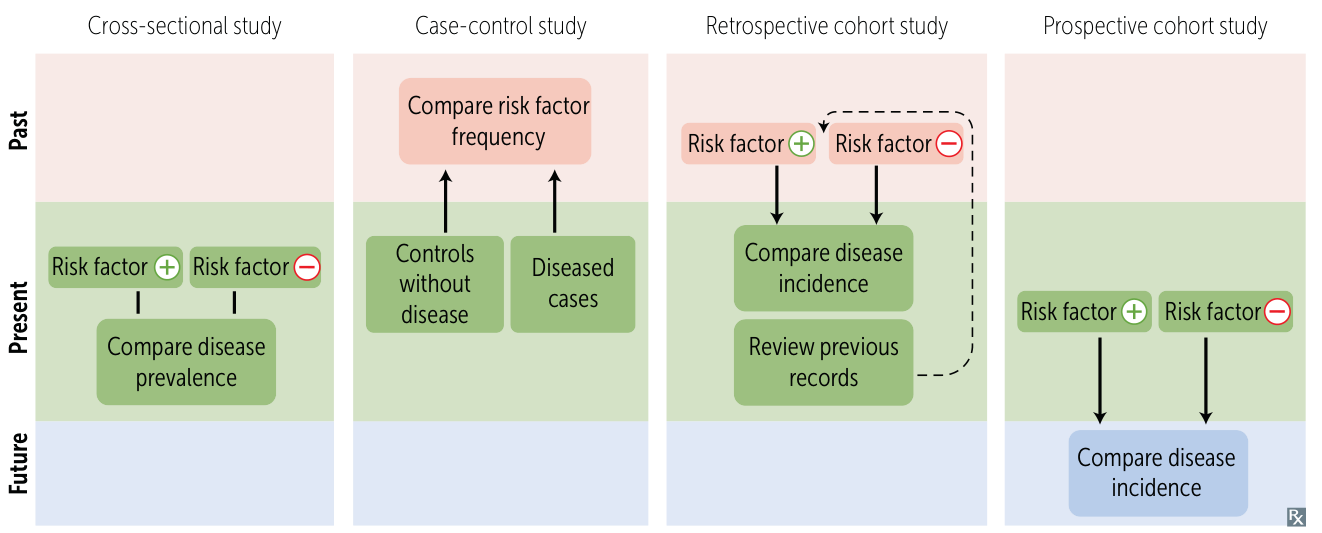
Pay attention to the difference between a case-control study and a retrospective cohort study: the distinction is whether you divide your groups based on exposure or outcome. c
Observational Studies (Investigator Observes Only)
- Case Series
- What: A descriptive report on a group of patients with the same disease or exposure.
- Use: Good for generating hypotheses.
- Limits: No control group; cannot establish association.
- Ecological Study
- What: Compares disease frequencies in different populations.
- Use: Hypothesis generation using population-level data.
- Limits: Prone to ecological fallacy (cannot apply group findings to individuals).
- Cross-Sectional Study
- What: “Snapshot in time” that measures exposure and outcome simultaneously.
- Key Question: What is the prevalence?
- Limits: Cannot determine temporality (which came first) or causality; Prevalence-Incidence Bias (Neyman Bias): Excludes rapidly fatal diseases or quickly resolving conditions (underestimated disease severity/mortality risk). c
- Case-Control Study
- What: Starts with diseased (cases) vs. non-diseased (controls) people and looks back retrospectively for exposure.
- Key Question: What happened? (associating past exposures with current disease).
- Use: Ideal for rare diseases.
- Measure: Odds Ratio (OR).
- Limits: High risk of recall bias; cannot calculate incidence.
- Cohort Study
- What: Follows a group (cohort) based on exposure status over time to see who develops the disease. Can be prospective or retrospective.
- Key Question: What will happen? (effect of exposure on outcome).
- Use: Measures incidence and establishes temporality.
- Measure: Relative Risk (RR).
- Limits: Inefficient for rare diseases; costly and time-consuming if prospective.
- Twin Concordance & Adoption Studies
- What: Studies used to disentangle genetic (“nature”) vs. environmental (“nurture”) influences.
- Twin Study: Compares trait frequency in identical (monozygotic) vs. fraternal (dizygotic) twins. Higher concordance in identical twins suggests a strong genetic component.
- Adoption Study: Compares traits in adopted children to their biological vs. adoptive parents.
Experimental Studies (Investigator Assigns Intervention)
- Randomized Controlled Trial (RCT)
- What: Gold standard study design. Participants are randomly assigned to a treatment or control group. Blinding reduces bias.
- Key Question: Is this treatment effective?
- Use: Establishes causality.
- Limits: Expensive, may have ethical limitations.