Assessing decision-making capacity
Capacity can be assessed by any physician who knows the risks and benefits of a treatment or procedure; don’t need psychiatric specialist c
- Communicate a Choice:
- Expresses a clear, stable preference.
- Frequent, arbitrary vacillation suggests lack of capacity.
- Understand Relevant Information:
- Comprehends Dx, proposed Tx, alternative options, and risks/benefits.
- Assessed via “teach-back” method (e.g., “Can you explain back to me the risks of refusing this surgery?”).
- Appreciate the Situation & Consequences:
- Acknowledges their condition and applies the information to their own clinical situation.
- Recognizes potential outcomes of refusal (e.g., acknowledges that leaving AMA may result in death).
- Reason Through Options:
- Patient able to weigh risks & benefits & offer reasons for decision c
- Decision does not have to align with physician recommendation, but the reasoning cannot be based on active delusions or hallucinations.
Surrogate decision-making
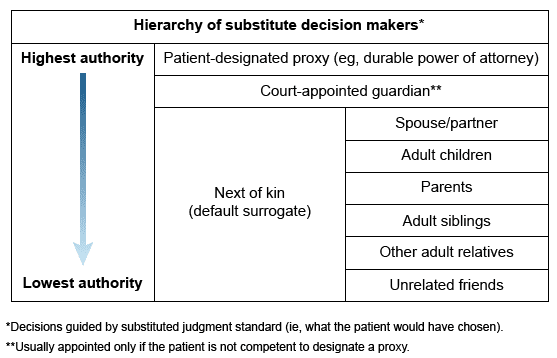
- Trigger: Activated only when a licensed physician assesses that the pt lacks decision-making capacity for a specific clinical choice.
- Priority Hierarchy:
- Competent Patient: Direct autonomous choice overrides all prior documents, surrogates, and family opinions.
- Advance Directives (Living Will): Explicit written directives regarding interventions (e.g., DNR/DNI, intubation, artificial nutrition).
- Designated Healthcare Proxy / DPOA: Legally appointed agent; supersedes all default family members (including spouse).
- Default Next-of-Kin (Statutory Hierarchy): Spouse → Adult Children (equal authority) → Parents → Adult Siblings → Other relatives/close friends.
- Unrepresented Patient: Implied consent (emergency) or Hospital Ethics Committee / court-appointed guardian (non-emergent).
- Standards of Decision-Making:
- Substituted Judgment (1st-line / Preferred): Surrogate must decide based on what the pt would have wanted, using the pt’s known values, religious beliefs, and prior verbal statements. c
- Best Interests (2nd-line / Default): Used only when pt values are entirely unknown; decides based on what a reasonable person would choose by weighing objective risks and benefits.
- High-Yield Board Scenarios & Management:
- DPOA vs. Living Will: Follow the Living Will. A written advance directive takes precedence over a surrogate’s conflicting personal preferences.
- Equal-Rank Surrogates Disagree (e.g., siblings): Facilitate a family meeting focused on pt’s values (substituted judgment); consult the Ethics Committee if deadlocked (do not take a majority vote; do not choose one sibling).
- Emergency with No Surrogate: Provide life-saving care immediately under implied consent; do not delay treatment to locate next-of-kin or consult ethics.
- Parental Refusal of Life-Saving Care for a Minor (e.g., blood transfusion): Administer life-saving therapy immediately; parental authority does not permit martyrdom of a child.
- Non-Emergent Parental Refusal: Obtain a court order or contact Child Protective Services (CPS).
- Confidential Care for Minors (No Parental Consent Needed): Contraception/pregnancy care, STIs, substance use disorders, and outpatient mental health.