Tip
Malignant Hyperthermia and Neuroleptic Malignant Syndrome (NMS) have almost same symptoms. The only differentiating factor is c
- Malignant Hyperthermia is triggered by inhaled anesthetics (e.g., halothane) or succinylcholine
- NMS is triggered by antipsychotics
Epidemiology
Etiology
- High-potency first-generation antipsychotics (most common association)
- Second-generation antipsychotics
- Other dopamine antagonists, e.g., metoclopramide, promethazine
Pathophysiology
- Central D2 receptor blockade in the nigrostriatal pathway and hypothalamus, resulting in movement disorders and impaired thermoregulation
Clinical features
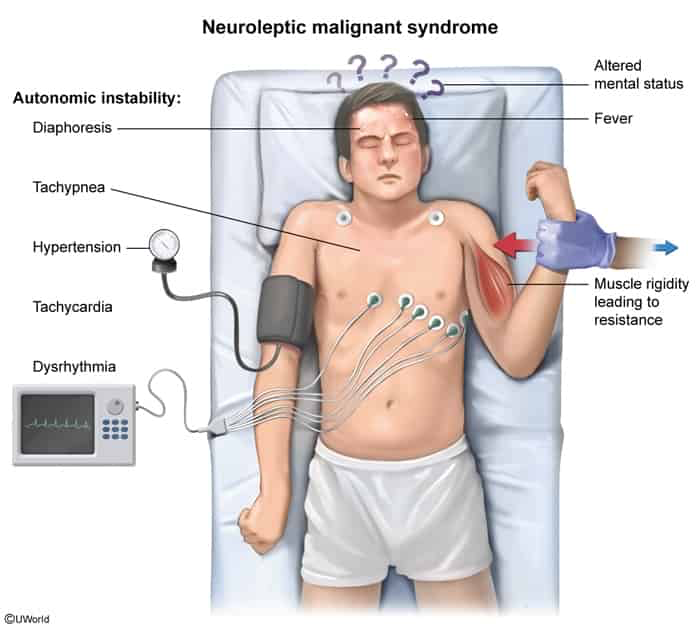
- Mental status changes (encephalopathy)
- Delirium (e.g., reduced vigilance)
- Confusion
- Stupor
- Catatonia
- Parkinsonism
- Hyperthermia: High-grade fever is common.
- Because muscles working overtime
- Autonomic instability
- Tachycardia, dysrhythmias, labile blood pressure
- Tachypnea
- Diaphoresis
Diagnostics
Clinical features similar to Serotonin syndrome
| Neuroleptic malignant syndrome | Serotonin syndrome | |
|---|---|---|
| Precipitant | Dopamine antagonist | Serotonergic agent |
| Onset | 1-3 days | <1 day |
| Altered mental status | Yes | Yes |
| Sympathetic hyperactivity | Yes | Yes |
| Diffuse rigidity | ”Lead-pipe” rigidity | No |
| Clonus | No | Yes |
| Reflexes | Hyporeflexia | Hyperreflexia |
Tip
- Neurotransmitter Specificity:
- Dopamine Blockade in NMS: - Dopamine is crucial for inhibiting overactivity in muscle movements. Its blockade removes this inhibition, causing muscles to become rigid. - The lack of dopamine dampens reflex arcs, leading to hyporeflexia.
- Serotonin Excess in Serotonin Syndrome: - Serotonin enhances excitatory signals in the nervous system. - Increased serotonin amplifies reflex pathways, resulting in hyperreflexia and clonus.
- Neuromuscular Impact:
- The balance between inhibitory and excitatory neurotransmitters is essential for normal muscle function.
- NMS tips the scale towards inhibition loss (due to dopamine blockade), causing rigidity.
- Serotonin syndrome tips the scale towards excess excitation, leading to clonus and hyperactive reflexes.
Treatment
- Immediate First-Line:
- Stop causative neuroleptic agent immediately (or immediately restart stopped dopamine agonists in Parkinson pts).
- ICU Admission & Supportive Care:
- Aggressive IV hydration with isotonic crystalloids (prevents renal heme-pigment cast precipitation from rhabdomyolysis).
- Active cooling: Ice packs (axilla/groin), cooling blankets, cold IV fluids.
- Airway & Circulation: Intubation for severe AMS, respiratory failure, or hypoventilation due to chest-wall rigidity.
- Second-Line / Medical Therapy (Moderate-to-severe cases refractory to supportive care):
- Dantrolene: Direct-acting skeletal muscle relaxant (ryanodine receptor antagonist); reduces hyperthermia and rigidity.
- Bromocriptine or Amantadine: Dopamine receptor agonists; restores central dopaminergic tone. c
- Benzodiazepines (e.g., IV Lorazepam): For agitation, catatonia, and mild rigidity.
- Anticholinergics are CONTRAINDICATED: Anticholinergics cause anhidrosis → Heat cannot dissipate → rapid, catastrophic acceleration of core temperature c
- Refractory:
- Electroconvulsive Therapy (ECT): Indicated if unresponsive to medical therapy within 48–72 hours.
- Long-Term / Re-challenge:
- Avoid neuroleptics for at least 2 weeks post-resolution.
- Rechallenge: Low dose, low-potency agent or second-generation atypical agent with slow titration.