Pathophysiology
- Nociceptive Pain: Arises from the stimulation of specialized nerve endings called nociceptors, which respond to actual or potential tissue damage. This process occurs in four key stages:
- 1. Transduction: Conversion of a noxious stimulus (thermal, mechanical, or chemical) into an electrical signal (action potential) at the peripheral nociceptor. Prostaglandins, bradykinin, and histamine are key chemical mediators released from damaged cells that activate nociceptors.
- 2. Transmission: The action potential is conducted along primary afferent nerve fibers to the spinal cord.
- A-delta fibers: Myelinated, fast-conducting fibers that transmit sharp, well-localized pain.
- C fibers: Unmyelinated, slow-conducting fibers that transmit dull, aching, and poorly localized pain.
- These first-order neurons synapse in the dorsal horn of the spinal cord, releasing neurotransmitters like glutamate and substance P.
- 3. Perception: The pain signal ascends from the spinal cord to the brain via tracts like the spinothalamic tract. It then reaches higher centers, including the thalamus, somatosensory cortex, and limbic system, where the conscious awareness and emotional response to pain occur.
- 4. Modulation: The brain and spinal cord can alter the intensity of the pain signal through descending pathways. These pathways release neurotransmitters like serotonin, norepinephrine, and endogenous opioids (e.g., endorphins) to inhibit the transmission of pain signals in the dorsal horn.
- Neuropathic Pain: Caused by a lesion or disease of the somatosensory nervous system itself. This results in abnormal signal processing, leading to pain that can be spontaneous or evoked by non-painful stimuli (allodynia) or an exaggerated response to painful stimuli (hyperalgesia). Mechanisms include ectopic impulse generation, central sensitization (an increased responsiveness of nociceptive neurons in the CNS), and structural changes in the nervous system.
General Approach: WHO Analgesic Ladder
- Step 1 (Mild Pain: Score 1–3): Non-opioid analgesics (APAP, NSAIDs) Adjuvants.
- Step 2 (Moderate Pain: Score 4–6): Weak opioids (codeine, tramadol) OR low-dose strong opioids Step 1 agents Adjuvants.
- Step 3 (Severe Pain: Score 7–10 / Cancer Pain): Strong opioids (morphine, oxycodone, hydromorphone, fentanyl) Step 1 agents Adjuvants.
- Step 4 (Refractory / Severe Chronic Pain): Interventional procedures (epidural, intrathecal pump, nerve block, neuroablation).
Neuropathic Pain Pharmacotherapy
| Drug | Mechanism of action |
|---|---|
| Tricyclic antidepressants (eg, amitriptyline, nortriptyline) SNRIs (eg, duloxetine) | ↓ Reuptake of serotonin & norepinephrine Inhibition of pain signals |
| Anticonvulsants (eg, gabapentin, pregabalin) | • Decreased depolarization of neurons in the CNS |
| Opioids | • Activation of central opioid receptors |
| Capsaicin (topical) | Loss of membrane potential in nociceptive fibers |
| Lidocaine (topical) | • Decreased depolarization of neurons in peripheral nerves |
Opioid Analgesics & Prescribing Principles
Agent Selection & Properties
- Morphine: Gold standard prototype. Avoid in renal failure (accumulation of neurotoxic metabolite M3G hyperalgesia/myoclonus, and active analgesic M6G profound sedation/respiratory depression).
- Oxycodone: Oral formulation only; safer profile than morphine in mild renal impairment.
- Hydromorphone (Dilaudid): ~4–7x more potent than morphine; preferred in moderate renal impairment.
- Fentanyl: High potency (100x morphine); highly lipophilic. Transdermal patch for chronic, opioid-tolerant pain only (onset 12–24 hrs; not for acute/unstable pain). Safest in severe CKD/ESRD and hepatic impairment (no active toxic renal metabolites).
- Methadone: Long and variable half-life ( 15–60 hrs); NMDA receptor antagonist + -agonist + SNRI activity. Excellent for neuropathic/cancer pain. Risk: QTc prolongation / TdP (requires baseline and follow-up ECG).
- Meperidine (Demerol): Avoid in USMLE settings. Toxic metabolite (normeperidine) causes CNS excitation, tremor, and seizures, especially in renal impairment. Serotonin syndrome risk with MAOIs/SSRIs.
- Tramadol / Tapentadol: Dual-action (weak -agonist + NE/5-HT reuptake inhibition). Lowers seizure threshold; risk of serotonin syndrome.
Dosing Strategies in Cancer & Severe Chronic Pain
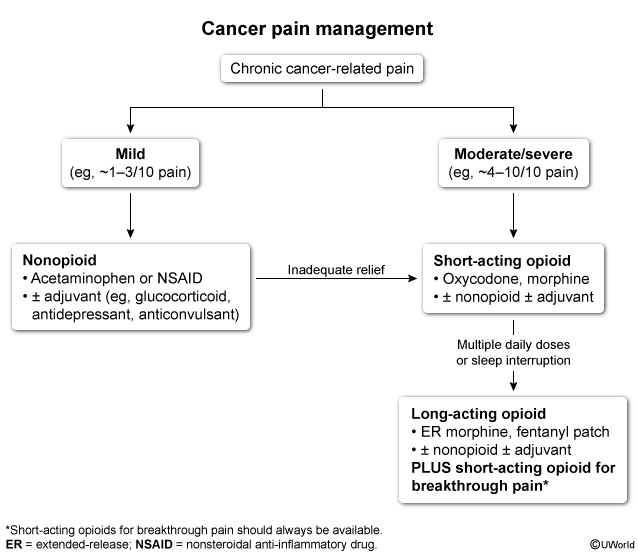
- Baseline Pain: Long-acting/extended-release (ER) opioid on an around-the-clock (ATC) schedule.
- Breakthrough Pain (BTP): Immediate-release (IR) opioid prn, typically calculated as 10% to 15% of total 24-hour baseline opioid dose, dosed q1–2h prn.
- Dose Titration: Increase total daily dose by 25–50% for mild-moderate pain, 50–100% for severe pain based on 24-hr usage of rescue doses.
- Opioid Rotation: When switching opioids due to tolerance/toxicity, calculate equianalgesic dose and reduce dose by 25–50% to account for incomplete cross-tolerance.
Risk mitigation for opioid prescribing
- State PDMP Query: Mandatory check of the Prescription Drug Monitoring Program prior to initial prescription and at least every 3 months to detect multiple prescribers (“doctor shopping”).
- Baseline UDT: Perform initial urine drug testing before prescribing to screen for undisclosed controlled substances or illicit drugs.
- Treatment Agreement: Execute a signed controlled substance agreement (“pain contract”) specifying a single prescriber, single designated pharmacy, and consent for random pill counts/UDT.
- Formulation & Duration: Prescribe lowest effective dose of Immediate-Release (IR) opioids; restrict acute pain treatment to ; avoid initiating with ER/LA formulations.
- Dosing Limits (MME): Exercise caution at ; strictly avoid or strongly justify escalating to .
- Avoid Sedatives: Do not co-prescribe Benzodiazepines (BZDs) or muscle relaxants due to severe risk of fatal respiratory depression (Black Box Warning).
- Co-Prescribe Naloxone: Prescribe take-home Naloxone (intranasal or auto-injector) and educate patient/household members. if dosage is , if concurrent CNS depressants are present, or if patient has comorbid pulmonary disease (COPD, OSA). c
- Routine Surveillance (“5 As”): Evaluate Analgesia, Activity (function), Adverse effects, Aberrant behavior, and Affect at each follow-up (q1–3 months) alongside repeat random UDT.
- Managing Aberrancy/OUD: Never abruptly discharge or abandon the patient; investigate early refill requests, run confirmatory mass spectrometry (GC-MS) for discordant UDT, and transition to Buprenorphine/Naloxone or Methadone if Opioid Use Disorder develops.