Core Concepts
- Definition: An experimental study design where participants are randomly assigned to an experimental group (receives intervention) or a control group (receives placebo or standard of care).
- “Gold Standard”: Considered the highest level of evidence for determining the efficacy and causality of a therapeutic or preventive intervention.
- Objective: To minimize bias when testing the effectiveness and safety of a new intervention.
Key Features
- Randomization:
- Each participant has an equal chance of being assigned to any group.
- Purpose: To minimize selection bias and control for confounding variables (both known and unknown) by distributing them evenly among the groups.
- Allocation Concealment: The process of hiding the next allocated group from the person enrolling the participant, which prevents selection bias during recruitment.
- Control Group:
- The group that receives a placebo, no treatment, or the current standard of care.
- Purpose: Provides a baseline to compare the effect of the new intervention against.
- Blinding (Masking):
- Concealing group allocation from individuals involved in the trial to prevent bias.
- Single-blind: Only the participant is unaware of their assigned group.
- Double-blind: Both the participant and the investigators/clinicians are unaware of the group assignments. This is the most common and preferred method.
- Triple-blind: Participants, investigators, and data analysts are all unaware of group assignments.
- Purpose: Reduces performance bias (systematic differences in care) and ascertainment/observer bias (distorted outcome assessment).
Trial Designs & Phases
- Common Designs:
- Parallel Group: Each group receives a different treatment simultaneously (most common design).
- Crossover: Each participant receives both treatments in a sequence, separated by a “washout” period. Participants serve as their own controls.
- Factorial: Tests two or more interventions simultaneously using various combinations.
Clinical trials
Mnemonic
Does the drug SWIM?
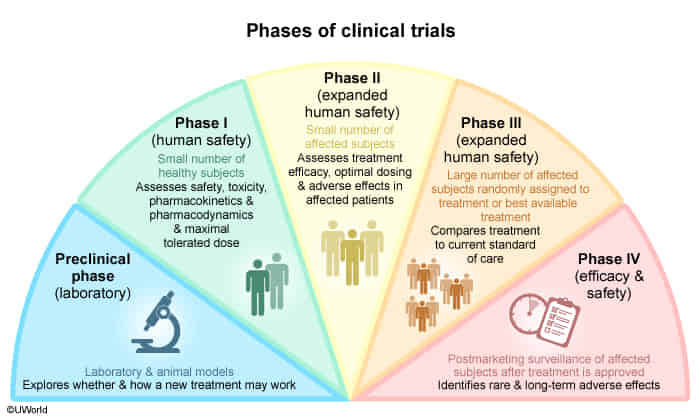
“Is it Safe?” Assesses safety, toxicity, pharmacokinetics, and pharmacodynamics
- Phase 0 trial
- Purpose: Exploratory phase with no therapeutic or diagnostic intent, aimed at gaining insight into pharmacokinetics and pharmacodynamics.
- Only < 1% of the therapeutic dose is used.
- Safety and toxicity are not assessed.
- Study population: Small sample consisting of either healthy individuals or a population with a disease of interest (∼ 10–15).
- Study design: Open-label.
- Phase I trial
- Purpose: Evaluation of pharmacodynamic and pharmacokinetic properties of the drug, safety, and toxicity.
- Evaluation of the maximum tolerated dose.
- Study population: Small number of healthy individuals or patients with a specific disease (∼ 15–30).
- Study design: Open-label.
- Phase II trial
- Purpose: Evaluation of efficacy, optimal dose range, and side effects (especially common and short-term side effects).
- Study population: Moderate number of patients with a specific disease (∼ 10–100).
- Study design: Randomized, Controlled, Anonymized.
- Phase III trial
- Purpose: Final confirmation of safety and evaluation of efficacy against placebo or the current standard of care.
- Study population: Randomized control trial with a large number of patients with a specific disease (∼ 100–1000).
- Study design: Randomized Controlled Trial.
- Phase IV trial
- Purpose: Postmarketing surveillance, comparing real-life efficacy to that described in research studies. Safety studies following approval (especially evaluation of rare and long-term side effects).
- Study population: Large number of patients with a specific disease after drug approval.
- Study design: Open-label.
Analysis & Interpretation
- Intention-to-Treat (ITT) Analysis:
- All participants are analyzed in the groups to which they were originally randomized, regardless of whether they completed or adhered to the treatment protocol.
- Benefit: Preserves the benefits of randomization and gives a more realistic measure of the treatment’s effectiveness in a real-world setting. Minimizes bias from attrition.
- Per-Protocol Analysis:
- Only includes participants who strictly adhered to the protocol.
- Risk: Breaks randomization and is more susceptible to bias, but may provide a better measure of the treatment’s effect under ideal conditions.
Potential Biases & Limitations
Selection Bias
Distortion during study enrollment or retention.
- Ascertainment/Sampling: Non-representative sample (e.g., volunteers only).
- Berkson: Hospitalized controls have more comorbidities than the general public.
- Healthy Worker Effect: Working cohort is inherently healthier than the general population.
- Attrition Bias: Differential dropout between arms. Fix: Intention-to-Treat (ITT) analysis. c
- Susceptibility (Confounding by Indication): Sicker pts receive the experimental tx. Fix: Randomization.
Measurement & Observation Bias
Distortion during data collection or evaluation.
- Recall Bias: Pts with disease recall exposures differently (classic in case-control).
- Observer/Detection: Unblinded evaluator scores groups differently. Fix: Blinding.
- Hawthorne Effect: Pts change behavior because they are being observed. c
- Pygmalion Effect: Researcher’s expectancy alters participant performance.
Screening Biases
- Lead-Time Bias: c
- Screening detects disease earlier apparent ↑ survival, but biological lifespan is unchanged.
- Fix: Measure cause-specific mortality rates, not survival time from diagnosis.
- Length-Time Bias:
- Screening disproportionately detects indolent, slow-progressing cases with better baseline prognosis.
Confounding vs. Effect Modification
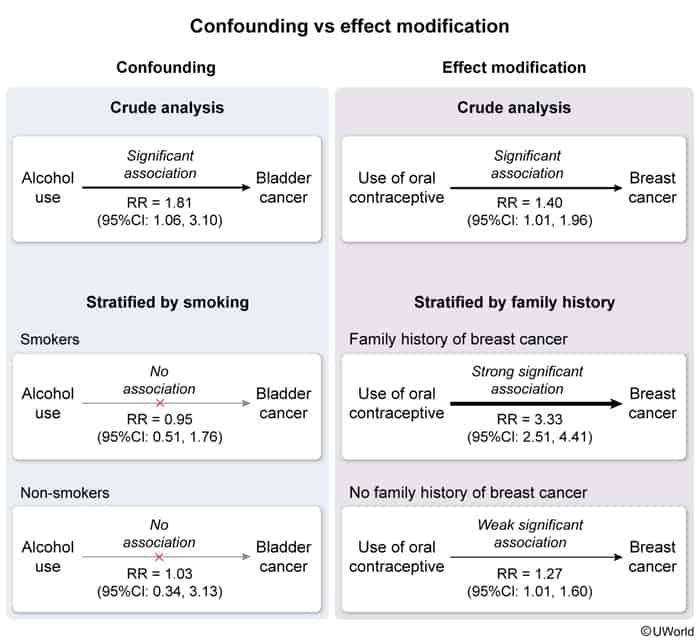
- Confounding:
- Third variable distorts exposure-outcome link (not on causal pathway).
- Stratified analysis: Association disappears or becomes equal across all strata.
- Fix: Matching, restriction, randomization, stratification.
- Effect Modification:
- Natural biological interaction (third variable modifies exposure effect).
- Stratified analysis: Association differs significantly between strata. c
- Note: Not a bias; must be reported, not controlled.
| Pattern after stratification | Interpretation |
|---|---|
| Subgroup RRs are similar to each other, but differ from the crude RR | Classic confounding pattern |
| Subgroup RRs are meaningfully different from each other | Effect modification |
 |